
Unlike Anatolia, Iran, and India, where steppe-related ancestry appears relatively late and with minimal archaeological traces, western and northern Europe provide clear evidence from both genetics and archaeology for a substantial population movement. Not only is this migration visible, but it also appears to have replaced much of the previous population in a relatively short period of time.
However, this creates a noticeable mismatch between genetics and linguistics. The various substrate theories (Paleo-Baltic, pre-Germanic, pre-Celtic, and others) are difficult to explain under the standard model. If these substrates originated from earlier Neolithic farming populations that were replaced before the core Indo-European branches diverged, then why do Germanic and Baltic display different substrate layers? Moreover, why are these substrates absent in Indo-Iranian if all these languages ultimately derive from the same Corded Ware expansion that supposedly replaced earlier European populations?
On the other hand, if we assume that these substrate theories are incorrect, we must confront another issue. There is clear evidence for non-Indo-European populations in western Europe most notably the speakers of the Basque language who are the direct descendants of the Bell Beaker population in the region. This raises another mismatch: how and why did the Indo-European R1b carriers replace previous populations yet end up culturally and linguistically distinct from Indo-European groups?
Recent research has further complicated the picture. A recent preprint on the origin of Celtic proposes an Iron Age spread of Celtic languages. If this is correct, then the Bell Beaker phenomenon no longer needs to be interpreted as Indo-European and may instead represent a population ancestral to modern Basque speakers.
If we acknowledge a close relationship between the Bell Beaker Complex and the Corded Ware Culture most likely as a daughter or sister culture then the assumption that Corded Ware itself spread Indo-European languages must also be reconsidered, along with its relationship to the Yamnaya Culture.
Another recent preprint proposes a late arrival for the Germanic language group. As the authors note:
“This East Scandinavian genetic cluster is first seen 800 years after the arrival of the Corded Ware Culture, the first steppe-related population to emerge in Northern Europe, opening a new scenario implying a Late rather than a Middle Neolithic arrival of the Germanic language group in Scandinavia.”
Origins of the Corded Ware Culture
The origins of the Corded Ware Culture have long been debated. Early scholarship was divided between two primary explanatory models.
The first was the “native farmer” hypothesis, which argued that Corded Ware emerged from local Neolithic farming communities in northern and central Europe through gradual cultural development. The second was the migrationist model, which proposed that Corded Ware was introduced by incoming populations from the Eurasian steppe.
This debate shaped early research and provided the framework for later archaeological and scientific investigations.
In The Horse, the Wheel, and Language (2007), David Anthony offered an explanation for how Corded Ware may have become Indo-European:
“Late Proto-Indo-European languages penetrated the eastern end of this medium, either through the incorporation of Indo-European dialects in the TRB base population before the Corded Ware horizon evolved, or through Corded Ware–Yamnaya contacts later, or both. Indo-European speech probably was emulated because the chiefs who spoke it had larger herds of cattle and sheep and more horses than could be raised in northern Europe, and they had a politico-religious culture already adapted to territorial expansion.”
However, thanks to aDNA research, it is now clear that the Corded Ware phenomenon involved a major migration of steppe-derived populations that largely replaced the preceding TRB populations. The long-discussed connection between Corded Ware and Bell Beaker can also be supported genetically, particularly through the prevalence of haplogroup R1b-L151 in Bell Beaker populations.
Yet this raises another puzzle. Neither R1b-L151 nor the typical northern Corded Ware haplogroup R1a-M417 are found in the Yamnaya population. One recent argument suggests that R1a may have been present in Yamnaya society but belonged to a lower social stratum that was not buried in kurgans and therefore left little archaeological trace.
This raises an important question, also highlighted by Iversen (2024): “if early Indo-European languages were introduced alongside Corded Ware or Yamnaya influences during the early third millennium BC, why do we not see archaeological evidence for the material culture associated with early Indo-European vocabulary around 2800 BC?”
To address this question, it is necessary to examine whether Corded Ware culture actually derives from Yamnaya traditions. If it does not, we must reconsider which of these populations was truly Indo-European and propose a more convincing explanation for how Indo-European languages spread across northern and western Europe.
Who were the Proto-Indo-Europeans?
Although the Proto-Indo-Europeans left no written records some aspects of their culture can be reconstructed through comparative linguistics and mythology. The society of the Proto-Indo-Europeans is reconstructed as hierarchical, with several distinct social roles identifiable through comparative linguistics and mythology. At the top stood a king or chieftain, whose title is often reconstructed as *h₃rḗǵs, meaning “ruler” or “king.” This figure likely held both political and military authority and may also have performed important ritual functions. His legitimacy was reinforced by religion and the support of priestly advisors who oversaw sacred rites and interpreted divine will.
Within this group were poet-priests, who preserved traditions through oral poetry. These priests played a key role in spreading the king’s reputation and preserving cultural memory through heroic narratives and genealogies.
Alongside the ruler existed a class of warriors, associated with martial prestige and the defense or expansion of the tribe.The Kurgan hypothesis proposes that the Indo-Europeans were a militaristic society that established themselves as ruling warrior elites over the local populations they conquered, forming dominant aristocratic groups.
The majority of the population were farmers and pastoralists, forming the productive base of society. Reconstructed words highlight the importance of agriculture such as *h₂érh₃ye/o (“plough”) and *yéwos (“grain” or “barley”) as well as animal husbandry, including *peḱu (“livestock” or “cattle”), which was likely a primary measure of wealth early on. Terms for specific animals, such as sheep and cattle, further suggest a mixed economy based on both farming and herding.
Some propose a fourth category sometimes interpreted as artisans. Their exact position in the hierarchy is debated with some arguing they may have been outsiders incorporated to the Indo-European system.
Having outlined the social structure, we can now consider which elements of Indo-European royal ideology might be reflected in material remains in Europe. While their presence can support an Indo-European identification, their absence may suggest a non-Indo-European context. This will mostly be based on Late-Indo-European cultures.
The Fort of the Indo-European King
Mallory & Adams (1997) considered fortified settlements to be a possible Indo-European ethnic indicator:
“Baltic also contributes to a set of cognates for fortified settlement (Lith. pilis ‘fort, castle’, Latv. pils ‘fort, castle’ < *pelH-), and it is only in the Early Bronze Age (c. 2000–1100 BC) that Baltic hillfort settlements begin to appear. Irrespective of where one wishes to locate the IE homeland, it is unlikely that we can speak of the full Indo-Europeanization of the Baltic region until 2000 BC, although IE speakers may well have begun to enter the east Baltic a millennium earlier. The geochronological position of Baltic also illustrates why the concept of assigning the IE homeland to the Baltic region is rather implausible, i.e., it requires IE expansions from an area that itself could only have become IE-speaking when we already begin to find differentiated IE stocks such as Anatolian or can confidently presume their existence such as Indo-Iranian.”
Two relevant reconstructed Indo-European roots are: *pelH- — “fort, fortified place” and *bhergh- — “height, elevated place; fort”. Mallory & Adams (1997) consider the possibility that *bhergh- may have been borrowed from a Near Eastern source:
“The alternative possibility that this word has been borrowed from a non-IE source is suggested by similar words in Near Eastern languages, e.g., Urartian burgana- ‘bulwark, fortress’, Syriac borga ‘tower’.”
It is impossible to know exactly what kind of fortified settlements these words originally designated. However, we can observe mythological parallels between later Indo-European groups. In a simplified reconstruction, an immortal king or god (Yima, Arawn, Zeus, Odin) rules over a great settlement characterized by abundance (food or ambrosia) sometimes after killing a monster. This settlement is usually associated with a mountain or elevated place. Examples include: the Vara of Yima, sometimes associated with different mountains, Caer Sidi in the land of Annwn (possibly connected with the Berwyn Mountains), the acropolis of Olympus, Asgard and Hlidskjalf (from skjalf, “high place,” “steep slope,” or “pinnacle”).
Archaeologically, the earliest known fortified settlement on the Pontic–Caspian steppe is Mikhailovka (c. 3500 BCE). According to Anthony (2007), although steppe settlements were generally small, fortification ditches protected Samsonovka and Mikhailovka, and a stone fortification wall was excavated at Skelya-Kamenolomnya.
Hecht (2007) argues that the Corded Ware Culture society was organized around small nuclear family groups. This interpretation is supported by archaeological evidence from small settlements containing houses and structures typically less than 10 meters long. Evidence for cereal production and consumption comes from archaeobotanical remains, pollen samples, and cereal‑processing tools found at these sites. In addition, some settlements were located on fertile agricultural soils, suggesting an agricultural subsistence base (Hecht 2007).
In a synthesis of 226 settlements across southern Germany, France, and eastern Switzerland, including the lake settlements near Zurich, Hecht identified three main settlement types: villages, hamlets, and farmsteads. Villages were most commonly found in Switzerland, though a few examples were identified in Germany, such as Luckaer Forst, Hunterdorf 1, Dümmer, and Succase. Hamlets and farmsteads were more typical of the Corded Ware settlement pattern, and no single standardized Corded Ware house type could be clearly defined.
Similarly, fortifications appear to have been rare even in later Corded Ware-related cultures. Out of more than 200 Abashevo settlements, only two show evidence of fortifications (Anthony 2007).
The earliest actual forts used by populations related to the Corded Ware horizon were those of Sintashta and Arkaim. These sites are sometimes interpreted by proponents of the Kurgan hypothesis as archaeological parallels to the Vara of Yima. However, it is very likely that their design was influenced by BMAC fortifications as Witzel (2000) notes:
“Both settlements also remind of the circular and rectangular fortifications of the BMAC culture (Parpola 1987, 1998). But note the alleged occurrence of bricks, something unusual in the steppe region. Indeed, Hiebert and Shishlina (1998), conversely, regard BMAC influence as possible.”
The Indo-European Smith
Rune Iversen considered metal as one of the missing Indo-European indicators in Corded Ware. PIE h₂eies- ‘metal, copper?’ and h₁roudʰ-o- ‘red’, which also came to refer to ‘copper’ and/or ‘ore’, may relate to Sumerian aruda (Rasmus Thorsø, Andrew Wigman et al., 2023). They offer a solution where they consider it a wanderwort from a pre-Indo-European language:
“For geographic reasons, Sumerian cannot have been the direct donor language, however, and we may well be dealing with a Wanderwort that is nonnative in either language.”
In my opinion, this is one of the clues pointing to the actual Proto-Indo-European homeland somewhere south of the Caspian Sea, the region where both Sumer and Maikop acquired their copper from. The semantic trajectory from denoting a color to denoting a metal strengthens the likelihood of an Indo-European origin.
In the Late Indo-European context, the central narrative of the smith often involves crafting a special weapon for the dragonslayer. Closer examination indicates that the smith may have been associated with Indo-European royalty. In Iran, the smith Kaveh whose clan is captured or imprisoned by the dragon is also a descendant of Jamshid, much like the dragonslayer Fereydun. In Greece, a similar theme appears: Cronus imprisons the uncles of Zeus, who forge the thunderbolt for him, allowing him to defeat the dragon Typhon.
This may be coincidental, but it is worth noting the case of the high king Cormac mac Airt, whose maternal grandfather was Olc Acha, a druid smith similar to how, in India, Tvaṣṭṛ is the maternal grandfather of Yemo and Manu.
In Northern and Western Europe, the smith in some cases is elevated to the main protagonist role. Wayland, King Lugh, and even the thunder god Perkunas are all smith-warriors. Almost all European smith myths are Indo-European in origin, and this influence even extended to the Finnish creator god Ilmarinen.
While it is true that there is no common designation for the smith, it is possible that smithing goes back to the earliest stages of Proto-Indo-European:
“If the preceding arguments are valid, it is possible to project a knowledge at least of one metal, apparently ‘copper,’ already in the early common Indo-European, i.e., before its disintegration into Anatolian and non-Anatolian in the first half of the 5th mill. BC (Starostin apud Blažek 2007, 85). This conclusion implies that the institution of smithery in Indo-European society could be comparably old, naturally depending on the location of the homeland. The apparent fact that there is no common designation of ‘smith’ in the Indo-European lexicon could be disappointing at first sight, but the same may be said about other crafts, including those using more ‘archaic’ technologies than smithery. In this perspective, the smithery terminology is not only rich, but also gives a witness about its relatively early introduction, especially if the divine smiths are taken into account. Unfortunately, our knowledge is limited by the absence of the terms for ‘smith’ in Anatolian and Tocharian.” (Blazek 2007)
The earliest evidence of actual metallurgy on the steppes comes from Yamnaya. Anthony (2022) notes:
“Khvalynsk pyrotechnology probably was not sufficient to smelt local copper oxide ores, which began to be mined in the Yamnaya period, by present evidence.”
Regarding Corded Ware metallurgy, Mikkel Nørtoft (2023) observes:
“A core Indo-European term for ‘copper’ (or perhaps generically ‘metal’) is preserved in Gothic aiz < Proto-Germanic ajiz- < Core-IE *háies- (Orsø, Olander), but no metallurgy and almost no metal has been found in Scandinavia or Finland, and very little in Northern Europe in general, during the CWC period. The conditions for preserving such a word in Scandinavian CWC communities, assuming they spoke an Indo-European dialect, are therefore quite poor.”
Only three small copper finds with secure context are known in Scandinavia, all from the later Battle Axe period (after 2600 BCE) in Sweden, and interpreted as Bell Beaker imports. Corded Ware-related cultures show little evidence of advanced metallurgy, unlike Yamnaya. The only Corded Ware-derived culture with advanced metallurgy techniques was Sintashta, due to BMAC influence:
“Finally, the technique of lost-wax metal casting first appeared in the north during the Sintashta period, in metal objects of Seima-Turbino type (described in more detail below). Lost-wax casting was familiar to BMAC metalsmiths. Southern decorative motifs (stepped pyramids), raw materials (lead and lapis lazuli), one mirror, and metal-working techniques (lost-wax casting) appeared in the north just when northern pottery, chariot-driving cheekpieces, bit wear, and horse bones appeared in the south.” (Anthony 2007)
Yamnaya graves, by contrast, show clear evidence of advanced metallurgy, and metalworkers are clearly identified:
“Metalworkers were clearly identified in several Yamnaya-period graves, perhaps because metalworking was still a form of shamanic magic, and the tools remained dangerously polluted by the spirit of the dead smith.” (Anthony 2007)
This is one of the stronger points supporting the identification of Yamnaya as an Indo-European culture. As noted, there is some indication that the original smith may have been a priest (Olc Acha, Kaveh, Kavya Usana), along with the Indo-European literary motif of the wordsmith or songsmith, may reinforce this interpretation.
The Indo-European Warrior Aristocracy
The two main hypotheses regarding its origin either as steppe warrior conquerors or native farmers have always been debated. Ancient DNA clearly confirms that the Corded Ware phenomenon was a result of migration from populations related to those of the Eneolithic steppe. But were these migrants truly warrior elites? According to Iversen, elite manifestations are absent in Corded Ware.
There is a strong argument against interpreting Corded Ware grave goods and burial practices as indicative of a rising elite class or a culture focused on martiality. The uniformity of grave goods, coupled with the absence of hierarchical markers, suggests a more egalitarian social structure, where the symbolic and practical functions of material culture may have had meanings different from traditional kurgan interpretations.
Vander Linden (2007) critiques traditional archaeological interpretations that impose evolutionary models of increasing social hierarchy and elite dominance onto the third millennium BC, including for the Corded Ware complex. He proposes that these societies, including Corded Ware, were more characterized by plural forms of equality (or “equalities”) rather than stratification or elite control:
“Given its scale and implications, this unity must be reckoned to be both social and complex, although evidence for ranking or hierarchical differences between individuals and groups is lacking. On the contrary, I suggest that this collective works through, and allows, a relationship in which each participating community seems to be on an equal footing with its neighbours.”
A PhD thesis by Virginia Garcia Diaz also challenged the view that these Corded Ware burials reflected an elite society noting the Corded Ware groups did not exhibit high social stratification. Instead, their land and animals were still treated as communal possessions, with benefits shared among the group, indicating a non-hierarchical society:
“Following the definitions of social inequality used by several researchers (Clark and Blake 1994; Hayden 1995, 2001), the Corded Ware groups could be considered as non-highly stratified society. The introduction of agricultural and pastoral practices changed the groups’ perception of the animals and the land, as people began to see both as property. The analysis of the Corded Ware settlements, however, suggested that land and animals, and the products obtained from them, were still considered communal possessions and that their benefits were shared among the entire group.” García Diaz (2017)
Beckerman (2015) also challenges the warrior interpretation. Items typically associated with warfare and social differentiation, like beakers and battle axes, might have had different meanings, potentially linked to daily tasks like hunting or agriculture, rather than combat. As Beckerman notes:
“No evidence was found for an increase in (social) differences between the sexes and the rise of individualization, martiality, and elites in the Dutch coastal zone. However, it is suggested here that not just beakers, but also other items currently associated with an ideology of warfare and social differentiation, may, in fact, have had a different meaning. It is possible that the battle axe may not signal interpersonal combat, but, rather, important daily tasks in hunting or agriculture.”
She also argues against the warrior interpretation:
“Indications for interpersonal combat are few. Combined with the high uniformity of grave goods and the minor importance of pastoralism in large regions (and thus the lesser need for defensibility of property), this argues against interpreting graves and grave goods as direct reflections of the rise of martiality and elites.”
Recently 63 battle axes and 59 axe-hammers were examined using use-wear analysis (looking at tiny scratches, polishes, pits, and damage under microscopes) plus experiments making and using replica tools to chop wood, split wood, break bone, dig earth/roots, etc.
Almost all of them (88% of battle-axes and over 98% of axe-hammers) show clear signs they were actually used as tools, not just fancy/ceremonial objects. They were multi-functional, mostly for working with wood (chopping, etc.), but also sometimes earth/roots, bone, or even as wedges. There’s no big difference in how battle-axes vs. axe-hammers were used, or between ones from graves (“ceremonial” contexts) vs. everyday finds. Some got re-sharpened/re-ground after use, showing they were practical tools over time. Very little evidence exists that they were mainly weapons (wear patterns don’t match that much), though it is noted that it is possible that they were used as such: “this may have been more widespread but not evident since it would cause little wear.”
However, the only known instance of violent conflict in the Corded Ware culture is the multiple burial at Eualau, where 14 individuals were found.
Even late Corded Ware-related cultures, such as Sintashta, show no evidence of significant hierarchy:
“There is little jewelry or ornaments in Sintashta graves, and no large houses or storage facilities in the settlements. The signs of craft specialization, a signal of social hierarchy, are weak in all crafts except metallurgy, but even in that craft, every household in every settlement seems to have worked metal. The absence of large houses, storage facilities, or craft specialists has led some experts to doubt whether the Sintashta culture had a strong social hierarchy.” (Anthony, 2007)
Note that these are supposed to be the hierarchical Indo-Iranian conquerors who imposed their language on the Dasa slaves.
And so we are left with the only example of real social ranking in a Corded Ware-related culture, which is the late Nitra Culture Burial 444.
Conclusion
Rune Iversen made an important observation in noting that the Corded Ware lacks key cultural markers often associated with Indo-European cultures, such as domesticated horses, wool, metallurgy, or Indo-European mythological motifs like the divine twins. Furthermore, elite manifestations and figurative representations, such as menhirs and statues, are absent from Corded Ware. These differences suggest that Corded Ware should not be considered the direct ancestor of any Indo-European-speaking group.
However, the depiction of the two-headed figure is more akin to the later depictions of Janus and is interpreted as a *Yemo-related figure elsewhere which if true may more likely represent a proto-Ymir. It is important to note that Proto-Indo-European (PIE) is older than the actual domestication of the horse, which occurred after 2500 BCE by groups related to the Yamnaya culture. This was solved by Ivanov and Gamkrelidze decades ago before any horse DNA: “The absence of a clear Proto-Indo-European word for ‘donkey,’ despite the widespread presence of domesticated donkeys in the areas where horses were domesticated and where Indo-European-speaking tribes lived, can be explained by assuming that *ekhwos was originally used to mean both ‘donkey’ and ‘wild horse; horse.’”
The absence of metallurgy and Yamnaya-style menhirs and depictions in Corded Ware sites can be explained by the fact that Corded Ware does not derive from the Yamnaya culture but rather from an earlier, pre-Yamnaya group. This is further supported by the Y-DNA evidence.
Iversen’s hypothesis of a secondary Indo-Europeanization phase originating from Sintashta is less plausible, as Sintashta itself lacks many of the typical Indo-European indicators. The warrior-elite ideology associated with Indo-Europeans likely spread from the Carpathian region, influencing communities in the Upper Danube and Upper Rhine regions, as well as populations in the Nordic areas. After 2000 BCE, we see the emergence of these new cultural dynamics:
“This factor is particularly relevant in the case of the centralized communities of the Otomani-Füzesabony culture. Its members built impressive fortified settlements, knew advanced methods of bronze casting, and maintained a vast network of contacts that connected the north of Europe with the eastern reaches of the Mediterranean world… This was the first culture in temperate Europe to use swords, which later became an integral part of the ‘Tumulus culture set’. The composition of some spectacular hoards and the presence of military items in some of the graves associated with such communities may suggest that a new type of individualized elite (military aristocracy) emerged in this very culture. The attractive ideology would then have spread to the west and north-west and be adapted by the ‘post-Early-Bronze’, de-centralized and mobile communities (most likely based on kinship) of animal farmers inhabiting the upper Danube basin and the upper Rhine basin, as well as by the peoples of the Nordic regions… The new lifestyle became a pan-European phenomenon, but involved a considerable degree of regional diversity that stemmed primarily from contact with local tradition.” (Makarowicz, 2017)
This same trend is evident further where after the collapse of the Unetice culture, the Věteřov–Mad’arovce cultural influence emerged at the start of the Trzciniec Culture. Then groups associated with the Tumulus culture arrived:
“At this initial (‘scouting’) stage, groups of newcomers could settle at the peripheries of the area inhabited by the peoples of the Trzciniec cultural circle. Due to the mobility already stressed, the attractiveness of their cultural model and the effectiveness of the decentralized kinship-based groups, the new lifestyle gained popularity over the course of several generations, becoming the dominant model of behaviour in local ‘Trzciniec’ communities, which gradually lost their former identity.” (Makarowicz, 2017)
And so by 1500 BCE the Corded Ware lifestyle was no more and was supplanted with this new warrior based society that controlled these trade networks.
We can reasonably conclude that the Tumulus culture, which derives from these Carpathian Basin cultures, serves as the cultural precursor to Italo-Celtic groups. It is also likely that the language directly ancestral to the Italo-Celtic-Germanic-Balto-Slavic group was spoken in the Carpathian region during the late 3rd millennium BCE.
Notably, we do not have direct genetic or archaeological samples from these groups dating back to 2000 BCE. Despite being the most significant Bronze Age phenomenon in Europe, they have received limited attention from Indo-Europeanist archaeologists, who typically focus on the BBC and CWC cultures. It seems the origin of these groups is usually linked to the same cultural phenomenon that produced the Vučedol culture, which was a hybrid of Yamnaya and European Farmer elements. The next section will assume this hypothesis is correct.
The Foederati Model
While this term is asynchronous it is similar to how various neighbors and allies of the Romans ended up speaking their language. Many different groups through different mechanisms ended up speaking the language of the Romans. Some were integrated within Roman society and granted citizenship and gradually adopted Latin. Others took advantage of the power vacuum that occurred after the fall of Rome and carved out independent kingdoms while still adopting the language. The key point is that the spread of Latin came from a high culture, one that was vastly superior to the original cultures of the Foederati. This mirrors how Early Indo-European languages and cultures spread often from a more hierarchical and advanced culture to others that were less so.
A few centuries before the formation of the Yamnaya culture, an unprecedented phenomenon emerged to the south of the steppe. It was more advanced than anything that came before it, and its influence played a key role in transforming steppe cultures. This Maikop culture had a significant influence on pre-Yamnaya and early Yamnaya steppe cultures:
“I also accept the general consensus that the appearance of the hierarchical Maikop culture about 3600 BC had profound effects on pre-Yamnaya and early Yamnaya steppe cultures. Yamnaya metallurgy borrowed from the Maikop culture two-sided molds, tanged daggers, cast shaft hole axes with a single blade, and arsenical copper. Wheeled vehicles might have entered the steppes through Maikop, revolutionizing steppe economies and making Yamnaya pastoral nomadism possible after 3300 BC.” (Anthony, 2019)
However, Anthony does not believe that the language spoken by the people of the Maikop culture was Indo-European. Despite arguing that Indo-European speech was emulated in Corded Ware because the chiefs who spoke it had larger herds of cattle and sheep he does not think that the people of Yamnaya emulated the language of Maikop despite adopting their cultural package and warrior ideology. Indeed, the ideal warrior of the Yamnaya culture was modelled after the Maikop warrior:
“However, as accounted for by Sabine Reinhold (2018), it is striking that Yamnaya graves generally do not contain objects depicted on the stelae. Prototypes of the weapons depicted on the stelae are on the contrary found in the North Caucasian Maikop elite graves (c. 3700–3000 BC). Thus, it is very probable that certain social conducts focusing on the warrior figure, hierarchization and a distinct display of power developed in early 4th millennium BC Maikop societies and were transferred to e.g. the North Pontic area where the anthropomorphic stelae came to express the new social order and martial focus” (Iversen, 2024)
Mallory claimed that Maikop was unlikely to be Indo-European because Caucasian languages are spoken today in the region of Maikop ignoring the fact that after Maikop collapsed the Yamnaya culture took over the region. However, he referenced Vasil’kov:
“Wall decorations from Novosvobodna tomb at Klady. The bow depicted in k1 and k2 has been seen as symbolic of the death of a king, e.g., in Vedic tradition the successor to a dead ksatriya would take the bow of the deceased in his hand as emblematic of the succession of power. The horses shown in k3 have been interpreted as the procession of horses that would encircle (counterclockwise) the grave of the deceased. Finally, the seated figure with the grill-like visage has been interpreted as Vayu/Vayu, the Indo-Iranian god of the wind and death, whose baleful glance could cause death.” (Mallory & Adams 1997)
Vasil’kov (1994) originally argued that the Novosvobodnaya culture was related to the Mikhailovka culture, a view now easily disproven through aDNA analysis. However, his interpretations remain valuable for understanding the cultural symbolism of this period.
One notable feature of the Novosvobodnaya elite burials is the presence of fork-like hooks, typically made of bronze. These artifacts are believed to have served both practical and symbolic functions. Likely used for fishing meat from sacrificial feasts, these hooks reflect the ritual sharing of food. This practice aligns with the Indo-European root bhag-, meaning “fate” or “destiny,” which is found in the Vedic references to bhaga, a god who bestows a person’s lot or share in life. Vasil’kov posits that these hooks spread to regions such as northern Iran and Bactria, and potentially even deeper into India, where they may have evolved into tridents, suggesting a possible cultural connection to Indo-Iranian tribes.
Further evidence of symbolic connections comes from a ritual structure found in a “royal” tomb at Novosvobodnaya. This structure includes a silver vessel with a stone pestle, topped by a bronze wheel with a shaft. The design closely resembles Indo-European cosmological symbols, such as the world-tree or world-axis, and may represent the “wheel of time” or the Sun. These symbols are significant in Indo-European cosmology, where they often symbolize the cyclical nature of life and the cosmos.
Additionally, two statuettes of dogs, one made of bronze and the other of silver, were found near the entrance of a tomb at Tsarskaya. These figures draw immediate parallels to the two dogs of Yama, the Vedic god of death.
Vasil’kov also offers an interesting interpretation of the bird motif, linking it to the Indo-Aryan Garuda, a divine bird closely associated with amṛta (immortality). The presence of horses depicted running around the tomb in a counterclockwise direction further underscores the cultural significance of circular movements in burial rites. In many Indo-European traditions, especially during burial rituals, such movements, particularly counterclockwise, are linked to death and the transition to the afterlife.
Whether all these interpretations are correct or not it is undeniable that the Maikop related cultures played a significant role if not the main role in the formation of Yamnaya. It is very likely that the start of Yamnaya was thanks to the Maikop colonists:
“Level 4 at Razdorskoe contained an early Khvalynsk component, level 5 above it had an early Sredni Stog (Novodanilovka period) occupation, and, after that, levels 6 and 7 had pottery that resembled late Sredni Stog mixed with imported Maikop pottery. A radiocarbon date said to be associated with level 6, on organic material in a core removed for pollen studies, produced a date of 3500-2900 BCE (4490± 180 BP). Near Razdorskoe was the fortified settlement at Konstantinovka. Here, in a place occupied by people who made similar lower-Don varieties of late Sredni Stog pottery, there might actually have been a small Maikop colony.” (Anthony 2007)
Indeed, Anthony explicitly states it:
“The earliest Repin pottery was somewhat similar in form and decoration to the late Sredni Stog-Konstantinovka types on the lower Don, and it is now thought that contact with the late Maikop-Novosvobodnaya culture on the lower Don at places like Konstantinovka stimulated the emergence and spread of the early Repin culture and, through Repin, early Yamnaya. The metal-tanged daggers and sleeved axes of the early Yamnaya horizon certainly were copied after Maikop-Novosvobodnaya types.” (Anthony 2007)
The same is also true for the eastern Yamnaya Volga groups:
“Again, contact with people from the late Maikop-Novosvobodnaya culture, such as the makers of the kurgan at Evdik on the lower Volga, might have stimulated the change from late Khvalynsk to early Yamnaya. One of the stimuli introduced from the North Caucasus might have been wagons and wagon-making skills.” (Anthony 2007)
Basically, Yamnaya formed from a steppe base and Maikop. Recently, this foederati model has made it to the mainstream where the Maikop culture is seen as a key source of Proto-Anatolian and potentially Proto-Indo-Anatolian:
“The Proto-Indo-European split: steppe Maikop groups introduced a superior cattle-based pastoral economy and transportation technology to the pre-Yamnaya groups living in the steppe in the mid to late 4th millennium BC. This is reflected in the earliest burials with nose rings to control the bulls, pairs of oxen in burials, while in the steppe the wagon is more often deposited (Reinholdt et al. 2017: Figure 8.7). Sabine Reinholdt and her team document and discuss this transmission of skills to the steppe environment that by the late 4th millennium BC led to the formation of the Yamnaya social formation. I suggest that this transmission also included a language transmission corresponding to the formation of Proto-Indo-European, as a sister language to Proto-Anatolian. Once the new economy and technology were adopted to the steppe environment, it was followed by a fast demographic and geographic expansion, whose final manifestation was the Yamnaya Culture starting around 3000 BC. By this time, the speakers of pre-Tocharian separated from the remaining groups.” (Kristiansen, 2019)
Though I do not think that Maikop was Proto-Indo-European (Indo-Hittite) but rather spoke a dialect ancestral to the Indo-European languages of Europe.
It should be noted that there is no evidence that Yamnaya spoke an Indo-European language when it showed up in the Near East. Northwest Iran (Itabalhum and later Urartu) where Yamnaya Y-DNA is prevalent was in fact mostly Hurro-Urartian speaking with an Indo-Iranian influence from BMAC. However, It could be as simple as them being unsuccessful in imposing their language.
The Origin of Maikop
There are several models for the formation of the Maikop culture, as well as its slightly earlier southern counterpart, Leilatepe. One of the weakest models is the Uruk expansion theory. The other is the different versions of the “Iranian”, where the chaff faced wares originates from NW Iran and another where Greater Khorasan Road influence leads to the formation of Maikop:
“Graves and settlements of the 5th millennium BC in North Caucasus attest to a material culture that was related to contemporaneous archaeological complexes in the northern and western Black Sea region. Yet it was replaced, suddenly as it seems, around the middle of the 4th millennium BC by a “high culture” whose origin is still quite unclear. This archaeological culture named after the great Maykop kurgan showed innovations in all areas which have no local archetypes and which cannot be assigned to the tradition of the Balkan-Anatolian Copper Age. The favoured theory of Russian researchers is a migration from the south originating in the Syro-Anatolian area, which is often mentioned in connection with the so-called “Uruk expansion”. However, serious doubts have arisen about a connection between Maykop and the Syro-Anatolian region. The foreign objects in the North Caucasus reveal no connection to the upper reaches of the Euphrates and Tigris or to the floodplains of Mesopotamia, but rather seem to have ties to the Iranian plateau and to South Central Asia. Recent excavations in the Southwest Caspian Sea region are enabling a new perspective about the interactions between the “Orient” and Continental Europe. On the one hand, it is becoming gradually apparent that a gigantic area of interaction evolved already in the early 4th millennium BC which extended far beyond Mesopotamia; on the other hand, these findings relativise the traditional importance given to Mesopotamia, because innovations originating in Iran and Central Asia obviously spread throughout the Syro-Anatolian region independently thereof.” (Ivanova, 2013)
Ivanova’s analysis stresses that the Maikop culture’s origins are more likely tied to the Iranian plateau and South Central Asia, rather than Mesopotamia, suggesting a broader and more complex network of cultural interactions.
Furthermore, the pottery associated with Maikop is likely to have originated from Iran:
“However, northwest Iran and particularly the plain of Urmia constitute an integral part of the chaff-faced “pottery province” (Marro 2007, note 36, map 1). This region, and not east Anatolia proper, may well have served as the port of entry of this pottery into the Caucasus.”
Ivanova also highlights that the precious stones associated with Maikop, such as lapis lazuli and turquoise, were sourced from regions in Iran and Central Asia, not Mesopotamia:
“Not only are the deposits of lapis lazuli, turquoise and possibly carnelian situated on the Iranian plateau and in the mountainous regions of central Asia, but the indirect supply with such materials via Upper Mesopotamia can be essentially ruled out. In the early fourth millennium lapis lazuli and turquoise were nearly absent in southwest”
Moreover, both Maikop and Yamnaya daggers also seem to have their origin in Iran/Turan:
“The second most popular implement, the tanged dagger, appeared at the turn of the fifth to the fourth millennium BC in central Asia and Iran. Among the earliest finds are daggers from Ilgynli-depe, Hissar I, and Sialk III.2 and III.5 … In summary, the north Caucasian metalsmiths manufactured a series of larger copper tools which were apparently of Iranian origin. None of the shapes described previously has been reported from fourth-millennium sites in the Syro-Anatolian region.”
Recent evidence further supports these links. We have 3 Armenian samples from the Areni cave, likely related to the earliest metallurgists in the Caucasus and to the beginning of the Chaff Faced Ware phenomenon in the south Caucasus:
“The Late Chalcolithic traditions in Armenia (Areni-1, Teghut, Nerkin Godedzor), Azerbaijan (Ovçular Tepesi, Mentesh Tepe, Leylatepe) and Georgia (Berikldeebi) share common characteristics and regional contacts to Maikop and Ubaid-Uruk. These societies are on the way towards growing complexity, a process reflected in the appearance of developed copper based metallurgy (molds, slags, ingots, kilns, pure and arsenic copper), new metal weapons/tools (knife/ daggers, spearheads, flat axes), ceramics (potter’s wheel, pottery signs), exotic and prestigious objects of gold, silver, and lapis-lazuli, stamp seals and status symbols (scepters), kurgans and jar burials, and rudiments of monumental architecture (cf. the “temple” of Berikldeebi). This is all accompanied by the blossoming of long distance trade, essential transfer of knowledge, and the development of centralized hierarchies” (Bobokhyan et. al 2014)
Most of the ancestry of these Areni_C people was local Caucasus ancestry with a little bit of steppe eneolithic ancestry from north of the Caucasus. However, their peculiar Y-DNA, L1a(1?) is not found in either group and is mostly prevalent in modern day South Central Asians. Its sister L1a2 is already found in the late neolithic of Turan. A few of the Maikop samples also carry the haplogroup L. The founding Steppe Maykop grave of Ipatovo (IV3002), which has southern ancestry, also carries a peculiar Y-DNA T1a3b is also found in Iran (I2512).
Though it is difficult to pinpoint the exact route through which these cultural and genetic traits moved, it is clear that there was a movement of people and ideas from Iran into the southern Caucasus. This is supported by both the genetic evidence and the cultural connections, as the populations of northern Iran and Turan during this period were closely related genetically and culturally.
In conclusion, the Maikop culture appears to have emerged from influences coming from the Iranian plateau and Central Asia, rather than Mesopotamia or Syro-Anatolia. The interactions that contributed to Maikop’s formation and subsequent cultural spread highlights the significant role of Iranian and Central Asian influences in shaping the early metallurgical, cultural, and social systems of the Caucasus.
Summary
This argument challenges the standard assumption that the Corded Ware Culture was the primary vehicle for the spread of Indo-European languages into northern and western Europe. While genetics clearly show that Corded Ware involved major steppe-related migration, its archaeological profile does not match many of the cultural traits usually associated with reconstructed Indo-European society: there is little evidence for strong hierarchy, fortified centers, advanced metallurgy, horse-centered ideology, or a warrior aristocracy. This creates a persistent mismatch between genetic replacement and linguistic development, especially when we consider the varied substrate layers in European branches and the possibility of later arrivals for Celtic and Germanic.
By contrast, many of the social and ideological features more consistent with Indo-European traditions appear more strongly in Yamnaya and, even more importantly, in the cultures that emerged later around the Carpathian Basin. These Bronze Age societies display fortifications, metallurgy, elite warrior ideology, and expanding prestige networks that better fit the spread of late Indo-European branches such as Italo-Celtic, Germanic, and Balto-Slavic. In this model, Corded Ware was not itself the direct Indo-European source.
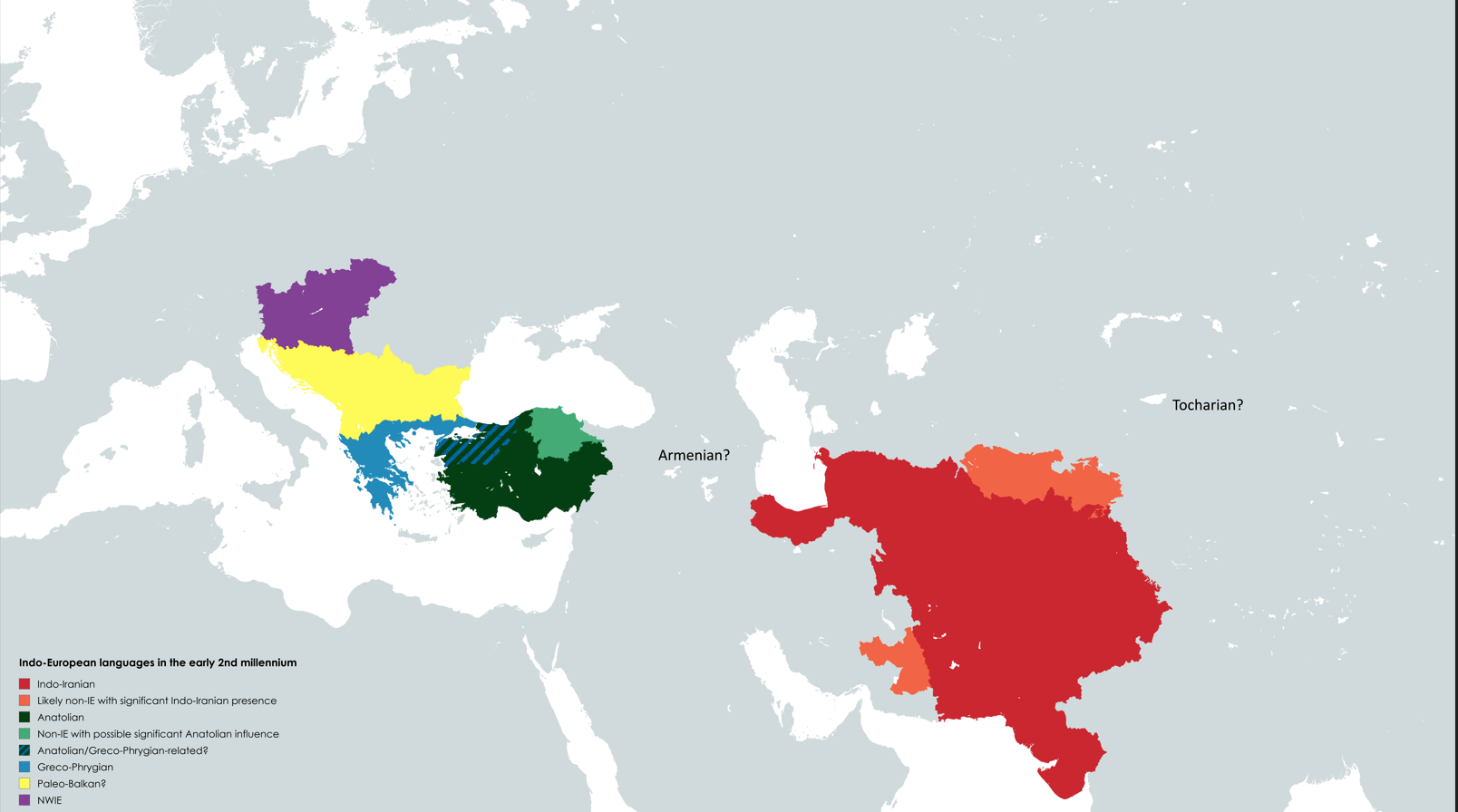
The deeper origin of this process may lie in the interaction between steppe groups and the high cultures south of the Caucasus, especially Maikop and related traditions. Maikop appears to have transmitted not only metallurgy, wagons, and elite symbolism into the steppe, but possibly also linguistic and ideological elements that shaped the emergence of Yamnaya. From there, Indo-European speech and aristocratic culture may have spread in stages through repeated processes of cultural dominance, alliance, emulation, and elite transmission.
The most likely conclusion is that the ancestors of several European Indo-European branches were formed not directly in Corded Ware, but in the Bronze Age interaction sphere stretching from Yamnaya through Maikop and into the Carpathian Basin, where the full package of Indo-European elite culture became visible and historically transformative.
113 thoughts on “Genetics Without Culture: The Missing Indo-European Package in Corded Ware”
Great article, I would consider Etruscan in addition to Basque.
Isn’t the Leylatepe origin for Maykop pretty obvious? Maykop is autosomally Post-Shulaveri-Shomu (Leylatepe, migrant) + Steppe Eneolithic (local). The northern variant of Maykop, so-called Para-Maykop, samples from Zolotarevka and Remontnoye are higher Steppe Eneolithic than core Maykop, and Zolotarevka-Remontnoye profile is supposed to have contributed ~25% admix to formation of Yamnaya over the core Sredny Stog profile.
I don’t agree with Corded Ware being non-IE, autosomally the culture is ⅔ Yamnaya, it’s not possible that after such huge demic diffusion and whole cultural migration the language didn’t shift. If you accept Yamnaya as IE, CWC also has to be. Recently afaik it was found that some plague also contributed to decline of GAC that helped in Yamnaya intrusion and formation of CWC.
Do we find pottery evidence of SC Asian derivation of IVC? Because to me it seems downstream of Pre-Harappan cultures (Togau Ware, Hakra Ware, etc.) only. Which would mean arrival of IE into Indus should be 4700-4400 BCE.
@Leon Kennedy
“I don’t agree with Corded Ware being non-IE, autosomally the culture is ⅔ Yamnaya, it’s not possible that after such huge demic diffusion and whole cultural migration the language didn’t shift. If you accept Yamnaya as IE, CWC also has to be.”
The author of the post (Vara) may want to clarify it further, but what I understand from the article is that it was Yamnaya who shifted from a non-IE language to an IE language, borrowing it from Maykop (along with all the cultural features that the article mentions). By that time, CWC had already split from the population that would become Yamnaya, so the CWC kept its native non-IE language (and culture).
“Recently afaik it was found that some plague also contributed to decline of GAC that helped in Yamnaya intrusion and formation of CWC.”
Yes, there was a big collapse throughout most of Europe and that’s why it had to be repopulated from the steppe by small pastoralist populations. This part is explained in a previous article dealing with the broader IE problem that you can find here: https://adnaera.com/2024/12/08/origins-and-spread-of-indo-european-languages-an-alternative-view/
@Matthew
“I would consider Etruscan in addition to Basque.”
Yes, Etruscan is another candidate. Not as solid and Basque and Iberian, though, since in Italy there was not a complete replacement from the steppe populations as in Northern and Western Europe, so there’s a chance that Etruscan could come from surviving EEF communities (though Etruscans are quite directly descended from the BBC people from the steppe themselves). Ultimately this can only be solved by linguistic analysis, but with Basque being the only living language that surely came from the BBC it’s difficult to know. It’s necessary for linguists to give back to those non-IE languages what belongs to them but is now classified as IE (I mention this problem in other previous posts, for example here: https://adnaera.com/2019/04/22/the-problematic-of-substrates-a-case-study-of-iberia/ ).
> from the article is that it was Yamnaya who shifted from a non-IE language to an IE language, borrowing it from Maykop (along with all the cultural features that the article mentions).
Yamnaya begins around 3300 BCE. Perhaps you mean Pre-Yamnaya.
> By that time, CWC had already split from the population that would become Yamnaya
Not true, oldest dates for CWC don’t go before 3000 BCE. Likes of Davidski keep pushing CWC origin not from Yamnaya but Yamnaya is clearly the originator, or rather some specific culture inside Yamnaya like Budzhak or Zhivotilovka-Volchanskoe
> so the CWC kept its native non-IE language (and culture).
This is an impossible special pleading since genetically CWC is ⅔ Yamnaya and uniparentally almost entirely from Yamnaya/Steppe. I’m fairly sure CWC material culture matches with reconstructed landscape of ancestral NWIE branch (Germanic, Italo-Celtic, Balto-Slavic).
@Leon Kennedy
I am agnostic as to whether CWC was IE or not. If it was then it’s pretty likely an extinct form of IE pretty similar to what Iversen proposes and if not then most likely non-IE just like Alberto proposes. However, I do agree that the known Indo-European languages do not derive from the language of CWC.
Your autosome argument can be spun around differently. Autosomally BBC is pretty similar to CWC as well and we know that the Basque speakers are pretty much direct descendants of the BBC. So if we accept BBC as non-IE then CWC is non-IE.
“CWC is ⅔ Yamnaya and uniparentally almost entirely from Yamnaya/Steppe”
Almost all of the Yamnaya samples we have are R1b-M269 (earliest in Volosovo?) and Z2103. The only CWC sample with Z2103 is I13467 from Bohemia which dates to the end of the CWC period same as the Bell Beaker I4253 (contacts with Yamnaya related cultures of the Balkans is not unlikely). Meanwhile, R1a-M417 is missing entirely from Yamnaya.
The Yamnaya profile existed a few centuries before the formation of Yamnaya proper (see the Mikhailovka 3500 BCE sample). So I’m not really convinced that CWC somehow derives from Yamnaya but is missing every archaeological marker.
“I’m fairly sure CWC material culture matches with reconstructed landscape of ancestral NWIE branch (Germanic, Italo-Celtic, Balto-Slavic)”
Except it really does not as noted by Iversen. There is no evidence of Indo-European religion or lifestyle in the CWC. This was the whole purpose of the post.
To clarify further. Neither the Ukraine neolithic farmer nor the steppe eneolithic people of the Caucasus and Volga (Khvalynsk) match with the reconstructed Indo-European culture proposed. There is no evidence of Indo-European rituals/iconography nor lifestyle in general and so the focus was mostly on Kurgans, which is just a burial type that a lot of Indo-Europeans did not use, and fantastical battles and conquests of EEF on horseback which we now can safely say did not happen. These pre-Yamnaya groups were very likely non-IE.
The earliest possible culture on the steppes that matches with the reconstructed Indo-European culture is Yamnaya. The reason why Yamnaya has these elements wasn’t due to internal development but rather due to the influence of Maykop whether due to a small colony of Maykop or whether the Z2103 clan was accepted in the Maykop society. A lot of what Yamnaya picked up would be considered guarded secrets back then for example a study of Vietnamese traditional metalworking villages: “Metallurgical knowledge is restricted to village members; outsiders who wish to learn metallurgy must perform particular ceremonies before they are accepted as members of the group. In this way, technological knowledge remains secret and owned by the group. This binds the metalworkers together; they practice rituals together and often support one another through difficult times.” (Hai, 2005)
Now interestingly that Corded Ware did not have these elements at all which we can safely reconstruct for Late PIE at least. The only possible scenario in which CWC actually spoke IE is if the scenario that Anthony proposed is correct, where they would emulate the language of Yamnaya because they were the superior group. But this language that would end up being spoken in Corded Ware would still not be ancestral to any LPIE language that survived. So, CWC = IE is possible.
Vasil’kov is correct in identifying the IE religion of Klady however, it did not spread from the Caucasus to Northern Iran/Turan but rather from Northern Iran/Turan to the Caucasus along with the the exotic goods and the technology.
There is more on the Snake eating bird in my previous post:
https://adnaera.com/2025/04/01/varas-and-dragonslayers-rethinking-the-indo-iranian-expansion/
My previous post is locked so I might as well post this here.
I was looking to see if a mainstream academic came up with a similar chronology for my Indo-Iranian post.
I don’t know how I missed this but Skjærvø (1999), puts Proto-Avestan in BMAC(2200-1700BCE) and Old Avestan (1700-1200BCE). He also references an 1874 source which puts Zarathustra in the time of the Rigveda 2000-1800 BCE.
I opted for the western and southwestern fringes of BMAC for Zarathustra’s homeland for various reasons mentioned in the post but it’s pretty interesting how you can reach similar conclusions with different methodologies.
Also one more thing I left out in the post is that many other people do have myths of snakes or snake deities that could not have originated due to contacts with Indo-Europeans, Awanyu, Quetzalcoatl..etc. But they do not share the same role and function of the IE tyrant-dragon-demon. Some of the African dragonslayer myths describe him as an eastern foreigner but they are attested too late anyways and after interacting with many different people already familiar with the myth. The only really similar myth is the native American Hé-no the thunder god battle with the Oii-gwi-ias and Jo-diʺ-kwa-doʹ underwater people who dress as snakes (though I’m not sure how accurately were these myths were recorded there could be some interpretation interference involved by the missionaries).
This is clearly visible in Mesopotamia where we see early depictions of snake deities but no actual dragonslayer myth but what we see is the opposite the most similar myth to the dragonslayer myth involves killing the Anzu thunderbird . Sarianidi has noted the similarity between BMAC and Mesopotamian iconography: “Human figures with horned goat’s heads in glyptic of Mesopotamia and Susiana were identified as “demons,” whereas in the Bactrian art they seemed to be benevolent creatures, often haunted by dragons which obviously had a negative meaning in the local system of symbols”. The same is true for the snake and eagle relationship, what is deified in one group is demonized in the other until ~2000BCE which is when the Mesopotamian gods turn into dragon slayers as well.
I just found this recently here is the same “Snake Fighter” in England:
https://upload.wikimedia.org/wikipedia/commons/b/b5/Cernunnos%2C_Roman_relief%2C_Corinium_Museum.jpg
So not only the same depictions of the BMAC snake goddess but also of the typical Iranian “snake fighter” are found in Europe. So hopefully this puts an end to the idea pushed by Francfort and Witzel of BMAC being non-IE because of the art.
@Leon
Early CWC is ~100% Yamnaya, their formation date with 25% EEF is ~2900BCE (Lazaridis et al 2024) corresponding with their culture and the linguistic splits commonly attributed to them + agricultural shift in those languages that Yamnaya did not have (CWC subsisted as agropastoralists basically).
@Vara #1
BB is around 50% CWC-like, 25% Yamnaya overall. Earliest BB samples don’t have any steppe at all (Lazaridis et al 2022, iirc supps)
@Leon+Vara
CWC derives from Yamnaya via IBD (Ringbauer et al 2023/2024)
“Notably, we reveal long IBD sharing between Corded Ware and Yamnaya groups, indicating that the Yamnaya herders of the Pontic-Caspian Steppe and the Steppe-related ancestry in various European Corded Ware groups share substantial co-ancestry within only a few hundred years. ”
“Our analysis of long IBD segments reveals that the quarter of Corded Ware Complex ancestry associated with earlier European farmers can be pinpointed to people associated with the Globular Amphora culture of Eastern Europe, who carry no Steppe-like ancestry yet, while the remaining three-quarters must share recent co-ancestry with Yamnaya Steppe pastoralists in the late third millennium bce. This direct evidence that most Corded Ware ancestry must have genealogical links to people associated with Yamnaya culture spanning on the order of at most a few hundred years is inconsistent with the hypothesis that the Steppe-like ancestry in the Corded Ware primarily reflects an origin in as-of-now unsampled cultures genetically similar to the Yamnaya but related to them only a millennium earlier.”
So a few hundred years before 2900 BCE.
I still thought it was up in the air for some reason. I think most takes on the matter don’t really adapt to the newest finding since almost all of the “weight” is based on various theories from when these things weren’t as known.
Anyway as far as testable hypotheses go one would have to attribute the IE languages associated with CWC in Europe to someone else aside from CWC despite their speakers deriving their steppe ancestry from CWC, while accounting for the splits and possibly linguistic/vocab features. Then the Yamnaya-attributed IE languages in Europe would have to be attributed to some other (non-steppe) source that must be traced and linked to its linguistic descendants through time, as well as correspond with splits etc. Something like that coming up in a future paper would be possibly more fun than Lazaridis et al 2017, the sperging would be monumental. But honestly chances of that are around 0,1%.
Whether there were particular sub-groups of these that spoke language A that eventually spread and branched while some other groups (of the same genetic group) spoke extinct language/es B could always be a possibility.
@Vara #2
Unrelated but I took a look at Iversen (2017 with Kroonen, 2018 presentation, 2024) and he flipflops from “CWC-derived SGC = IE” to “actually SINTASHTA royal elite Aryan kangz chieftains came in Central Europe and influenced us in 1500 BCE”, holy schizo (p. 119).
Anyway like all archaeologists he ignores hard evidence (doesn’t even look like he has read any papers) and insists that any future answers to theories should come from “further and more thorough archaeological, archaeogenetic and linguistic analyses” where you can see he’s coping since archaeology is really not needed at all when something is disproven by adna/linguistics. They just got left out and don’t like it
I don’t remember how a theory on this goes, we were talking about IE religion and how it’s preserved better horizontally in the South (Europe to West-Central Asia) than vertically in Europe 2-3 years back in Vas’ blog and I recall this from it: IE languages associated with CWC traveling upward and westward into the Steppe and then Europe and losing their religious character (for a myriad reasons as usually happens historically) then having it re-introduced. This re-introduction correlated with cultural and to some degree genetic influence from the South (Europe), as there was a trade network in place already.
More plausible. Also not sure if the case could be made for some more shared religious elements to have been introduced post-I-Ir split from W.Asia>S-C.Asia, or in fact being more recent into Europe than the Balkanic languages, correlating more with late splits and then upward spreads from there on.
Also what’s up with Danish academics being so infatuated with Sintashta? Did Kristiansen hope he’d get to LARP as Indra on a flying chariot and they now try to salvage it looking for an excuse to “discover” contact with them? Can’t spell Copenhagen without cope lmao
test
@Vara
Some religious (temple architecture) elements in BAMC are traced as far as Minoans too.
I think it was Sariyannidis saying this
@Leon Kennedy
“Yamnaya begins around 3300 BCE. Perhaps you mean Pre-Yamnaya.”
Yes, we’re essentially talking about a period of formation of what would become the proper Yamnaya Culture (which starts around 3300-3200 BC). So that period of interaction with Maykop would be around 3500-3200 BC?
We don’t know exactly the direct precursor of the CWC was at that time, but it was not a core part of the group that would become the proper Yamnaya Culture. Even when the autosomes at that time were identical, that doesn’t mean they had to be geographically together. Afanasievo is identical to Yamnaya too (and even shares the same paternal lineage as the main one, unlike CWC) and it’s thousands of kms away from it by 3300-3200 BC.
What matters is that the resulting cultures (Yamnaya and CWC) of both groups are clearly different due to one group having close contact with the North Caucasus cultures and the other one not. That’s what the post explains in detail.
Just like Vara mentions that he’s quite agnostic on whether CWC was linguistically IE or not, I’m quite agnostic about Yamnaya being linguistically IE or not. We both agree that CWC is culturally not very IE at all, and that Yamnaya does have several IE cultural traits. But the language they spoke is harder to know. I personally think that it’s necessary for the CWC to be non-IE in order to explain the substrates in Northern Europe (plus the non-IE language of the BBC), but regarding Yamnaya I think it may have adopted an IE language and that would help explain the whole IE-isation of the Balkans. But it’s not strictly necessary in my view. Further data may clarify that.
I’m not very considerate of Basque because Bell Beaker is complicated phenomenon compared to CWC, and it’s true in Bell Beaker distribution is where we find remnants of local language in Europe while in CWC distribution we only find GAC substratum at most. Basque, etc. can be explained as some CWC + EEF but retention of EEF, similar to how Dravidians are Old Indo-Aryan + local Megalithic culture and the language of local culture was retained. If CWC had EEF haplogroups and less Yamnaya admixture, I could see it retaining local language too. But that’s not the case, and neither is there strong evidence for existence of a non-IE language that derives from CWC and persisted well later after CWC itself.
@Vara
Do you put Gathas in BMAC?
Material culture of CWC aside, how do you genetically derive NWIE from Balkans?
I doubt anyone dates Gathas to BMAC, even Sarianidi wouldn’t do it because the material culture is not compatible and since it would make composition of Younger Avestan texts way after Gathas. Gathas correspond to Middle-Late RigVeda, so one must have a clear timeframe assigned for RigVeda in order to date Gathas. Gathas can be earliest pushed to Proto-Yaz/Pre-Yaz and Post-BMAC cultural sphere of Namazga VI. That would be 1700-1500 BCE. In that case RigVeda must be 2000-1450 BCE. This date is proposed by Giacomo Benedetti as well and seems to be most plausible date, while the 2800-1900 BCE timeframe is less likely due to incompatibility of Mature Harappan landscape with that of RigVeda.
@Orpheus
“Earliest BB samples don’t have any steppe at all”
I think this is what Alberto was talking about on how there is an archaeological misidentification. When I was checking stuff up for this post I looked up at the earliest BBC in the Netherlands. There is almost unanimous agreement from local archaeologists that the BBC was a development from the Corded Ware Culture.
The issue with the IBD links is that we know for a fact that some Yamnaya proper groups and Corded Ware groups interacted and female mediated mixing is not unlikely. However, there is a clear mismatch with the Y-DNA of these groups. The R1a-M417 clan does not derive from the R1b-Z2103 clan and we do not have strong evidence of R1a-M417 even in the post-Yamnaya related cultures at all. Also, If I remember correctly from the IBD Yamnaya and Afanasievo were much closer meanwhile CWC and BBC were pretty close.
“Anyway as far as testable hypotheses go one would have to attribute the IE languages associated with CWC in Europe to someone else aside from CWC despite their speakers deriving their steppe ancestry from CWC, while accounting for the splits and possibly linguistic/vocab features.”
I don’t think it’s that complicated. The Corded Ware lifestyle was replaced by 1500 BCE almost entirely by people from the Balkans. This 2nd millennium phenomenon is what Indo-Europeanized these regions/brought the known IE languages that are spoken till this day. According to archaeologists these Balkan groups go back to Vucedol thus to Yamnaya. It’s pretty simple except for the fact that there really isn’t much work done on these cultures.
Iversen reminds me of Mallory. He can identify the problems with the steppe hypothesis but the solutions he proposes are unlikely. His Sintashta solution makes no sense especially when Sintashta itself lacks these IE elements as I explained in the post.
“Also not sure if the case could be made for some more shared religious elements to have been introduced post-I-Ir split from W.Asia>S-C.Asia, or in fact being more recent into Europe than the Balkanic languages, correlating more with late splits and then upward spreads from there on.”
On PIE religion. I focused on religious beliefs associated with material things we can linguistically reconstruct and identify through archaeological contexts, as Iversen puts it: “why do we not see archaeological evidence for the material culture associated with early Indo-European vocabulary around 2800 BC “, and not vague abstract religious concepts that can be easily transferred, for example Zoroastrian ideas of good and evil.
We can already see similar beliefs in Klady and Iran at 3500 BCE which basically means that these beliefs were associated at the very least with Late PIE speakers. In reality we do not see these beliefs at all in Corded Ware so maybe they lost them or maybe if they were depicted they did not survive? Then we look at the social layer of religion and paleo-linguistics. The Indo-Europeans were extremely warlike yet we find no evidence of that at all in Corded Ware so maybe the evidence did not survive. Then we look at the supposed hierarchical Indo-Europeans and we find no evidence of hierarchy. Let’s assume that CWC was Indo-European and they were ancestral to NWIE but somehow lost these elements for some reason or another. How likely is it that they kept words in their vocabulary for things they did not interact with until after 2000BCE? If this vocabulary was reintroduced later by groups such as Sintashta or other Indo-European populations, we would expect it to appear as loanwords. The fact that many of these terms are reconstructed as inherited rather than borrowed creates an issue with the Iversen and the borrowed model.
Sarianidi’s theory of BMAC culture from the west is no longer accepted. In fact, a lot of BMAC’s cultural elements are found at a minimum a thousand years earlier than the BMAC phase.
@Alberto
“Yamnaya does have several IE cultural traits”
Yes, but so do other non-IE groups but that shows you how far CWC is from Indo-European. There is also the fact that when Yamnaya related groups were attested they did not speak Indo-European languages.
I predicted the Caucasus models years ago. The steppe hypothesis is absolutely dependent on the Caucasus otherwise it fails entirely. This is what Kristiansen realized way earlier than the PIE from Sredny group.
@Leon Kennedy
“neither is there strong evidence for existence of a non-IE language that derives from CWC and persisted well later after CWC itself”
That is because CWC itself was replaced in these regions by 1500BCE. We do know that there are different substrates in these NWIE languages which would make no sense if they all derived from CWC. One of these languages, Germanic, is even considered the “least IE” language of them.
“Do you put Gathas in BMAC?”
No, it doesn’t match. Check my previous post if you want and the clarifying comments it’s pretty long and dense though compared to this one.
“Material culture of CWC aside, how do you genetically derive NWIE from Balkans?”
Unfortunately, we don’t have a single sample from the Balkans dating 2000BCE especially not an Ottomani related sample. These Balkan groups themselves would carry BBC and CWC ancestries as contacts between late BBC groups and Unetice groups are well established.
For Celtic we have an upcoming preprint which derives them from the Urnfield culture. The Urnfield culture itself derives from the Tumulus culture that is brought up in this post.
https://www.biorxiv.org/content/10.1101/2025.02.28.640770v3
@Vara
Dunno, Harvard classified these samples as BB. Maybe they’re talking about later BB which did have these elements, and so they just assume that the rest came from CWC too or developed along the way when it’s (probably) the other way around
Anyway not a hot topic, just throwing it in there because it was brought up.
Yes Yamnaya is closer to Afanasievo and CWC is more distant, while BB (at least the samples I pulled up from Ringbauer) are distant to all of them but slightly less distant to CWC groups.
I don’t have a stance on the tribal dynamics between CWC and Yamnaya, as there wasn’t one tribe alone. They do descend from the same people though. If there was recent mixing between CWC and Yamnaya it can be tested on their IBD with GAC (it’s strong in all CWC samples as per Ringbauer) and also when it happened (it’d be more recent, which I didn’t find). I’m trying to figure out how to test this out in a way that arrives to a deduction that we can then use to eliminate a group as a candidate for a linguistic family.
“The Corded Ware lifestyle was replaced by 1500 BCE almost entirely by people from the Balkans. This 2nd millennium phenomenon is what Indo-Europeanized these regions/brought the known IE languages that are spoken till this day.”
We need to test this in some way. Also by 1500 BCE both CWC-attributed languages had already split and the Balkans themselves had Yamnaya-attributed IE languages which are completely unrelated to the CWC-attributed ones. Balkanic splits quite early (Greek itself is 2200-2000 BCE and it’s one of the last ones).
“According to archaeologists these Balkan groups go back to Vucedol thus to Yamnaya.”
Pontic Yamnaya > Vucedol diagonally? Yes that makes more sense geographically, but Vucedol didn’t exist for centuries at that time. Where were the supposedly ensuing people? (Genetically they’re all over the place too, see Clemente et al 2021.) Most importantly, in what way does Yamnaya ancestry appear in the ancestors of the future IE-speaking peoples? They descend from CWC, not Yamnaya. (Yediay-Kroonen et al 2024)
By 3000-2000 BCE in North and even Central Balkans the ancestry is traced to BB not Yamnaya. 2000-1000 BCE Yamnaya is nonexistent in the Balkans aside from Greece (near the Peloponnese), Central, North, West and Southwest Europe is just BB and CWC, to the point where any small IBD relation with Yamnaya can be attributed to shared ancestry instead of actual genetic contribution (plus the groups are completely different, Balkanic/CWC-attributed). What can be tested against that?
Then there is McColl & Kroonen et al 2024, where we see the same. West & South West Europe = BB derived, North Europe = CWC derived, Central Europe = mixed BB and CWC.
That’s why I am being so skeptical. It requires a lot of evidence basically while it has to accommodate the linguistics as well in some way. Same reason Sintashta is a horrible candidate for Indo-Iranian.
Almost forgot. There’s also the Skourtanioti paper (and I think another paper too) that trace BB/CWC ancestry in the Balkans including in the North around that time (which actually did have an impact in Greece). ~2000 BCE or so.
“The Indo-Europeans were extremely warlike yet we find no evidence of that at all in Corded Ware so maybe the evidence did not survive.”
We don’t really see any steppe group at the time being warlike in the first place, including Yamnaya. Don’t forget that they also differ genetically from the people they inherited IE from, to a significant degree which can easily affect predisposition, especially if we take into account drift, and pre-Yamnaya groups don’t seem warlike either. Not above average and definitely not close to organized warfare (annihilating entire settlements) from the Neolithic. We see a lot of trading and expansion with them, but definitely not particularly warlikeness that stands out.
As far as hierarchy goes there is always hierarchy everywhere, regardless of religion as one household is bound to have better crop yield, steal more cattle from someone and so on. CWC itself saw a bunch of overturns in dominant haplogroups although this is not hard evidence of anything (but it does reflect varying success among different clans). In terms of archaeology there is stratification is grave goods (like Krol et al, or Tornberg & Vandkilde). But this will be found everywhere, even poor HG groups since that’s just what happens.
“Let’s assume that CWC was Indo-European and they were ancestral to NWIE”
Pause here, I actually don’t find this likely. I don’t think BBC derives directly CWC but from a sister group, possibly before CWC as a culture existed. Genetically they form as separate groups almost at the same time, corresponds with linguistic splits too, couple of centuries if not decades of difference. So they don’t have to trace their languages linearly but rather to a shared ancestor which was the same ancestor Yamnaya came from. CWC is more like a branch rather than a source.
“How likely is it that they kept words in their vocabulary for things they did not interact with until after 2000BCE?” This is debatable, I did read this in Iversen. The horse argument for example doesn’t hold up and I’m surprised he even made it (multiple groups kept and bred horses, both the domesticated type and other types, they just didn’t ride them), he was probably looking for some confirmation bias so he can put up a theory to then claim the Sintashta LARP.
For the rest, I’d like to see a paper comparing the for and against arguments for this, possible explanations and so on. A simple argument is, “why wouldn’t they use these words?” Semantic drift is common and very easy to explain them.
Digging around I also found support for the stance that CWC did in fact have wool. They definitely processed fibers and there is an increase in sheep bones. (Leuzinger & Reicher, and an adna paper for animal remains I have somewhere shows this iirc.) So with just a quick search, nothing too deep, I can already see that there is a side(s) that proponents of one set of arguments (which are cited back to Kristiansen and Iversen themselves as seen in Nortoft 2024) won’t bring up either willingly or because they didn’t notice it. Plus “wool” could be used to denote not necessarily the term as it became known to us (rather something more generic, spun fibers), kind of like how Gamkrelidze & Ivanov showed that for the “horse”.
Linguistics arguments for specific vocabulary words are generally highly subjective to interpretation (and the theory one wants to push lol), and very often various archaeological findings come out that make them far less compelling. It becomes just guesswork and a couple of indicators. Not to mention it cannot be compared to actual dna and any obstacles it poses to such a theory – the point where if there is no other alternative, no actual explanation is required. Not being able to explain something doesn’t mean that something else didn’t happen (especially when there is evidence that it did).
Hence my reluctance. Plus I really like meta-theories that will compare/weigh what’s for and against a hypothesis, which is why rotating qpAdm models are so important also. We already have 200000 different hypotheses as is but their proponents won’t actually try and falsify them. We also have the recent example of early/PIE languages going from “100% pastoral 0% agriculture trust me bro” to “oh damn these guys definitely ate a bunch of grains alright ehm what do we do now??”. There are 10000 different takes and 1000 different interpretations, but with genetics we actually don’t have that, it’s more like 3-4 because we can instantly compare what’s available (and new evidence will birth a new hypothesis and discard an old one so there’s no clogging).
Also Kristiansen & co constantly talk about how CWC was supposedly this or that, became definite aristocratic supersoldiers all of the sudden so I wouldn’t be surprised if the elements they attribute to them end up being already there (not the first time this would have happened – this was also true for Mycenaeans despite the colossal LARP and multiple books on the topic, Dickinson has a good paper out detailing it) from before, or the other things they see as indicators aren’t actually indicating anything like that and it’s more generic (but they want to see their theory in it).
Tl;dr post-2000/1500BCE is a really really bad date. Arguably even worse than tracing Greek or Greco-Phrygian (as if they’re standalone languages) to Catacomb.
Btw Steppe hypothesis doesn’t even exist anymore. What is called “steppe hypothesis” now, the actual kurganist that came up with it would dismiss as “not steppe hypothesis”. They just kept the name so they can associate their work with it lol
My own (obviously 100% correct as always) take on this is that saying Yamnaya has an “IE culture” is actually only half real. They have maintained and possibly further developed the pastoral aspect, but not the rest while actual IE culture (traced south of the Caucasus) combines several traits that Yamnaya lacks. Meaning that we can look at various shared elements, with non-IE speakers as well. Just a hunch
@Vara
Wait I missed this. I don’t know what Sariyannidis says, I mentioned that as BMAC>Aegean (basically what you said). When I read his article on it I thought he meant that himself as well since at that time I-Ir had already split
@Orpheus
Sarianidi claimed that BMAC was a result of a movement from the west where basically the Mitanni were first attested. In his works they would move east and form BMAC. This of course is backwards.
“We need to test this in some way. Also by 1500 BCE both CWC-attributed languages had already split and the Balkans themselves had Yamnaya-attributed IE languages which are completely unrelated to the CWC-attributed ones. Balkanic splits quite early (Greek itself is 2200-2000 BCE and it’s one of the last ones).”
I didn’t understand your point here. In this model Yamnaya would reach the Balkans around 3000BCE and split into the European Branches of Paleo-Balkan, Greco-Phrygian and NWIE. We do have a clear trace from Celtic now Hallstat < Urnfield < Tumulus Makó-Kosihy-Čaka cultures> Vucedol (thus ultimately to Yamnaya) link can be established or not. And yes these groups should’ve picked up BBC and CWC ancestries. I don’t see the issue with that. Much like the BMAC Indo-Iranians picked up Sintashta related ancestry as they moved north.
So really we have European IE already in the Balkans in 3000BCE mil which would split up to the 3 main branches Albanian/Paleo-Balkan, Greco-Phrygian, and NWIE. This isn’t any different from your typical steppe language tree other than the fact that Indo-Iranian is not there.
“We don’t really see any steppe group at the time being warlike in the first place, including Yamnaya.”
When we first see Yamnaya they at the very least occupied fortifications and when they appeared south of the Caucasus they did show up as elites and allegedly conquerors?
“I don’t think BBC derives directly CWC but from a sister group, possibly before CWC as a culture existed.”
As in a group straight from the steppe? The thing with CWC is that it’s the first steppe culture in northern Europe. Also, BBC is a few centuries younger than CWC (hence the Dutch BB development from CWC theory).
“It becomes just guesswork and a couple of indicators.”
The thing is that we shouldn’t be fixated on one aspect of Indo-Europeans and formulate an entire theory based on it (example horses). I remember years ago I argued with Davidski that Indo-Europeans were cow people and not horse people because I couldn’t really find a core Indo-European myth based on the horse nor one that really requires a horse. Lo and behold turns out domestication of the horse occurred centuries after PIE split up.
I approach genetics, archaeology, comparative linguistics, and paleo-linguistics as interconnected areas, and the more pieces I can fit together, the clearer the overall picture becomes. For example, a single I2a in western Anatolia around 2000BCE does not prove to me that Anatolian languages derive from the steppe but Turan related ancestry and uniparentals and cultural impact in the Andronovo groups does prove to me that the spread of Indo-Iranian was south to north. Sure, if any of these fields seem inconsistent or unclear, I’m willing to explore other possible explanations.
Hope that makes sense.
So Armenian is also from Yamnaya? Do you agree on Balkanic (Albanoid, Hellenoid, Thracoid) being from Yamnaya, right?
My issue is CWC or CWC derived seems to genetically contribute to NWIE groups without any outside admixture from North/NW Balkans as proposed. Plus the haplogroups are also downstream of CWC ones.
@Leon Kennedy
“My issue is CWC or CWC derived seems to genetically contribute to NWIE groups without any outside admixture from North/NW Balkans as proposed. Plus the haplogroups are also downstream of CWC ones.”
I don’t think this is true. Sure BBC and CWC both contributed heavily to the incoming Balkan groups but that’s to be expected as we do not propose a total genetic replacement model for the spread of IE.
From the preprint I linked earlier:
“In the Czech Republic, we find almost all individuals being modelled with a large proportion of Hungarian/Serbian ancestry during the Late Bronze Age.”
Looking at the supposed Hallstatt Celts for example:
Czech Samples:
DA111: R1b-P312 (Bell Beaker)
I14983: R1b-Z2110 (Common Balkan marker from Yamnaya Z2103)
I17607: R1b-P312 (BBC)
I17312: R1b-Z2103 (Yamnaya)
I16327: G2a2b2a1a1b1a1a2a (Balkans)
I18227: G2a2b2a1a1c (Balkans possibly?)
German Samples:
HOC001: R1b-P310 (BBC)
APG001: R1b-P312 (BBC)
HOC002: G2a2b2a1a1b1a1a2a (Balkans)
HOC003: G2a2b2a1a1b1-Z1815 (Balkans possibly?)
HOC004: G2a2b2a1a1b1a1a2a1a1 (Balkans)
LWB003: G2a2b2a1a1b1-Z1815 (Balkans?)
MBG006: J2-Z597 (Balkans, ultimately the Caucasus)
MBG012: G2a2b2a-P303 (Balkans?)
MG013: R1b-P310 (BBC)
MBG016: G2a2b2a1a1b-L497 (Balkans)
MBG017: G (?)
This also makes it’s way all the way to England. So as you can see quite peculiar non-CWC/BBC haplogroups spread with the Italo-Celtic movements.
How much Y-DNA and autosomal turnover do you find, then? So far it seems 90% of uniparentals are just CWC/BBC derived
@Leon Kennedy
“neither is there strong evidence for existence of a non-IE language that derives from CWC and persisted well later after CWC itself.”
Surely we can’t have strong evidence for languages (IE or non-IE) in the CWC area during the Bronze Age. Languages there are only attested some 3000 years after the CWC. But we can have clear clues about their existence or not. For example, as I mentioned in a previous article:
“This paper presents an analysis of those words, attested in Balto-Slavic, that do not have a clear Indo-European etymology and that could have been borrowed from some substratum language. It is shown that Balto-Slavic shares most of those words with other Indo-European languages of Northern and Western Europe (especially with Germanic), while lexical parallels in languages of Southern Europe (Greek and Albanian) are much less numerous.” Ranko Matasović, Substratum words in Balto-Slavic, 2013.
Or this other paper by Anthony Jakob examining some non-IE bird names in Balto-Slavic:
“It is curious that two of the bird names appear to show two irreconcilable variants within Slavic. This is remarkable, since the split of the Slavic language family was relatively late, datable to the first millennium CE. The existence of multiple variants in Slavic would appear to suggest that multiple non-IE languages were still present in Europe in the Common Era.”
We really have to look at the data as a whole. Once you cross reference genetics, linguistics, archaeology, historical sources, etc… is when the picture becomes really clear.
“How much Y-DNA and autosomal turnover do you find, then? So far it seems 90% of uniparentals are just CWC/BBC derived”
You can check the previous post to this one where I commented on the paper linked by Vara above about Celtic origin and spread. There you can see PCAs and admixture models that show a clear shift in Bohemia ca. 1500 BC.
I estimated (well, Gemini AI did) the percentage of local (EEF) females in reproductive age that should be part of a steppe community in order to reach the admixture levels that we see across Europe.
If we consider that the CWC expansion started around 3000-2900 BC and reached Ireland by 2200 BC (some 750 years or around 26 generations), and that by then they had acquired 50% of EEF admixture, we get an average of 5.26% of the females in reproductive age were foreign per generation, or around 2.63% of the community as a whole (that accounts for all females and males, elder females too). This is assuming equal number of children per female from those incorporated females and those that were born in the community (if those foreign females were used mostly for having more children so that those from the community would need to have less, then those percentages would drop further).
Graph
The same calculation but with the target being southern Iberia by 2200-2100 BC (800 years or some 28 generations) and reaching 85% EEF admixture (so only 15% steppe left), gives an average of 13.29% of foreign females in reproductive age per generation and 6.6% of the whole community per generation.
Graph
Not that this matters too much, but to give some real numbers (though average ones) for the following 2 scenarios sometimes proposed:
1) A massive male migration instead of a migration of communities with complete family units. Such scenario would result in ~1.1% steppe admixture left after 6 generations, or around 2800-2700 BC, so basically identical to the previous Neolithic population.
2) That in Iberia reaching as low as 15% steppe in the south means that the chances of adopting the local language were very high (since there’s an accumulated 85% EEF admixture). Even in that scenario, we’re still hitting a 6.6% of foreigners (all females) in the community per generation. That means in a community of 200 individuals, 13 of them would be foreign females.
Things are always more complicated than that and language transmission can’t be judged on admixture alone.
@Alberto
Do you still think the plague was the main factor in the collapse of the EEF?
@Vara
It’s difficult to know the exact reason why there was such a population collapse ca. 3000 BC throughout northern Europe. I would think that climate change may have been the main trigger, but once decline starts many other factors can come in too, including diseases like the plague.
Southern Europe was more resilient to this collapse, which is why I would attribute it to the climate (end of the Holocene Optimum and an abrupt cooling) as the primary cause rather than disease. In the southern half of Iberia, for example, there seems to have been a thriving population during that first cooling event that affected Northern Europe, and instead the collapse of the local Chalcolithic societies is linked to a second climate change that occurred ca. 2200 BC, known as the 4.2 ka event:
“On the Iberian Peninsula, in general the climate between 2800 and 1100 cal BC is quite stable and relatively humid. A reconstruction of precipitation shows two rapid, pronounced dry phases from 2350 to 2200 cal BC (4.3 – 4.15 ka BP) and from 2100 to 2000 cal BC (4.05 – 3.95 ka BP). The dry phases were followed by a shift towards wetter conditions, suggesting a more complex pattern of climate change than other regions during the 4.2 ka event.
On the entire Iberian Peninsula, there is a slight decrease in settlement activity from 2500 cal BC, followed by a significant decline between 2300 and 2100 cal BC.” (Wikipedia).
A recent study about population discontinuity in the Paris Basin briefly discusses the ~3000 BC collapse across Northern Europe:
“The large-scale decline in the construction of these megaliths towards the end of the fourth millennium BC, could, in principle, reflect either a shift in cultural behaviour or a demographic decline. However, demographic analyses and recent genetic results in combination with data from distributions of radiocarbon dates have provided increasing support for the latter hypothesis. One of the theories put forward to explain this so-called Neolithic decline is that environmental exploitation brought about by farming, such as soil degradation and deforestation, reduced the land’s capacity to support agriculture and livestock and, thus, its ability to support local populations. Others argue that the close contact between humans and animals in the Neolithic increased the risk of pathogen emergence, which, together with the increased population density, increased the risk of transmission.” (Seersholm, F.V., Ramsøe, A., Cao, J. et al. Population discontinuity in the Paris Basin linked to evidence of the Neolithic decline. Nat Ecol Evol 10, 677–688 (2026). https://doi.org/10.1038/s41559-026-03027-z).
They find that the Megalithic phase came to an end with a peculiar death profile:
“the demographic profile is suggestive of excess mortality, particularly affecting juvenile individuals, perhaps indicating a catastrophic event, such as war, famine or a disease outbreak or, on the contrary, a rapid increase in the population” (They did find pathogens in the deceased, including Yersinia pestis).
Interestingly, they also found that after that phase there was a repopulation that came from Southern France / Iberia before the BBC came in and replaced those too. That repopulation, didn’t reach the rest of Northern Europe, though, which remained mostly depopulated until the steppe pastoralists came in.
@Alberto
That makes much more sense than a simplistic disease model.
Hey, is FrankN active? Btw, what do you guys think about Leylatepe being some sort of IE vector into Steppe. Shulaveri-Shomu (6000-4400 BC) -> Leylatepe (start c. 4400 BC) -> Maykop and ext. (start c. 3900 BC) -> Yamnaya (start c. 3300 BC). And we see Shulaveri-Shomu expansion into Anatolia proper as well most likely, as Anatolia_LateC samples are South Caucasus + Anatolia_N (Barcin, Tepecik, Catalhoyuk). I don’t think Indo-Iranian can be derived, but it’s a possibility as chain of sequence does go from Shulaveri-Shomu (6000-4400 BC) -> Zagros_LN (upper variant c. 5600 BC, lower variant c. 5400 BC) -> Mehrgarh II (c. 4700 BC)
Is it possible to derive Early Harappan from Greater Anau complex (which itself deriving from Cheshmeh Ali?). I can see a possible sequence that isn’t too early. Anau culture is also seen as deriving from Cheshmeh Ali and Sialk in many aspects. Genetically it is also feasible to model Anau as Monjukli + Iran_C-like, or related modelling. Anyways, if Anau is taken as Proto-Indo-Iranian, Early Harappan may be derivable from it if we consider Hakra & Togau Ware to be marginally ancestral to Early Harappan rather than total. So, Late Greater Shulaveri-Shomu (5000-4400 BCE) -> Post-Shulaveri (Greater Leylatepe) (4400-3400 BCE) -> Anau (4000-2300 BCE) -> Early Harappan (3300-2600 BCE)
Justifying older split for Indo-Iranian is implausible but just for the sake of it let’s consider.
Late Greater Shulaveri-Shomu can be seen as final unity of PIA. Shu-Sho migrates into Anatolia during early 5th millennium BCE most probably, forming Anatolia Chalcolithic cultures as apparent. Late Shu-Sho splits into two sides, the western remnant is based on plateau and recieves Steppe Eneolithic admix, as seen in Armenia_C (Areni), this culture is known as Sioni and is contemporary to the eastern remnant of Shu-Sho which is Leylatepe, based in lowlands mainly. Leylatepe is seen as progenitor of Maykop which is genetically also proven, as Maykop is admix between Leylatepe and predecessing Steppe Eneolithic which occupied much of Maykop’s territory before Maykop’s beginning c. 3900 BCE. Now, Greater Leylatepe (including the Early Chalcolithic settlements of NW/NC Iran such as Sialk and Cheshmeh Ali, Hajji Firuz) migrates eastwards and forms the Anau horizon comprising of sites ranging from Tepe Hissar in the west and Sarazm in the east, Mundigak in the south. This horizon spans across Gorgan, Margiana, Bactria, Helmand and is more or less a unified culture in many aspects. So we have a sequence as follows:-
Late Shulaveri-Shomu (5000-4400 BCE) : final unity of Proto-Indo-Anatolian
-> Anatolia Early Chalcolithic (admix between Anatolia Ceramic and incoming South Caucasus input) (4800?-3800 BCE, evolving into Anatolia Late Chalcolithic) : Pre-Proto-Anatolian
-> Post-Shulaveri (eastern remnant) = Greater Leylatepe (4400-3400 BCE) : final unity of Proto-Indo-European
–> Maykop & Para-Maykop in the North Caucasus Steppe (3900-3100 BCE) : Pre-Proto-Europic branch
—> Proto-Yamnaya? (c. 3600 BCE) or Yamnaya (c. 3300 BCE) : Proto-Europid, splitting into Pre-Proto-Tocharian, Proto-Balkanic, Proto-NWIE nodes
–> Anau horizon (4000-2300 BCE) : Pre-Proto-Indo-Iranian branch
—> Initial Early Harappan (3300-3000 BCE) : Proto-Indo-Iranian branch splitting into Pre-Proto-Iranic and Pre-Proto-Indic
—–> Helmand culture (3100-2000 BCE) : Pre-Proto-Iranic
—–> Mature Harappan (2600-1950 BCE) : Proto-Indo-Aryan
@Orpheus
“Sarianidi claimed that BMAC was a result of a movement from the west where basically the Mitanni were first attested. In his works they would move east and form BMAC. This of course is backwards.”
Seems like it yeah. Haven’t read a lot on him, turns out this was a good thing since I didn’t pick up on that claim hah
“I didn’t understand your point here. In this model Yamnaya would reach the Balkans around 3000BCE and split into the European Branches of Paleo-Balkan, Greco-Phrygian and NWIE.”
I mean, in what way can we actually test that this happened? Linguistically it doesn’t fit and in what way we can trace this in later populations? That’s what I mean with testing
“We do have a clear trace from Celtic now Hallstat < Urnfield Vucedol (thus ultimately to Yamnaya) link can be established or not. And yes these groups should’ve picked up BBC and CWC ancestries. I don’t see the issue with that. Much like the BMAC Indo-Iranians picked up Sintashta related ancestry as they moved north.”
I don’t see an issue with that either, but how is the original Yamnaya-like link seen? (Which would then have to move into BB)
At the same time why would that prove that CWC didn’t speak IE without any Yamnaya influence at the time? I mean in a genetical or/and linguistical argument, since archaeologically this argument can be made of course. Also there is an obvious problem with linguistic splits. On a similar note we see Sintashta-like ancestry in Indo-Aryan speakers but Sintashta doesn’t work as the linguistic source despite that.
If we wanted to be more strict we’d look for substratums or influences in Balkanic (incl. Armenian) from NWIE since they were close together in this theory and also from some of the BA samples in the papers I mentioned we see they overlap heavily (if we are to expect Balkanic in those areas at the time) but I don’t think we see any such thing. At the same time there would have to be an explanation of how Yamnaya-like Vucedol IE speakers (hypothesized) managed to convert both the CWC (already formed) and BB (already formed). There could be more requirements in order to make a strong case that I’m possibly missing
“So really we have European IE already in the Balkans in 3000BCE mil which would split up to the 3 main branches Albanian/Paleo-Balkan, Greco-Phrygian, and NWIE. This isn’t any different from your typical steppe language tree other than the fact that Indo-Iranian is not there.”
On paper it’s pretty much the same yeah. Linguistic splits don’t fit though
“When we first see Yamnaya they at the very least occupied fortifications and when they appeared south of the Caucasus they did show up as elites and allegedly conquerors?”
Fortification are pretty common, but I’ll be a bit more specific here. With Fibiger in mind, what we see is not some kind of mass graves, constant serious injuries etc but simply settlements (or semi-nomadic settlements) near other settlements, trading. From the Neolithic to the Bronze Age there is a reduction of violence (and we also see increase in trading and side by side living), especially in Yamnaya-heavy cultures (including CWC here) in NW and NE Europe. BBs stand out as more violent and warlike but unsurprisingly they are 75% EEF-like.
This doesn’t meant people weren’t violent obviously, but the theory of “warlike Yamnaya” as some kind of unique or extreme example has no evidence and at the same time is basically refuted now when we see them as actually rather peaceful for their time.
I’m not aware of any Yamnaya-like individuals south of the Caucasus that are any of that. We see it all the time south of the Caucasus in non-steppe individuals (genetically and culturally) however.
“As in a group straight from the steppe? The thing with CWC is that it’s the first steppe culture in northern Europe. Also, BBC is a few centuries younger than CWC (hence the Dutch BB development from CWC theory).”
Not not exactly, basically pre-CWC/BB split from Yamnaya (or pre-Yamnaya culturally, the split actually coincides with the cultural formation of Yamnaya so I can theorize a rift between clans adopting a more Caucasus-like culture combined with semi-nomadism and other clans moving westward)
Basically Yamnaya and pre-CWC/BB split, but then BB has already split before CWC itself forms. They split from the same group instead of CWC spawning BB. Fits with haplos and language differences as well as the close distance between CWC and BB.
“The thing is that we shouldn’t be fixated on one aspect of Indo-Europeans and formulate an entire theory based on it (example horses). I remember years ago I argued with Davidski that Indo-Europeans were cow people and not horse people because I couldn’t really find a core Indo-European myth based on the horse nor one that really requires a horse. Lo and behold turns out domestication of the horse occurred centuries after PIE split up.”
Agree 100% on that
“I approach genetics, archaeology, comparative linguistics, and paleo-linguistics as interconnected areas, and the more pieces I can fit together, the clearer the overall picture becomes. For example, a single I2a in western Anatolia around 2000BCE does not prove to me that Anatolian languages derive from the steppe but Turan related ancestry and uniparentals and cultural impact in the Andronovo groups does prove to me that the spread of Indo-Iranian was south to north. Sure, if any of these fields seem inconsistent or unclear, I’m willing to explore other possible explanations.”
Same, although I personally focus mainly on autosomal (including IBD and DATES) and linguistic datings. Culture or haplos are a good extra but are easy to ship or be obfuscated through time, interactions, bottlenecks and other factors.
Because of this I generally don’t get behind a hypothesis (even though I have suggested Greco-Phrygian split in Anatolia), because it can very easily change. At the same time I’m open to anything (literally – even Sintashta being Brahmin Aryan Supermen if this is somehow proven), and use what I have saved over the years to raise some objection if I find them. Because genetic options are finite and language is inherited, one way to find candidates is to try and see which ones don’t fit (this is something Vas favored and I started relying on more after 2022)
(Speaking of DATES that’s another way to test stuff that kurganists hate)
The tl;dr would be that we generally seem to agree, I just find several obstacles with this proposed hypothesis based on the papers we got. Which they might be lifted in the future obviously (even some new groups incorporating earlier pre-Yamnaya groups and later Yamnaya-like groups; I wouldn’t actually be surprised if this happened)
@Leon
Balkanic seems to be Yamnaya-like instead of CWC-like (it’s definitely not CWC-like) but we don’t actually know where it came from. If there were early IE splits taking place south of the Caucasus Balkanic could have also formed there, or could be independently mediated via Anatolia into the Aegean and into the Balkans losing any steppe-like trace. The strongest contestant is Yamnaya but we lack the actual source that would fit the splits dates and in BA Greece (which could be an example and benchmark for assuming earlier things) all we see before Mycenaeans is mixed CWC/BB-like ancestry when it’s a steppe source, while in Mycenaeans it’s Yamnaya-like (whether it’s actually Yamnaya or something sharing a similar composition, possibly masked with some CWC/BB residue, I have no idea)
also I was just looking at McColl et al 2025 and ~2800 BCE there is BA Anatolia ancestry impact in the Aegean and Thrace. Although this could actually mean nothing and be unrelated
@Alberto
@Vara
Wrt demographics, something that could also contribute is mismanagement. Northern EEFs didn’t seem particularly well-off compared to the Southern ones and after generations, in small communities, few individuals could have significant impact by a failed attempt at either a new settlement, investing crops somewhere, making mistakes or something else. At the same time attacks from other EEF groups are common and documented (Fibiger etc), so it seems it was a combination of weakening settlements, possibly moving to other settlements to stay there (which would accelerate famine – and disease if there were pathogens), then finally getting attacked as easy prey and mostly wiped out
At the same time overall weakness could contribute to offspring mortality so even if populations were higher than we assume, their offspring didn’t survive as much in 1-2 generations so it’s like they practically didn’t exist.
@Orpheus
I lost my original comment so hopefully I don’t miss anything.
“I mean, in what way can we actually test that this happened? Linguistically it doesn’t fit and in what way we can trace this in later populations? That’s what I mean with testing” & “I don’t see an issue with that either, but how is the original Yamnaya-like link seen? (Which would then have to move into BB)”
BB is irrelevant. We can test this with Italo-Celtic which spread with Urnfield which has it’s origin in the NW Balkans. This isn’t controversial and has been a mainstream model against JP Mallory’s Celtic from BBC for decades. If Italo-Celtic is from the NW Balkans then it’s sisters Germanic and Balto-Slavic shouldn’t be that far.
“At the same time why would that prove that CWC didn’t speak IE without any Yamnaya influence at the time?”
Because the Pre-Yamnaya people of the steppes were not Indo-European.
“At the same time there would have to be an explanation of how Yamnaya-like Vucedol IE speakers (hypothesized) managed to convert both the CWC (already formed) and BB (already formed)”
This is already explained in the Conclusion section. It’s not Vucedol converting CWC 3000BCE rather its supposed descendants converting the descendants of CWC. A group carrying superior technology and a new lifestyle replaces that of the late CWC groups. BB and CWC being already formed is makes no difference much like the kingdom of Urartu being already formed when the Iranians showed up.
“BBs stand out as more violent and warlike but unsurprisingly they are 75% EEF-like”
We do not have much evidence of violence in BBC hence the hunter theory. At least for CWC we there is one example.
Yamnaya south of the Caucasus:
https://www.journals.uchicago.edu/doi/epdf/10.3764/aja.122.3.0463
“Evidence for a significant destruction followed by the sharp discontinuity in the material culture could represent a violent termination of the Kura-Araxes occupation at Nadir Tepesi. This possibility provides one hypothesis for the end of the Kura-Araxes culture elsewhere as well in the Mughan Steppe…On the other hand, Kohl hypothesizes the possibility of a “push-pull process” in which new groups of people with wheeled carts and oxen-pulled wagons gradually moved from the steppes of the north into the southern Caucasus, and the Kura-Araxes communities subsequently moved farther south.”
Though I don’t think that Yamnaya was the only group in conflict with KAC. In fact we do have evidence of Iranian grey ware sites replacing those of KAC in northern Iran. And yes Yamnaya was not as violent and warlike as the South Central Asian cultures.
@Leon Kennedy
Leila tepe > Maykop > Yamnaya is already suggested in this post.
The movement is from Iran to Leila tepe not vice versa. I don’t think Proto-Indo-Iranian is from Anau. Anau was burnt down by people coming from NE Iran forming the Namazga III culture. Early Harappa was also burnt down 2800 – 2600BCE.
@Vara
You seem to misinterpret the “burnings” and base your theory by taking “burnings” as evidence of material culture intrusion. The Kot Diji “burnings” for example have nothing to do with your supposed migration from SC Asia, rather an internal phenomenon which probably lead to Mature Harappan integration. You also seem to entirely neglect genetic samples and introduce implausible timeframes for arrival. Harappan genetic profile was already formed by 3100 BCE so any “migration” must preceded Early Harappan complex. EH and MH are continuous with each other. Similarly Anau genetic profile is already formed by 3800 BCE and no further admix is observed till the beginning of BMAC phase (integration) c. 2300 BCE. This Iran-centric theory with North Iran as purported homeland of Alberto and yours fails flat on most markers, albeit just being a revised version of OIT after all. It also has zero academic significance and plausibility that Armenian hypothesis actually does.
> The movement is from Iran to Leila tepe not vice versa
Incorrect, Leylatepe is rooted in Late Shulaveri-Shomu (Alikemek-Kultepe c. 5000-4400 BCE). The genetic profile of Leylatepe is also same as typical Shu-Sho profile. The dispersal arrows are only coming into Iran proper from NW Iran which is for all purposes inside the South Caucasus sphere during that timeframe.
@Orpheus
I mentioned that Balkanic is clearly from Early Yamnaya, where have I said that Balkanic is CWC? Balkanic seems to explained the simplest by Yamnaya movements into Balkans around early-mid 3rd millennium BCE and into Armenia around mid-late 3rd millennium BCE. Similarly Tocharian is also clearly from Afanasievo. Only Indo-Iranian is seeming possible from non-Steppe route, but I am not committed to it as the only possibility and see Steppe route more plausible as of yet. Only for Anatolian there seems are probable case which may be accepted by mainstream academia in near future
@Leon Kennedy
I am really getting tired of repeating things I’ve already written.
On Anau:
“Another line of cultural interactions can be traced in the materials of late
NMG II–early NMG III when the westernmost sites of the Anau culture are
abandoned temporarily or permanently (Tilkin Depe, Ak Depe, Anau North),
while Ak Depe near Ashkhabad is destroyed by fire …Furthermore, from the very beginning of the Late Chalcolithic, both at Kara Depe and Geoksjur 1, gray pottery, characteristic of the southeastern Caspian region, is found not only in the cultural layer, but also among the burial inventories … Altogether, these analogies point at an increasing influence from central and northern Iran in the late 4th millennium and of a migration of populations from the southeastern Caspian region towards the northeast, up to the Ashkhabad oasis”
The genetic profile of these people has been very similar since 5000BCE this does not mean that one group did not replace the other. You could easy model BMAC with Hissar.
The cause of the destruction of the Early Harappans is still unknown. However, some hints are there in the Priest-Kings statues and the monumental buildings which lead us to the Helmand:
https://youtu.be/zDAJHf1w3H4?si=boakzG-_0zMlY476&t=730
Yes the base of Leila-Tepe/Areni is Caucasus Neolithic as I already wrote. Haplogroup L is not from Shulaveri.
I don’t want to copy and paste the “Origin of Maikop” section again but here we go:
Ivanova also highlights that the precious stones associated with Maikop, such as lapis lazuli and turquoise, were sourced from regions in Iran and Central Asia, not Mesopotamia:
“Not only are the deposits of lapis lazuli, turquoise and possibly carnelian situated on the Iranian plateau and in the mountainous regions of central Asia, but the indirect supply with such materials via Upper Mesopotamia can be essentially ruled out. In the early fourth millennium lapis lazuli and turquoise were nearly absent in southwest”
Moreover, both Maikop and Yamnaya daggers also seem to have their origin in Iran/Turan:
“The second most popular implement, the tanged dagger, appeared at the turn of the fifth to the fourth millennium BC in central Asia and Iran. Among the earliest finds are daggers from Ilgynli-depe, Hissar I, and Sialk III.2 and III.5 … In summary, the north Caucasian metalsmiths manufactured a series of larger copper tools which were apparently of Iranian origin. None of the shapes described previously has been reported from fourth-millennium sites in the Syro-Anatolian region.”
Again influence is clearly from Iran/Turan > Caucasus.
You’re taking Ivanova’s observations out of context again, just to push this Iran-centric fantasy of yours while the data points to South Caucasus & NW Iran instead. Ivanova implied Iranian material affinity but does not specify the culture. Maikop’s origin in Leylatepe is quite strong, and the Iranian affinity of Maikop just means the Iranian Chalcolithic horizon consisting of Sialk, Cheshmeh Ali, Godin Tepe etc. is merely part of the broader South Caucasus and NW Iran complex, as is also genetically evident. And they did have contacts with older Neolithic cultures of east, Jeitun, Gissar, Mehrgarh I, etc.
> Again influence is clearly from Iran/Turan > Caucasus.
Your cognitive dissonance is interesting. Explain to us if IVC profile existed since Early Harappan then how did your “burnings” bring Indo-Aryan by 2700 BCE. The Chalcolithic of Anau horizon (which includes Tepe Hissar) is derivative of older North-central Cheshmeh Ali ware, which is directly linked to or a part of Hajji Firuz tradition. The genetic profile or Anau is just terminal Jeitun + migrant NW-NC Iran profile (Seh Gabi C and Hajji Firuz LN). There is absolutely no Iran -> Caucasus arrow going either genetically or materially. All the older Late Neolthic sites are in South Caucasus and NW Iran, not in NE Iran and Kopet Dag. The funny part is even the Early Neolthic of NE Iran is derived from older Zagros Neolithic in some way, and there was an older migration into Jeitun as I mentioned which gave Monjukli.
There is total sum of 0 academic support for Iran-centric peddling of Vara. Atleast for Armenian hypothesis there is some support, MPI, Gamkrelidze-Ivanov, Grigoriev, practically even Harvard. Iran-centric origin is merely rebranded OIT, i.e. implausible outright. Not much different from the OITists who push for “NW Indian subcontinent origin”. I propose the information should be looked at without lens of ethnic chauvinism or emotional attachment, Vara being Iranian may be too committed to homeland being near his village just as Davidski cannot digest a shred of PIE being south the Caucasus mountains.
I tried to map the dispersal route in a very quick and rough manner:-
https://files.catbox.moe/58s0q0.jpg
Iran-centric model is merely a pipe dream of Vara and co. South Caucasus is the only region that could unite all 3 branches, and gives influx northwards, westwards, eastwards. It is central to all branches and has been entertained in academia which gives it 100 times upper edge than the Iran-centric model
@Leon Kennedy
“Iranian Chalcolithic horizon consisting of Sialk, Cheshmeh Ali, Godin Tepe etc. is merely part of the broader South Caucasus and NW Iran complex, as is also genetically evident.”
Yes, it’s very possible that there was a genetic contribution from the neolithic South Caucasus to Iran but there is no evidence that the North Iranian cultures derive from it. The issue with Shulaveri being IE and not pre-IE is that PIE is a copper age language.
“There is absolutely no Iran -> Caucasus arrow going either genetically or materially.”
The Lapis Lazuli and the arsenic copper was from the Caucasus? L1a1-M27 from CHG?
Target: Russia_Caucasus_Maikop_Novosvobodnaya
Distance: 1.9316% / 0.01931573
37.4 Russia_Caucasus_Eneolithic
20.6 Georgia_Kotias.SG
17.8 Turkey_Barcin_LN.SG
15.0 Turkmenistan_C_Geoksyur
8.0 Armenia_Aknashen_N
1.2 Israel_PPNB
They do have Eastern affinity. Also, didn’t Vasistha have qpAdm models where he modelled Maikop with Geoksyur?
“Explain to us if IVC profile existed since Early Harappan then how did your “burnings” bring Indo-Aryan by 2700 BCE. ”
Do you think “genetic profiles” is the only way a language can spread? Mikhailovka I, Afanasievo and Yamnaya have the same genetic profile but they’re entirely different cultures that most likely spoke different languages. Though I suspect the people that would’ve brought Proto-Indo-Aryan from Mundigak would’ve been pretty close to the Harappan profile.
“The funny part is even the Early Neolthic of NE Iran is derived from older Zagros Neolithic in some way, and there was an older migration into Jeitun as I mentioned which gave Monjukli.”
Yes this is pretty obvious but PIE is a copper age language. In the copper age the cultural influence is from northern Iran.
“There is total sum of 0 academic support for Iran-centric peddling of Vara.”
Uh huh but there is a lot of support for Harappa deriving from Leilatepe? You realize Heggarty just released a paper on an Iran neolithic hypothesis which is what made me write this post?
I was a supporter of the South Caucasian homeland around the time you first started learning how to “read”. I just think there’s a better alternative with the current data.
Also, relax. Try not to rant about random things.
> The issue with Shulaveri being IE and not pre-IE is that PIE is a copper age language.
PIA* is a Late Neolthic – Early Chalcolithic language (Mallory-Adams), whereas PIE* is more suitable for a Chalcolithic-Bronze landscape especially accounting for wagon terminology and other linguistic arguments. Anyways, I do not think Shulaveri-Shomu is PIA proper, but Late Shulaveri-Shomu (5000-4400 BCE, Alikemek-Kultepe) as I explicitly mention it. Late Shu-Sho is the base of Sioni and Leylatepe. Early Shulaveri-Shomu is largely irrelevant unless one believes in Heggarty type arguments. The S Caucasus genetic input in Anatolia happens anytime between 5000-4000 BCE.
> The Lapis Lazuli and the arsenic copper was from the Caucasus? L1a1-M27 from CHG?
Long distance trade routes with Jeitun, Kelteminar, Mehrgarh I, etc. older cultures existed. NW Iran had links with Monjukli phase as well. L1 is a West Asian haplogroup which shows up in Sioni, suggesting it’s presence in Late Shu-Sho and Leylatepe.
> They do have Eastern affinity. Also, didn’t Vasistha have qpAdm models where he modelled Maikop with Geoksyur?
Vasistha’s models are outdated and were speculative even then, he tried too hard to push Sarazm into anything under the sun, along with several of his incorrect notions. Maikop is best modelled as 70% Leylatepe (Azerbaijan_C) + 30% Steppe Eneolithic (inhabitants of Maikop territory prior to beginning of Maikop). Novosvobodnaya is Early Maikop with slight Darkveti-Meshoko pull.
> Do you think “genetic profiles” is the only way a language can spread?
Genetic profile formation is what limits archaeological fantasies of cultural derivation. Since Early Harappan genetic profile had formed by 3100 BCE, and no admix is observed after that, anu external derivation or migration must be limited to before 3100 BCE. No, Mundigak genetic profile was not of IVC. There is no material evidence that Mature Harappan derives from Helmand culture or Anau. To the contrary, Helmand culture is possibly a derivative of Earliest Harappan subcultures in Upper Balochistan and Punjab, there is some evidence for it, similarly BMAC may possibly be derived from Helmand. Only a special pleading for Anau -> Early Harappan is somewhat justifiable as Pre-Harappan cultures have somewhat ambiguous and unclear identity and if one assumes that Farmer component of IVC is Anau, then that would also prevent Pre-Harappan cultures from being sole ancestor to Early Harappan.
Lower Mikhailovka, Afanasievo, Yamnaya are derived from similar groups. To say they spoke “unrelated languages” would be wrong. Afanasievo is just Yamnaya moved eastwards. Whereas Lower Mikhailovka precedes Yamnaya and is a Post-Stog culture. See the map I posted. Yamnaya profile had formed in all likelihood by 3600 BCE and it is possible Post-Stog / Pre-Yamnaya culture (or cultures) can be derived from Remontnoye.
@Vara
“If Italo-Celtic is from the NW Balkans then it’s sisters Germanic and Balto-Slavic shouldn’t be that far”
I don’t disagree with that though. My question is how is that linked to Yamnaya genetically, not geographically to a specific point. Since I don’t have this hypothesis preset in my mind, I don’t arrive at that conclusion.
Additionally, that area is BB/CWC-heavy genetically throughout the years and around the EBA in question, at least in the papers I mentioned. Considering the early Yamnaya-like movements there reaching as low as Bulgaria, an overturn with incoming CWC/BB can be hypothesized
“Because the Pre-Yamnaya people of the steppes were not Indo-European.”
If you mean going by culture (~3300 BCE) then we disagree here as I don’t use it as a primary marker. There’s no way to know or test it, additionally there’s no acceptance of such a position in the labs afaik (they go by adna).
Keep in mind, the same theory/argument was used for Mycenaeans and it got refuted, both genetically and linguistically (datings) and I’d even say archaeologically (Dickinson comes to mind) although the first two were enough
“It’s not Vucedol converting CWC 3000BCE rather its supposed descendants converting the descendants of CWC.”
I touched on that with my earlier comment about dates. Doesn’t work linguistically, extremely late
“A group carrying superior technology and a new lifestyle replaces that of the late CWC groups.”
If we are to compare, CWC were superior in technology due to their economy (tools etc) as well as superior in resources, with no particular clear edge of Yamnaya over them when they weren’t even warlike to begin with. Subsequent assumed Yamnaya descendants would also not be (unless influenced), and would be the ones that had to change up their lifestyle significantly in the first place (nomadism to settlements). At the same time CWC lifestyle remained settled agropastoralists (basically more or less EEF lifestyle, which also had some mobility), plus after a point Yamnaya were practically extinct and their diluted descendants would be in contact for centuries with nearby populations in Europe. Which is not at all like a sweep, if presented like that
Overall, this has already happened with Mycenaeans. A theory is made, then rationalizations are attempted as to how it could have possibly happened, making it compelling. It very often DOES seem very compelling but if it’s scrutinized it usually doesn’t hold because several problems/incompatibilities appear.
What I’m trying to say without being rude is:
This theory (Maykop>Yamnaya>CWC/BB) is based on presumptions (and partially on assumptions, older archaeologists to blame for this tbh) that have little compelling evidence going for them while the evidence we currently have go against it and provide more likely alternative(s). It is definitely not mainstream (I am not aware of any labs entertaining it) but it’s not because of this that it has many problems. The linguistic dates for language splits are impossible with the proposed timelines based on cultures, so if it really was Yamnaya it didn’t happen at the hypothesized time but earlier
If that changes in the future and it can be supported then that’s fine, currently it’s not.
Like with Sintashta or Mycenaean kangs from 1600 BCE Anatolia (lmao), there are problems that simply make it impossible while the cases it makes for something are not hard to explain (like a 100% population replacement would be, for example)
“We do not have much evidence of violence in BBC hence the hunter theory. At least for CWC we there is one example.”
Soriano or Ryan-Despraz off the top of my head, BB absolutely did engage in organize warfare as did EEFs earlier. Obviously not some kind of Assyrian war machine but the point here is that Yamnaya aren’t warlike (if anything, less warlike than their neighboring populations, including older ones), which I point out because Yamnaya warlikeness was part of the wider mythologized narrative of horse warriors used as a non-sequitur ex machina to explain language spread.
Wrt Yamnaya south of the Caucasus:
I meant adna samples, I was curious of that since Yamnaya just got instantly diluted in the Caucasus. I’ll look up the references on the paper you linked to see what arguments he makes in favor of Yamnaya (if we are to assume they weren’t moving due to forced displacement from CWC movements as per Lazaridis)
Another issue I have with archaeologists is that they will never do a pros/cons of a theory, they’ll only present it in a way that seems plausible (like many of our hobbyist friends do lmao). Very often they aren’t even aware of evidence pointing to another direction. So he could even convince me of something without it being actually true, because he hasn’t presented everything and at the same time I’m not aware of it.
1/2
To understand what the data points to, check the following models:-
So as it seems, Late Shulaveri-Shomu is the binding contributor which goes into 1) Anatolia, 2) an eastern remnant stays which is Leylatepe.
Let’s allow some flexibility and consider the contemporary NW Iran sites as part of Greater Leylatepe complex and in general part of S Caucasus sphere. We know Hajji Firuz genetically and materially is very closely related to Shulaveri-Shomu-Aratashen, so it can be considered part of it more or less. Chronologically, the sites in NC Iran appear after Hajji Firuz. The aDNA samples from Seh Gabi and some observations inferred from later and contemporary groups allows that the NC Iran Early Chalcolithic group is basically extension of Hajji Firuz slightly eastwards. So, we have a shared horizon spanning from Azerbaijan lowlands to NC Iran (Cheshmeh Ali). The Seh Gabi Chalcolithic aDNA samples score like Hajji Firuz N + excess Ganj Dareh N. Considering it as the profile of Cheshmeh Ali, it won’t be geographically nor genetically much separate from the the group near Azerbaijan lowlands. Thus the Greater Leylatepe complex between 4400-4000 BCE can be taken as PIE (NOT PIA), such that it migrates into North Caucasus, forming Maikop, and migrates eastwards, forming Anau culture. If so, PIE split into Europic and Indo-Iranic could be roughly by ~3800 BCE or broadly 3900-3600 BCE, with early dialectal divergence probably happening between 4400-4000 BCE (along with some minor subcultural transformations such as innovation of kurgans in Leylatepe, i.e. the western group of GTC (Greater Leylatepe culture).
https://files.catbox.moe/md1kw9.jpg
https://files.catbox.moe/zzxfng.jpg
https://files.catbox.moe/z6am4g.jpg
https://files.catbox.moe/7yzt9w.jpg
https://files.catbox.moe/md5a10.jpg
https://files.catbox.moe/md1kw9.jpg
https://files.catbox.moe/4bogxl.jpg
2/2
At the same time we see from the Dorian Invasion hypothesis that several destructions can occur without any of the population movements theoretically associated with them. To bring up Mycenaeans again, their appearance was always unquestionably linked to new populations and movements and turns out that no such thing happened, it was a gradual development and emergence of new local elites and increased trade (BA Anatolia influence also). It took decades and thousands of pages of linking new incoming religions and practices, organized military states, warrior aristocracies (all of these things existed too) just for another archaeologist to look at all that and go “well there’s no evidence of any of that, nice story tho”. And turns out that the population movements that we can actually detect were unrelated to any warfare or any Greco-Phrygian language.
I’m trying to clarify how haruspex style theories can seem compelling and believable but when attempted to be verified, 9 out of 10 of them are just untestable ad hoc fallacies and are falsified by the constraints imposed by linguistics and adna (which the theory makes claims on, as these would be impacted long-term and short-term). Which is actually boring because in the past there were some pretty cool ones and I still hope some of them are true (they aren’t) purely out of preference. It kind of ruins the fun
“Though I don’t think that Yamnaya was the only group in conflict with KAC. In fact we do have evidence of Iranian grey ware sites replacing those of KAC in northern Iran. And yes Yamnaya was not as violent and warlike as the South Central Asian cultures.”
Also keep in mind that carts and wheeled wagons were used for warfare south of the Caucasus which makes them far better equipped for something like that
PS1 almost forgot, wrt CWC/Yamnaya possible conflict, CWC lifestyle is the one out of which organized military campaigns emerged like with EEFs (continuing well into the great wars and expansions in the LBA). At the same time ancient nomadic populations (especially West Eurasia) are quite tame and under significantly higher stress and scarcity, in smaller numbers too
PS2 Wrt BB, how did they adopt IE from Yamnaya? They split from CWC quite early (possibly pre-CWC) and large IE speaking areas in BA Europe (including Iron Age) descend from BB, not CWC or Yamnaya [even though the case can be made that since CWC bordered northern BB, northern BB descends directly from CWC and not the rest of the BB (or is a mix between the two).]
It’s in the papers I mentioned including McColl who as he mentions in the paper, “(…) new evidence supporting the linguistic model in which Celtic languages were mediated to France, Britain, Iberia and Italy during the Late Bronze Age by populations associated with the Urnfield Culture”
“Concretely, our findings support a major component of the Celtic languages forming in, and spreading from, Bronze Age Eastern Central Europe in association with the archaeological Urnfield, Hallstatt and La Tène Cultures”
I’m going through the supplementals and will give it a proper read in the next days, but all I see is everyone in those regions (Netherlands, England, Scotland, France, Italy, Czech Republic) having very large and recent ancestry shared with CWC+BB and zero Yamnaya (only exception a signal of older admixture in the Czech Republic alongside the CWC/BB signals). This is 2800-2000 BCE before 1500 BCE, and Yamnaya ancestry goes extinct altogether after that, with no recent admixture either.
If Italo-Celtic is from the NW Balkans and Germanic and Balto-Slavic aren’t that far (but also why wouldn’t they be? They don’t split all at the same time) and populations from the area before and after these languages split are CWC+BB, and earlier BA cultures from around that area are related first to CWC over Yamnaya (Skourtanioti paper iirc), why is Yamnaya relevant at all? Actually any IE marker, especially ones that are shared by more southern populations, comes up in the Balkans post-2000 BCE it makes more sense to link it to the Aegean (which did have established trade with the north). Considering the ~2000BCE and definitely earlier CWC/BB ancestries in Greece showing interactions, really what else do we need? But archaeologists would rather harp about imaginary steppe Conans who were extinct at that time, they can’t let go
McColl supports early Bell Beakers as IE speakers btw, what is your take on this? I don’t have an opinion on this and I find it more plausible that early BB waves into Iberia didn’t speak IE
“The presence of the Lusitanian language in Iberia, alongside less ambiguously Celtic evidence, is consistent with a model of two Indo-European waves entering the Peninsula, with only the later wave having undergone the full set of PIE > PC changes. Genetically we see support for a model in which Iberia is impacted by two distinct Bell Beaker-related migrations – the first the arrival of Steppe ancestry around 4300 BP, and the later appearance of Knovíz-like ancestry by 2500 BP. Thus if Celtiberian is a more recent intrusion, Lusitanian might have developed from the speech of local populations resulting
from the initial wave.”
Back to our stuff, with a quick look at Urnfield chariots, we can see these are Mycenaean/Aegean spoked wheels which ultimately come from 2000-1900 BCE Kultepe iirc in Anatolia. So there is very obvious and extremely significant cultural impact from South>North of Balkans, coming from regions with established IE presence. This actually corresponds with IBD from BA Anatolia in McColl which did expand into the Aegean and a few centuries later into NW Balkans, increasing from 2400 to ~1200 BCE (before expanding more, via proxies carrying that ancestry from there) as well as some excess CHG-Iran ancestry (Lazaridis et al 2022) increase in the Balkans at that time, and also explains how Yamnaya themselves don’t particularly resemble these cultures since these guys behave a lot more like Mycenaeans and Aegean/Anatolian warlike populations (who were also far more advanced at the time). Which I’d argue makes the extinction of Yamnaya and their overall lack of impact unsurprising
To conclude, I could be missing something here (I don’t know) and so my initial commentary remains where it was: this theory is similar to almost any other so far, meaning it primarily looks for confirmation while running into insurmountable obstacles (linguistics first and even genetics now, not sure yet if I’d add archaeology/culture from the south/Aegean as a third). If it is somehow proven in the future then this is welcome (why would it be bad in the first place? If anything it’s more cool than just peasants moving around), but I doubt it will as it is already falsified by the linguistic datings we got now (Heggarty et al 2023) since the language splits do not correspond with it and are older (seeming to correspond with something related to CWC/BB), so that would have to change first.
Any additional evidence of zero Yamnaya presence or impact is just extra to this but imo not surprising as Yamnaya were literally a few groups of nomadic peasants themselves if we’re to be honest lol. At this point I don’t think it’s unlikely that they were forced to become nomadic just to survive after being kicked out of the pre-Yamnaya/pre-CWC group from more dominant clans who went on to successfully establish themselves in Europe and be more territorial. Obviously just a fun theory, but kinda fits Yamnaya.
@Leon
Lol why did you read it as a kind of rebuke? Obviously you didn’t claim it’s from CWC, I simply mentioned that it isn’t to highlight that Yamnaya is the most probable candidate based on what we have right now but at the same time we don’t know what the Yamnaya-like source is, while at the same time we see CWC-like ancestry in BA Greece. It could very well be from a non-CWC/BB pre-Yamnaya group (or partially ancestral/related to the pre-Yamnaya formation), if at all
3rd mil BCE is impossible for Balkanic, the language is way older. By 3rd mil branches have already split
> while at the same time we see CWC-like ancestry in BA Greece
Incorrect, there are no CWC affiliated uniparentals there. The Steppe ancestry in Greece derives from Balkans_BA and is related to Vucedol etc.
> 3rd mil BCE is impossible for Balkanic, the language is way older. By 3rd mil branches have already split
You’re claiming this based on..?
@Leon
Nah, Logkas even directly shared IBD with CWC iirc. The steppe source in all these samples (not just Logkas but the ones in Peloponnese too) prefer CWC/BB sources over Yamnaya with all the Balkan sources in there being related to CWC/BB themselves, while Mycenaeans prefer Yamnaya 1:10 Minoan with additional excess CHG/Iran_N-like that these samples don’t have. On top of that they are formed ~3000 BCE which is long before Greco-Phrygian
Doesn’t really matter where EBA steppe-related ancestry came from, it’s not from Yamnaya. It also fits fine with verified connections to the Balkans
Clemente et al 2021, Skourtanioti et al 2023, Ringbauer et al 2023
Language split datings come from Heggarty et al 2023 but this one also comes from Greek itself, proto-Greek has a consensus of ~2000 BCE and Balkanic has a dozen languages in it with Greek being one of the last if not the last to split. Chances of dozens of non mutually intelligible distinct languages forming within such a short timeframe is zero
Nothing complex or controversial about it
@Leon Kennedy
This files you linked above give an error. Could you check and post them again so we can know what you mean?
I don’t really get why you would argue so strongly about two nearby places (Azerbaijan and North Iran) for PIE, saying that one is clearly wrong and just a fantasy and arguing for the other. They are geographically, genetically and culturally close to each other.
Mariya Ivanova does argue that Maykop has its origins to the east (Iran/SC Asia), it’s not some quotes taken out of context. I have read her book and that’s her conclusion from all the data she gathered (and she’s researched thoroughly about it). Genetics support such scenario too. But admittedly, genetics are a bit complicated in West Asia where there’s mixing going all ways.
My preference for a more eastern location than the South Caucasus is due to it having less problems to explain the arrival of IE languages to India and the Tarim Basin. It’s not like it’s impossible from the South Caucasus, but you find a few problems that by moving further east you just don’t need to solve.
If you could explain more specifically what’s the data that you are seeing that points to the late Shulaveri-Shomu Culture as PIE instead of further east (North Iran / SC Asia) we may be able to assess it better. I don’t know if the files above did provide genetic information that could show your point, but otherwise you’d need to be more specific about either genetics or archaeology or anything else you think that proves your point and falsifies anything written by either Vara or myself about the subject (because we have provided the data to support our conclusions on our posts).
Got some news Harvard is cooking
Will take a break until then as I’m not following the scene as closely anymore
Take care all!
@Orpheus
Now I get what you’re saying. A lot of your objections make sense.
“I don’t disagree with that though. My question is how is that linked to Yamnaya genetically, not geographically to a specific point. Since I don’t have this hypothesis preset in my mind, I don’t arrive at that conclusion.”
As of now we can’t link them with absolute surety. I can argue that they carry Yamnaya R1b-Z2103. You can counter argue that late CWC and BBC groups showed up in the Balkans and absorbed it already. The only argument I can make is that archaeologists told us a long time ago hence why this whole theory is based on the assumption that the archaeologists are correct.
Trying to recreate that Italo-Celtic preprint. For the Tumulus samples that we have:
Target: Czech_MBA_Tumulus
Distance: 1.4408% / 0.01440823
41.6 Germany_CordedWare
28.6 Italy_North_Remedello_C.SG
19.2 Croatia_Jagodnjak_MBA.SG
6.6 Hungary_EBA_Mako
4.0 Hungary_EBA_BellBeaker
As you can see an increase in Balkan ancestry from the previous Unetice period.
These Mako people are supposed to be another Vucedol related group but the sample is pretty weird. Maybe Alberto can take a lot at it. Looks like low steppe Balto-Slavs:
Target: HUN_Mako_EBA
Distance: 3.9597% / 0.03959685 | R3P
46.8 Hungary_LateC_Baden
27.0 Bulgaria_EBA_Yamnaya
26.2 Lithuania_EMN_Narva
Jagodnjak mostly derives from this population:
Target: Croatia_Jagodnjak_MBA.SG
Distance: 1.2960% / 0.01295953
79.0 Hungary_EBA_Mako
17.8 Croatia_MBA_Cetina
1.6 Croatia_LateC_EBA_Vucedol
1.6 Hungary_EBA_BellBeaker
Cetina itself should have extra BBC-related ancestry:
Target: Croatia_MBA_Cetina
Distance: 1.2222% / 0.01222156
47.8 Croatia_MN_Sopot
28.2 Russia_Samara_EBA_Yamnaya
22.0 Czech_BellBeaker
2.0 Hungary_LateC_Baden
It does look like these Vucedol variants are different “ethnicities” as some Hungarian archaeologists thought. And it doesn’t look like the Yamnaya groups went extinct. In this case we genuinely need more samples.
“If you mean going by culture (~3300 BCE) then we disagree here as I don’t use it as a primary marker.”
I do think that the pre-Repin/Yamnaya neolithic farmers and fish hunter gatherers do have a big problem in the linguistic department. I also agree with the steppe crowd that it’s pretty hard to link them to the Caucasus.
“I touched on that with my earlier comment about dates. Doesn’t work linguistically, extremely late”
I’m assuming from a Heggarty dates stand point. In fact the Albanian part of his tree is the worst part of it. He has Greek and Albanian splitting at ~3500 BCE this is impossible to explain in terms of a steppe origin and so he assumes a southern movement for it. So basically if Albanian and Greek come from the Anatolian route then it doesn’t affect this hypothesis at all either. On the other hand the timeline fits with almost every other tree model.
https://upload.wikimedia.org/wikipedia/commons/1/17/Indo-European_tree_diagram_according_to_Eric_Hamp_1990.png
This fits perfectly with what I propose here. While I don’t follow a specific tree model (they all have their issues) for IE I do think that Eric Hamp makes most sense as there’s been a recent argument for the early Indo-Iranian split. Though it does have its problems like Phrygian not forming a clade with Greek.
“If we are to compare, CWC were superior in technology due to their economy (tools etc) as well as superior in resources, with no particular clear edge of Yamnaya over them when they weren’t even warlike to begin with.”
I don’t think CWC stone tools are better than the Bronze and meteorite iron tools and weapons of Yamnaya. Yamnaya burials are also way richer. Remember it is only after Srubnaya that the Yamnaya related cultures were replaced.
“Subsequent assumed Yamnaya descendants would also not be (unless influenced), and would be the ones that had to change up their lifestyle significantly in the first place (nomadism to settlements).”
Yes. This has been the case with every steppe nomadic group that managed to migrate west just look at Hungary. It’s more or less that their lifestyle is incompatible with the new environment.
“Soriano or Ryan-Despraz off the top of my head, BB absolutely did engage in organize warfare as did EEFs earlier.”
I just looked at the Ryan-Despraz it’s pretty interesting. While there is evidence of conflict it is less than that of the EEF and the Bronze Age. “It is true that there is less evidence for violent traumas during the Bell Beaker period, but it does still exist. And even if it were a period of relative peace, this does not mean that warfare was not still a consideration of daily life”
Someone make the counterargument to Gimbutas and argue that the CWC and BBC period was the most peaceful one in European history.
“This theory (Maykop>Yamnaya>CWC/BB) is based on presumptions (and partially on assumptions, older archaeologists to blame for this tbh) that have little compelling evidence going for them while the evidence we currently have go against it and provide more likely alternative(s). It is definitely not mainstream (I am not aware of any labs entertaining it) but it’s not because of this that it has many problems. ”
Well, the Maykop>Yamnaya is pretty much accepted in mainstream archaeology; it’s just that not all of them agree that there was a language change. We already have an almost Yamnaya like sample (KST001) in a Maykop burial. In my opinion, the only way Yamnaya can be IE is through that Maykop influence.
“I meant adna samples, I was curious of that since Yamnaya just got instantly diluted in the Caucasus. I’ll look up the references on the paper you linked to see what arguments he makes in favor of Yamnaya”
The R1b northwest Iranian samples of Hasanlu a Hurro-Urartian area pretty much:
I4356
I4232
I4269
I4280
I6388
I6426
I6429
I6430
I6431
F38
I4355
“Another issue I have with archaeologists is that they will never do a pros/cons of a theory, they’ll only present it in a way that seems plausible”
This is especially true with archaeologists dealing with Indo-Europeans.
“At the same time we see from the Dorian Invasion hypothesis that several destructions can occur without any of the population movements theoretically associated with them.”
Yes, destruction aren’t necessarily evidence of a movement. However, some movements don’t even leave much of a genetic impact (Turkic/Hungarian/Romanian). Or Maykop which is 3 different genetic groups. Which is why I always look at it from a multidisciplinary approach.
“Wrt BB, how did they adopt IE from Yamnaya?”
They didn’t. We don’t need BB to spread IE in the first place. The only group that can be associated with them is Italo-Celtic and we can safely say Italo-Celtic spread in the 2nd mil.
“This actually corresponds with IBD from BA Anatolia in McColl which did expand into the Aegean and a few centuries later into NW Balkans, increasing from 2400 to ~1200 BCE (before expanding more, via proxies carrying that ancestry from there) as well as some excess CHG-Iran ancestry (Lazaridis et al 2022) increase in the Balkans at that time, and also explains how Yamnaya themselves don’t particularly resemble these cultures since these guys behave a lot more like Mycenaeans and Aegean/Anatolian warlike populations (who were also far more advanced at the time)”
This is pretty close to Alberto’s argument. I’m offering an alternative with this post.
“(linguistics first and even genetics now, not sure yet if I’d add archaeology/culture from the south/Aegean as a third)”
I don’t think this fails the linguistics argument just because it doesn’t fit within the Heggarty timeframe. CWC also fails the archaeolinguistics argument but you are willing to let it pass. It also doesn’t fail the genetics argument yet since we can say that some Yamnaya Y-DNA did spread with the Celts. For archaeology even I’m skeptic since as you say some of these old school archaeologists haven’t always been right.
I think your main objection is pretty clear now, which is how can we safely trace back these Balkan groups which spread Celtic to Yamnaya. Which is also pretty much what Alberto has said in his post. IMO, we can’t say for certain without actual samples from the Balkans but this is the alternative to his European IE from Anatolia which is also required by a Heggarty model (which I hope is true for all the reactions it will cause).
@Orpheus
“If you mean going by culture (~3300 BCE) then we disagree here as I don’t use it as a primary marker. There’s no way to know or test it, additionally there’s no acceptance of such a position in the labs afaik (they go by adna).”
I want to clarify this part.
There are serious issues with identifying Harvard’s CLV people of Khvalynsk as IE (I’d argue the same with the current Sredny alternative). Nothing new here but issues with the steppe hypothesis highlighted by Mallory:
“If this were not bad enough, it is also difficult to map the agricultural vocabulary across a Pontic-Caspian homeland within Europe itself. Main elements of the scheme suggested by Nikolai Merpert in 1977 still appear to be valid in current models of the evolution of steppe cultures involving an east (Volga-Ural) to west (Dnieper) cultural trajectory but if there was little or no agriculture east of the Dnieper, then how can we describe the eastern archaeological cultures of the Don (Repin), Volga (Khvalynsk) or the entire Don-Ural region (Yamnaya) as Indo-European if they lacked arable agriculture?
“https://www.researchgate.net/publication/341919588_Twenty-first_century_clouds_over_Indo-European_homelands
Kroonen et al also argue for a western steppe homeland for the PIE because the Volga (and thus the CLV) doesn’t show any signs associated with IE agriculture. Western Yamnaya here is their core IE. They assume an early Indo-Iranian split much like I do: Anatolian > Tocharian > Indo-Iranian. They also claim the following: “Similarly, the closely related Afanasievo culture, with its lack of evidence for agriculture, does not provide an evidently suitable context for the Tocharian homeland”. Indeed, even eastern Yamnaya doesn’t have evidence for agriculture but then again these groups end up extinct and replaced by Srubnaya.
https://journals.plos.org/plosone/article?id=10.1371/journal.pone.0275744
Again these are the mainstream steppe proponents and they too are finding issues with identifying the Volga people as Indo-European. If they were IE in your opinion what languages did they(Khvalynsk) spread? We don’t need to treat pre-Yamnaya populations as Indo-European or constantly work around the problems that creates, simply because certain labs propose it because they carry CHG ancestry. Harvard pushes for CLV PIE because they need it to explain Anatolian languages through Areni_C which does have steppe eneolithic ancestry.
But these CLV people are mostly fish hunter gatherers who just managed to get their hands on cattle and sheep:
“What made their sudden rise even more intriguing is that the nitrogen levels in their bones suggest that more than 50% of their meat diet continued to come from fish. In the Volga region the bones of horses, the preferred wild prey of the earlier hunters, still outnumbered cattle and sheep in kitchen trash. The domesticated cattle and sheep that played such a large ritual role were eaten only infrequently, particularly in the east.” (Anthony, 2007)
There’s nothing that suggests these people would impose Indo-European languages on the Areni_C people. The only thing these groups share is kurgans of which the Caucasian ones are much larger and richer. Even later in Maikop the southern groups were the richer elites (the R1b-V88 was a sacrificed boy). There is nothing that suggests these Khvalynsk groups were Indo-European in the first place. Sredny on the other hand is replaced by Yamnaya and only perhaps serves as a genetic base for pre-Yamnaya (though the oldest Yamnaya-like sample, KST001 is culturally from Maykop). We don’t even have to argue that these groups were IE but they lost their IE character and then it was introduced again then lost again, and ignore all the linguistic and archaeological problems when we could simply go for the parsimonious solution which is that they weren’t IE and they didn’t spread any IE language.
Hamp and Kroonen are both proponents of the steppe hypothesis but their models work better for what I propose than a steppe scenario. The issue is where would Indo-Iranian be on the steppes in their model? Kroonen et al makes Indo-Iranian split after Tocharian but somehow also ends up in Corded Ware which makes no sense. They also do not have a clear solution to an early Tocharian split because Afanasievo doesn’t fit. Heggarty, Hamp, Kroonen, Iversen and Mallory are all good at identifying the problems but their solutions are incomplete.
@Leon Kennedy
“Anyways, I do not think Shulaveri-Shomu is PIA proper, but Late Shulaveri-Shomu (5000-4400 BCE, Alikemek-Kultepe) as I explicitly mention it.”
This is possible. The reason I prefer a slightly more eastern homeland is because the traditions (Chaff Faced Ware) that come after it do not derive from Shulaveri.
“L1 is a West Asian haplogroup which shows up in Sioni”
Areni is not a Sioni tradition but rather a Godedzor one which is related to the Chaff Faced ware cultural traditions which by all accounts isn’t derived from Shulaveri.
“Maikop is best modelled as 70% Leylatepe (Azerbaijan_C) + 30% Steppe Eneolithic”
I don’t think this is true.
“Genetic profile formation is what limits archaeological fantasies of cultural derivation.”
Kura-Araxes and Maykop were entirely different cultures and traditions despite their genetic profile looking the same. One is native South Caucasian almost egalitarian herder based culture which expanded over the region after the other one which is a prestige culture that collapsed probably because it couldn’t maintain long distance trade contacts. Another example is modern day Hungarians who are genetically similar to their Central European neighbors but speak an unrelated language.
“No, Mundigak genetic profile was not of IVC.”
We don’t know that yet. What we know is that Mehrgarh and Mundigak were part of the same Togau horizon around 4000BCE.
“There is no material evidence that Mature Harappan derives from Helmand culture or Anau. ”
This just sounds to me like you may be too committed to the Indo-Iranian homeland being near your village.
Mature Harappan culture doesn’t need to be entirely derived from Namazga. There’s no consensus on the causes of the transitional period of the Indus Valley. It ranges from natural disaster to Shaffer & Lichtenstein’s one ethnic group dominating the rest.
Here is a summary by Possehl on the differences between Early Harappa and Mature Harappa: “We do not know very much about the Early Harappan Mature Harappan Transition. The Mature Harappan has a suite of artifacts and new technologies that are quite different from the Early Harappan. The entire “look” of the Mature Harappan is new, with a new style of pottery, including clay fabrics, vessel forms, and painting. There is some continuity in ceramics, but the differences between Early Harappan and Mature Harappan pottery are clear. There are new metal forms: pots, pans, copper tablets, blades, fishhooks, a razor, and the like. Bronze is introduced on a broad scale. Baked-brick architecture and the town planning that accompanies it are characteristic Mature Harappan features. Brick-lined well technology is also a feature of the Mature Harappan, the one example in earlier contexts probably being in the Early Harappan Mature Harappan Transition. Bead-making technology is much expanded, along with the widespread use of carnelian, etching, and the complex technology of drilling very long, hard stone beads. Terra-cotta carts and triangular terra-cotta cakes are also unique to the Mature Harappan, although the triangular cakes are also found in the Late Kot Dijian. The distinctive Harappan stamp seal is a feature of the Mature Harappan not present in the Early Harappan. This list could go on, but what has been presented suffices to make the point: From the perspective of artifacts, the Early Harappan and Mature Harappan are quite different. Since such changes do not take place instantaneously, it would seem that these technologies were developed within the Early Harappan-Mature Harappan Transition.”
Terra-cotta carts are pretty interesting here as the oldest one is from Altyn Tepe 3200-2800BCE. Then you have blades and the weapons that we know of are pretty similar to Iran/Turan, “The simple socketed axe-adze from Mohenjodaro closely resembles ones from Hissar (Schmidt 1937:P1.52) and Shahi Tump (Stein 1931). At Hissar this axe was found in IIIC context (Schmidt 1937:205). A macehead from Mohenjodaro, dated to ca. 2000 B.C. (Piggott 1947:31), also is typologically similar to one from Hissar IIIC (Schmidt 1937:P1.52).” (Lamberg-Karlovsky, 1967). Then you have the priest-king of the IVC who is believed to be a foreigner from Helmand or BMAC as per Kenoyer and Vidale.
The reality is that there have been multiple different movements from Turan influencing the Indus region from 3000 BCE all the way to late BMAC where sites like Sibri and Quetta are sometimes classified as BMAC. Which makes perfect sense as they may have been different waves of Indo-European languages or dialects (Bangani substrate, outer/inner Indo-Aryan).
“It is not fortuitous if Seistan is the area where the BMAC/GKC presence is the strongest and if Mehrgarh, Nausharo, Shortughai, and Sibri offer a very large amount of BMAC/GKC pottery. Earlier, during periods SiS I/Mundigak III, Seistan and Mundigak had also been reached by strong Central Asian influences as shown by the NMG III pottery found at both sites (Biscione 1973; see also Chapter 1). Similarly, the Quetta valley shows the same Central Asian pottery (Fairservis 1956: figs. 414–415) and Mehrgarh, Nausharo, and Sibri are close to it and are on the natural route connecting it and ultimately Afghanistan – with the Indus valley (see Chapters 20 and 21). Apparently, the expansion of the BMAC/GKC followed the same routes as those of the NMG III expansion a thousand years earlier.” (Biscione & Vahdati, 2020)
In fact, the early trail of destruction is pretty clear starting at Hissar around 3400BCE in which the Grey Ware dominates followed by the abandonment of Anau sites (3200 BCE) afterwhich the Namazga III horizon is formed and then the burning of Mundigak and SiS 2800 BCE. The idea that these destructions were caused by migrants is hinted at by Ratnagar: “One would again assume that such artifacts were personal possessions, and would thus think of travelers or migrants into South Asia. We do not know if the destruction of Mundigak IV.1 was connected with such movements, perhaps of single travelers or prospectors”. Then by some coincidence a century or two we see burning/abandonment of settlements and a new culture appearing in the Indus. The later burnings and temporary abandonment of Hissar/SiS..etc are a different phenomenon most likely related to BMAC expansions.
Lastly, the Indus being the Indo-Iranian homeland faces trouble from both linguistics and genetics. Iranian itself would’ve absorbed the supposed Indo-Aryan substrate which we have no evidence of. Most Parthian and steppe Iranian samples are best modelled with Grey Ware related people of Parkhai/Hissar which have less IVC ancestry than the BMAC elites for example.
I’m going to need sources and data points from now on.
@Leon Kennedy
I checked if there’s any genetic support for a South Caucasus -> SC Asia migration around 3900 BC. We only have one sample from Tepe Anau that predates 3900 BC (NEO310, 4800-4400 BC) but I can’t see any significant difference between that sample and all the later ones we have from Turkmenistan (which should be where the impact would be noticed first and would be more evident). I used distal sources so that they’re quite clearly distinct from each other:
https://adnaera.com/wp-content/uploads/2026/04/vah_sc_asia.png
Even if we only have one sample predating 3900 BC, looking at the columns that should show a western shift (SW Caucasus and NW Turkey, both abundant in the South Caucasus Neolithic) remain at very low levels until a small bump in the LBA.
On the other hand, a migration that started to arrive around 4200 BC to the South Caucasus from the east is not only clear archeologically, but it shows in the genetics too (notice the column with the Sarazm samples, which are from the extreme NE of the SC Asian cultures and without any western admixture):
https://adnaera.com/wp-content/uploads/2026/04/vah_s_caucasus_maykop.png
Like Vara mentioned above, the Areni Cave samples that carry L1a represent that migration already, being clearly different from the Neolithic ones and having SC Asian admixture (the Areni / Godedzor tradition is already seen as precursor of Maykop).
@Orpheus, @Vara
Yes, Italo-Celtic can be very safely detached from the BBC. Not just because we really need that (and have evidence of) the BB folk spoke a non-IE language (ancestral to Basque and Iberian), but because the spread of those languages have been one of those things that archaeology alone got right many decades ago. I mean, I already studied in primary school some 40 years ago that Celts arrived to Iberia in the Iron Age from Central Europe, originally connected to the Hallstatt culture. Decades after that, David Anthony proposed that the origin of those languages was in the Yamnaya culture and spread to the Carpathian Basin before moving further tho their known locations (so pretty much as this posts outlines too). And genetics have also confirmed this to be the case. The connection to the BBC was just a very short affair that happened when it was found out (around 2015-17?) that the BBC came from the steppe and replaced the previous Neolithic people and formed the basis of the modern Western European populations. But it never went too far due to the many problems it brought, particularly with the age of the languages. So I think that part is clear pretty much for everyone (steppe hypothesis or any other proposed in this blog).
The reality of the European branches of IE languages outside the Balkans is that they’re very young. Proto-Celtic and Proto-Italic are the oldest ones, and they’re close to 1000 BC. Balto-Slavic is a few centuries younger (probably close to 500 BC) and Germanic is even younger (closer to 100 BC). It’s hard to argue for their origin in the CWC-BBC just because those migrations formed the basis of modern European genetics in those areas without any respect for all the archaeological and linguistic data available (and even genetic, even if that’s much more subtle).
When it comes to Balkanic, and Greek in particular, it’s really hard to link it in any way to the steppe. As I showed in my earlier post, the sequence in Greece is quite clear. 2700-2200 BC, no steppe, no West Asian admixture:
https://adnaera.com/wp-content/uploads/2024/11/vah_pre-steppe.png
2300-1900 BC, steppe appears at high levels, but without West Asian admix:
https://adnaera.com/wp-content/uploads/2024/11/vah_steppe.png
It’s very clear that those people came from the western Balkans in the Adriatic coast (anywhere north of Albania, I’d guess), because the eastern side of the Balkans had a lot of West Asian admixture by then, both the steppe communities and the local ones (shown on that same post). If anyone would try to attribute the Greek language to those migrants, it’s not just extremely difficult to do so by looking at Greece itself (1600-1200, Mycenaeans: https://adnaera.com/wp-content/uploads/2024/11/vah_mycenaean.png, a different population altogether), but they’d need them to have been the ones who took the language to Phrygia, in Anatolia), which makes it even more complicated.
@Alberto
If I remember correctly, Orpheus thinks that Greek comes from Anatolia rather than a straight steppe migration. Basically, Yamnaya > Balkans (Paleo-Balkan) > Anatolia (Greco-Phrygian) > Greece (Greek). The Phrygians staying in their original homeland rather than migrate there 1200 BCE.
IMO the Thrace route is pretty obvious for Greek.
Alberto and @Vara,
Very well researched articles. But,
Couldn’t someone say that CWC lost the archetypal IE markers like strong hierarchy and other cultural and mythological markers as they adapted to a new environment? Very early CWC (still on the Steppe) might have had it, but because (someone might say) CWC was formed from non elite men venturing abroad, they lost their proto-culture. Similar to how early Romance dialects/langs don’t have the culture of their reconstructed classical ancestor.
Also, why couldn’t BBC have adopted a local language around NW Europe and then kept it when they moved to Iberia. I’m fine with saying Bell Beakers aren’t the Italo-Celts, especially based on the evidence highlighted in Alberto’s recent article. However you extend this to say this means CWC itself wasn’t IE, which is more of a stretch. The main reason I’m not comfortable with this idea is the origin of Germanic. Most everyone agrees proto-Germanic, whenever it was first formed, must have been still united in Scandinavia where it then spread southward into Denmark and beyond in the first millennium BC. There are 3 main migration waves into Scandinavia in the post EEF era: one BAC R1a dominated, one R1b BB dominated, and one Kiukainen culture-descended I1 prevalent migration (this culture is in Finland and is descended from CW and a local culture called Comb Ceramic). The last one probably contributed to proto-Germanic, and this is also somewhat necessitated by the fact that there seems to have been extensive contact between Balto-Slavic and Germanic, which means there needs to have been more time for this contact to occur, instead of with an early arrival with the R1a wave and the western R1b wave, far from Balto-Slavic. Regardless, it plausibly still could’ve been from the first wave, or less likely, the second wave, but the third wave is the most convincing.
The reason I bring all of this up is to say, as far as I know, there was no direct, strong contact between Yamnaya or Carpathian groups (or their descendants) and any of the 3 groups I listed above.
Maybe you know more about this than I do, so I ask you these questions:
-How do you explain the very close lexical and typological similarities between Proto IIr and the Proto European IE langs like P-BS. In your model you seem to imply a central Asian origin for Indo Iranian, which wouldn’t agree with how close these proto languages were, even if hypothetically BMAC spoke a very divergent form of IE due to to IE having ancient origins in this area.
-How would you trace the spread of Carpathian or Yamnaya IE into Germanic. You say that: “the Tumulus culture, which derives from these Carpathian Basin cultures, serves as the cultural precursor to Italo-Celtic groups. It is also likely that the language directly ancestral to the Italo-Celtic-Germanic-Balto-Slavic group was spoken in the Carpathian region during the late 3rd millennium BCE.” Where is the evidence that Germanic comes from this group? Can you provide a linear cultural progression for skeptics to follow?
IN CONCLUSION:
Your theory seems to mainly rest on the non-IE cultural nature of CWC and the Basque-Iberian language of the BB descended Iberians and Basques. However you don’t account for alternative explanations for these phenomena and, at least based on my understanding, don’t adequately explain phenomena that are adequately explained by the CWC-IE model for the Germanic and Indo-Iranian branches.
Just realized this sentence “Very early CWC (still on the Steppe) might have had it, but because (someone might say) CWC was formed from non elite men venturing abroad, they lost their proto-culture.” doesn’t make a lot of sense.
Should’ve said, “Very early CWC (still on the Steppe) might have had it, but as non elite men ventured abroad to a new environment, they lost their proto-culture.” The reality is they don’t even need to have been non-elite to facilitate loss of culture, they just needed to venture to a new environment and interact with new populations which then leads to loss of some elements of the ancentral culture. Maybe them being non-elite played some part in that, but that is more speculative. Maybe the CWC lineages were still elite, but not to the level of the Kurgan buried individuals.
@Robb
“Very early CWC (still on the Steppe) might have had it, but because (someone might say) CWC was formed from non elite men venturing abroad, they lost their proto-culture. Similar to how early Romance dialects/langs don’t have the culture of their reconstructed classical ancestor.”
But all the supposed groups that should descend from CWC have these IE markers. In that case they lost them then regained them from another group (Greeks in the case of the typical Aegean spread and Sintashta in the case of Iversen). The issue is that many of these mythological elements have evolved differently in these groups than in NWIE and that’s why they are reconstructed for PIE. So at the end of the day we need another Indo-Europeanizing phase so might as well say this second Indo-Europeanizing phase brought the NWIE languages.
“Also, why couldn’t BBC have adopted a local language around NW Europe and then kept it when they moved to Iberia.”
I think it’s entirely possible but unlikely to me that CWC spoke an extinct form IE and that during the formation of the BBC a new language was adopted but from who and why? There was almost a total replacement in Western Europe and culturally Early BB was pretty similar to CWC.
“The main reason I’m not comfortable with this idea is the origin of Germanic. Most everyone agrees proto-Germanic, whenever it was first formed, must have been still united in Scandinavia where it then spread southward into Denmark and beyond in the first millennium BC.”
I propose that IE languages were spoken in the Nordic Bronze Age. The start of the Nordic Bronze Age was because of the adoption of this Balkan ideology: “The attractive ideology would then have spread to the west and north-west and be adapted by the ‘post-Early-Bronze’, decentralized and mobile communities (most likely based on kinship) of animal farmers inhabiting the upper Danube basin and the upper Rhine basin, as well as by the peoples of the Nordic regions”
It’s generally accepted that the Nordic Bronze age did not develop locally but rather from Central Europe by the late “Unetice” groups which is a term that lumps up various CWC, BBC, and the Balkan derived cultures that succeeded them. The idea that NWIE descends from Unetice groups has been proposed by linguists decades ago. I propose something similar with the only difference being that the Northern Balkan groups that are sometimes considered to be a part of the late Unetice phenomenon but are ultimately from Yamnaya are the ones that spread NWIE languages.
Some propose the spread of swords from Cetina > Carpathian > Northern Europe ultimately from travelers to the Aegean. However, even if these groups adopted new technologies a lot of the Indo-European markers, especially those visible in the NWIE groups (hierarchy, smith-priest elites, forts..etc.) were already present in Vucedol.
If you are looking for another interpretation check this out: https://www.researchgate.net/publication/272312010_Breakthrough_of_the_Nordic_Bronze_Age_Transcultural_Warriorhood_and_a_Carpathian_Crossroad_in_the_Sixteenth_Century_BC#pf1e
Vandkilde proposes that the Nordic Bronze Age rose from the Ottomani Cultures and not from Tumulus: “Although NBA II has been frequently described as the true kick-off phase of the NBA on the grounds that it rose from the Central European mature Tumulus culture of the fifteenth and fourteenth centuries BC, this article will argue that it was the preceding period that was historically decisive in this manner”
According to her, the spread of this culture is because both groups speak Indo-European languages. I find this explanation pretty unconvincing as 1600 BCE Greek and whatever was spoken in Northern Europe and the Carpathian was simply unintelligible and culturally the Greeks were more similar to the Minoans than any Indo-European group to the north.
As for the aDNA side of things. It really isn’t clear what happened in the Carpathian Basin from Y-DNA diversity to even the diversity of the EEF ancestry especially in Hungary. But we do have confirmation that people related to the low steppe Balto-Slavic looking Mako people were moving to northern Germany in the Tollense samples.
“How do you explain the very close lexical and typological similarities between Proto IIr and the Proto European IE langs like P-BS. In your model you seem to imply a central Asian origin for Indo Iranian, which wouldn’t agree with how close these proto languages were, even if hypothetically BMAC spoke a very divergent form of IE due to to IE having ancient origins in this area.”
Regarding the Indo-Iranian relationship with other IE languages there is simply no consensus on which language group is closest to Indo-Iranian. Almost everything has been considered to be closest to Indo-Iranian from Albanian to Greco-Armeno-Aryan to Indo-Slavic. Recently more linguists have come to the idea that Indo-Iranian might be an early split. For example: “Indo-Iranian does not have a clear next relative.It is rather distinct in some respects, so an early split seems quite possible (Hamp’s scenario), but only under the assumption of continued areal contact.There is good evidence for early proximity to Eastern Europe – with different developments shared with either the south (Greek, Albanian, Armenian) or the north (Baltic-Slavic, Germanic), or with the east (satem languages).An original position at the eastern fringe of Europe is corroborated by contacts with both Western and Eastern Uralic.”
https://www.cambridge.org/core/books/indoeuropean-language-family/indoiranian/C01D66B2DA24680E0808EFEC10E389C9
There is an issue here assuming the eastern fringes of Europe are further from where the rest of the Indo-European branches were spoken since there is nothing that fits IE in terms of archaeology: “It follows that the early, eastern Yamnaya of the Don-Volga steppe, with its lack of evidence for agricultural practices, does not offer a perfect archaeological proxy for the core Indo-European language community”
https://journals.plos.org/plosone/article?id=10.1371/journal.pone.0275744
This one also proposes an early split for Indo-Iranian after Tocharian and Anatolian. However, they still propose that Indo-Iranian was spoken In Corded Ware which overcomplicates things.
The relationship between Indo-Iranian and Balto-Slavic for example can be explained by the steppe Indo-Iranians who were their neighbors.
Sintashta and early Andronovo are poor fits for Indo-Iranian from both aDNA and archaeology. Sintashta lacks the typical Indo-European markers which show up clearly in the Avesta in Rigveda. We have proof of BMAC ancestry in 1500 BCE Andronovo related sites but no proof of Andronovo/Sintashta related ancestry in the Parthian samples for example.
I wrote a much longer post on Indo-Iranian which goes over archaeology, Vedas/Avesta, Near Eastern texts, and aDNA if you want to take a look at it:
https://adnaera.com/2025/04/01/varas-and-dragonslayers-rethinking-the-indo-iranian-expansion/
@Vara thanks for the response.
What I would say is, there needs to be some distinction between mythological and cultural markers re:lack of IE elements in CWC. Mythological elements are primarily reconstructed from linguistic evidence, which we obviously don’t have for CWC. The absence of mythological symbolism in CWC shouldn’t be a reason to totally reject their IE affinities. As for their cultural markers being different from that of the reconstructed IE culture, this is easily resolved by the fact that descendant cultures are not obligated to keep the culture of the ancestors, especially as they migrate to a new environment. Also “lost their proto-culture” in the first comment was sloppy language, because it is too strong and also ambiguous, and I just meant to say “some elements of their proto/ancestral culture”.
Regarding this: “The relationship between Indo-Iranian and Balto-Slavic for example can be explained by the steppe Indo-Iranians who were their neighbors.” I suppose it is possible that Iranian speakers influenced both Balts and Slavs after Srubnaya, but the Baltic-Slavic-IIr are best explained by either borrowing in the in the IIr and BS stage or a common origin (“On the other hand, the Balto-Slavic–Indo-Iranian pair looks like a typical ancient clade, a fact that might be slightly obscured with later local contacts already after the split of both pairs, e.g. between ancient Slavic and Iranian languages, but becomes more transparent if we specifically operate on the level of the reconstructed Proto-Balto-Slavic and Proto-Indo-Iranian basic lexicon. Within the 110-item Swadesh wordlist, the following exclusive Balto-Slavic–Indo-Iranian innovations can be noted (Kassian, Zhivlov et al. 2021):
COLD: Baltic *šal-t-a-, Iranian *сar-ta (further replacements: Slavic *stoːd-en-, Old Indic śītá-).
GREEN: Slavic *zel-en-, Baltic *žal-ya-, Old Indic hárita-, Iranian *ʒar-i-.
HAIR: Slavic *vals-u, Iranian *warc-a- (further replacements: Baltic *mat-a-, Old Indic kéśa-).
TO SWIM: Slavic *ploː-, *pluv-, Old Indic plav-, Iranian *fraw- (further replacements: Baltic *peld-eː).” https://www.nature.com/articles/s41599-025-04986-7
Of these, SWIM is the strongest evidence for an ancient origin or ancient close contact (you don’t have to believe the authors’ opinion about a clade, as it could be interpreted as being evidence of close contact). Anyway regardless of whether Greek or BS is closest to IIr, IIr’s homeland had to have been in the same area as either, i.e. either the Steppe (CWC then F-B then Abashevo…) or “Armenia” to Turan as proposed by Heggarty (I’m less familiar with this model and what intermediate cultures should be here), but even then the steppe model is more satisfying to account for shared European-IIr similarities. I do agree that Greek and IIr share some striking similarities which a lot of have noted, and I don’t know how to fully make sense of that. Either way, IIr certainly must form a clade with some other language family, either Greco-Armenian or BS. Regarding the Germanic aspect, the reason I was convinced of a Italo-Celtic origin from Tumulus is the smoking gun of the recent genetic evidence, which aligns with what many archeologists have said over the years. So far there seem to be very weak to no genetic affinities between NW Balkan and Scandinavia, unless there is a study that says this that I don’t know about. Contacts between Nordic BA and Central Europe are expected but that doesn’t prove language shift…Is there a clear archeological-genetic linear progression between some Tumulus or Tumulus-related culture and Scandinavia. Or is that an area where more evidence is needed that will ultimately prove your theory?
@Robb
“Also “lost their proto-culture” in the first comment was sloppy language, because it is too strong and also ambiguous, and I just meant to say “some elements of their proto/ancestral culture”
I understood what you were saying. The issue with that is that the elements that they lost are were carried by their descendants so Yamnaya has these elements but Corded Ware does not but Balto-Slavic, Italo-Celtic and Germanic do.
I agree, there needs to be a distinction between mythological elements/depictions and the archaeological markers. I actually focused more on the archaeolinguistic markers that are typically reconstructed for PIE.
Let’s look at Sintashta, the supposed Proto-Indo-Iranian culture. We will ignore the lack of religious depictions because that isn’t necessarily conclusive, even though Indo-Iranian religious beliefs are clearly depicted in BMAC. We know from Old Indo-Aryan and Iranian texts that the Indo-Iranians were a pretty hierarchical culture more so than any other Indo-European group. We know that their elites lived in forts (*pelH- ) just like the other supposed Indo-Europeans. However, when looking at Sintashta we see that their forts were modelled after those of South Central Asia but we do not see evidence of this hierarchical culture at all which is pretty evident in South Central Asia.
So it goes like this: Yamnaya (fits with archaeolinguistics) > Corded Ware (doesn’t) > Sintashta (doesn’t) > actual Indo-Iranians. The same can be said with every other Indo-European group that is supposed to descend from Corded Ware. Basically the middle cultures do not match with Indo-European.
Hopefully this explains my point of view better.
“COLD: Baltic *šal-t-a-, Iranian *сar-ta (further replacements: Slavic *stoːd-en-, Old Indic śītá-).
GREEN: Slavic *zel-en-, Baltic *žal-ya-, Old Indic hárita-, Iranian *ʒar-i-
HAIR: Slavic *vals-u, Iranian *warc-a- (further replacements: Baltic *mat-a-, Old Indic kéśa-).”
Why couldn’t these be a loanword from Iranian? Steppe Iranian especially since some Scythian languages replaced the r with l? Even parallel developments are possible.
SWIM seems to be from PIE: “•IE COGNATES: Gr. πλεω ‘I sail, swim’, Lat. pluit ‘it is raining’, OCS pluti ‘to flow,to sail’, Lith. pláuti ‘to rinse, to wash off’, OHG flouwen ‘to rinse, to wash’, Engl. toflow, etc.” (Cheung, 2007)
Maybe I’m missing something but these 4 words are far from conclusive?
“Anyway regardless of whether Greek or BS is closest to IIr, IIr’s homeland had to have been in the same area as either, i.e. either the Steppe (CWC then F-B then Abashevo…) or “Armenia” to Turan as proposed by Heggarty (I’m less familiar with this model and what intermediate cultures should be here), but even then the steppe model is more satisfying to account for shared European-IIr similarities.”
The European model is missing much from culture to the inability to explain the Indo-Iranian presence in West Asia to even the lack of genetic evidence in NE Iran.
So what I propose is that the language that would become Indo-Iranian moved east from northern Iran around 3400 BCE and would reach Turan around 3200 at the earliest. South Central Asia itself was in contact with the Northern Caucasus as late as 3000BCE. This would fit perfectly with the fringes of the rest of Indo-European world proposed by Kummel and Hamp.
“Contacts between Nordic BA and Central Europe are expected but that doesn’t prove language shift…Is there a clear archeological-genetic linear progression between some Tumulus or Tumulus-related culture and Scandinavia. Or is that an area where more evidence is needed that will ultimately prove your theory?”
Germanic is a pretty tough one since it’s supposed to be the least IE one due to a strong substrate. The current proposed archaeological progression from Vankilde is Ottomani culture (which lumps Vatya, Fuzesabony, Madarovce, Wietenberg and Veterov) > Nordic Bronze Age.
I didn’t focus on aDNA for this post because we are lacking so many samples from the Carpathian. It’s really not clear what was happening from genetics in that region and that period. We have 1 R1a sample from Fuzesabony which can be modelled as 50% Corded Ware and 50% Mako and it might be an outlier as it’s pretty different from its Vatya neighbor samples. Then we have the Nagyrev culture which is derived from Vucedol yet the two samples that we have are the typical BB R1b while Cetina is mostly the typical Balkan J2b.
As for now the Tumulus > Italo-Celtic link is pretty clear in my opinion since it can be safely traced to Croatia. And since Tumulus also ultimately derives from Vucedol the related languages should do so as well (we can make a case that the Mako people contributed to modern day Balto-Slavs as well).
The Indo-Iranians (whoever they were) were influenced heavily by BMAC with the emphasis on fire and homa/soma, no doubt about that, and even many/most mainstream steppe proponents think that.
> “As for now the Tumulus > Italo-Celtic link is pretty clear in my opinion since it can be safely traced to Croatia”. Agree.
I agree that the absence of certain IE cultural features in CWC is noteworthy, but I don’t know if that calls for throwing out their IE affiliation. Anyway, hopefully more research and samples clear up some of these questions.
Until we get out of the aDNA drought we’re currently in, I think “Indo-Slavic Lexical Isoglosses and the Prehistoric Dispersal of Indo-Iranian” is a pretty good book to read/skim and has the most comprehensive and readable argument I’ve seen for the Steppe and CWC origin for IIr, chapters 3,4,5 specifically. It’s entirely available here: https://brill.com/downloadpdf/display/title/72253.pdf. By the way I wanted to note that Sintashta does appear to have forts and *(t)plh appears to be a Greek-BS-IIr isogloss.
@Robb
I already mentioned Sintashta having forts in the post however these forts are emulating the ones from BMAC: “The earliest actual forts used by populations related to the Corded Ware horizon were those of Sintashta and Arkaim. These sites are sometimes interpreted by proponents of the Kurgan hypothesis as archaeological parallels to the Vara of Yima. However, it is very likely that their design was influenced by BMAC fortifications as Witzel (2000) notes:
“Both settlements also remind of the circular and rectangular fortifications of the BMAC culture (Parpola 1987, 1998). But note the alleged occurrence of bricks, something unusual in the steppe region. Indeed, Hiebert and Shishlina (1998), conversely, regard BMAC influence as possible.””
The emphasis on fire is again pretty common to IE in general.
I think for Indo-Iranian the situation is pretty solved. We have a clear evidence of a movement from Turan to the steppe around 1500 BCE that is pretty much confirmed by both archaeology and aDNA now. We also have samples from post BMAC and they show clear continuity up to the Parthian samples. The only evidence we have is the sample from Turkmenistan Iron age which is contemporary with the Median expansion but also did not reach Parthia.
From my previous post: “However, thanks to aDNA we can now trace the movements of the Indo-Iranians to the steppes with Kyzulbulak_MLBA2 and more importantly the J2a1a4b Taldysay_MLBA2 (~1500 BCE). This haplogroup probably made its way from Hissar (the oldest sample is I2337 from 3500 BCE) to Turan as it is found in BMAC-related sites and Swat. There is also a link with later steppe nomads such as the MJ-16 Scythian (600BCE) in Ukraine and the Tian Shan Saka.
We also have BMAC-related pottery appearing in the steppes, “In the 2nd millennium BC settlement of Shagalaly II, between Kokshetau and Zerinda, in the Akmola region of northern Kazakhstan, T.S. Maljutina brought to light imported pottery of Oxus origin, or imitation, in stratigraphic association with Fedorovo and Alekseevka pottery”. The BMAC pottery continues well into the post-BMAC period, “A baked-brick hypogeum dated back to the 14th–13th centuries BC was excavated by V.K. Mertz in the graveyard of Karaoba, along the Irtysh River valley, south of the Burly archaeological facies… It contained some wheel-made pottery sherds belonging to large jars of the late Oxus Civilization production in close association with numerous Begazy-Dandybaj complete vessels… This funerary structure is the earliest and easternmost baked-brick hypogeum excavated thus far in the steppes of Eurasia. Other finds of wheel-made Oxus pottery have been documented at Begazy-Dandybaj sites in central Kazakhstan: Myrzhyk… Kent, Domalaktas, Bajshura, and the Tasyrbaj burial ground… Similar finds are known in the Inner Syr Darya River delta, in the Tagisken 2 burial ground, where ceramic vessels of southern Central Asian production stratigraphically are associated with funerary hypogeums built in baked bricks” (Bonora, 2020). There is enough archaeological and genetic evidence at the right time for a BMAC-related group to bring Indo-Iranian languages to the steppes.”
https://adnaera.com/2025/04/01/varas-and-dragonslayers-rethinking-the-indo-iranian-expansion/
I don’t think it’s possible for the Sintashta hypothesis to explain the Indo-Iranian words and names in West Asia. This again is a pretty strong evidence that doesn’t suffer much from methodology. The Sintashta hypothesis requires Indo-Iranians to borrow a culture that isn’t Indo-Iranian but somehow matches perfectly with the Indo-Iranian culture and then somehow keep their original language and then impose this language with no evidence of any strong archaeological and genetic impact even though we have evidence of genetic impact south > north.
I’ll take a look at the Palmer book later but from a quick glance looking at the linguists he cites there is no clear agreement on the Balto-Slavic-Indo-Iranian unique innovations which I think simply because lexical isoglosses (vocabulary words) alone are the not that reliable indicators of genetic language subgrouping.
I’ll look more into this archeological and genetic evidence in Central Asia.
I looked at the Dragonslayer post and it was very informative. Your solution of an Indo-Aryan language among the Scythians is also interesting.
Religion and physical and cultural artifacts spread much more easily than language in prehistory and even antiquity. As we go forward in time, demonstrating genetic and especially Ydna change becomes less important to proving linguistic change, but early on in the copper and Bronze Age and prehistory it unfortunately has to be demonstrated. With that in mind, may I ask you to sketch a comprehensive account of how Germanic could have spread to Scandinavia with near 0 genetic change. Trade and evidence of southern goods and ideas in the north shouldn’t be enough to demonstrate a change in a people’s entire language. I hope there is more evidence than that to demonstrate the NW Balkan origin for Germanic. I know we could talk about Rome/gaul and similar examples from history but there is a subtle genetic change even in those historic examples cited as showing discont of genetics and lang, and more importantly there was a conquering powerful and adjacent empire to enforce that mechanic. In the case of Gaul it’s a classic elite/urban shift and the process of language shift took 600 years or more. But there was probably no conquering prehistoric Tumulus empire that could’ve enabled that Rome/Gaul mechanic to take place. That’s why I think believing in CWC being the originator of some European families like Germanic is still the best theory around. Despite CWC’s weakness in metallurgy and the famous Smith-Devil archetype in IE langs including Germanic, is it not plausible that this and other archetypes was borrowed from Tumulus or some other culture without accompanying language shift. Language shift surely deserves the highest evidence bar, with either substantive genetic and preferably substantive male genetic shift, or a near complete archeological replacement even if the genetic evidence isn’t that strong. Wouldn’t you agree with that?
Also, can we address the Germanic question on its own terms without talking about BB?
Most important excerpts from Palmer’s book on Indo-Slavic:
-“Various scholars have proposed a closer dialectal relationship between Indo-
Iranian, Balto-Slavic, Albanian, Armenian, Greek, and Phrygian: the so-called
eastern Indo-European dialect group (Meillet 1908; Bonfante 1931; Porzig 1954;
Meid 1975; Euler 1979). The same group of branches have also tentatively been
considered to form a phylogenetic subgroup by Olander (2019) and Søborg
(2020), following Ringe, Warnow & Taylor (2002), which may be termed the
Indo-Balkanic hypothesis.”
-“Thus, even if additional evidence for an Indo-Balkanic subgroup emerges, such a scenario has to reckon with an Indo-Slavic node further down in the tree structure.”
– “Importantly, the results show three shared innovations (*ǵʰos‑to- ‘hand’,
*h₂eǵ- ‘goat’, and *neih₁- ‘to churn’) that occur in Indo-Iranian and Balto-Slavic
to the exclusion of Greek, Albanian, and Armenian”
-“As the discussion in 1.3 has shown, it is unclear whether there are any Graeco-Aryan shared innovations to the exclusion of Balto-Slavic (i.e., where Balto-Slavic retains the ancestral state) which could justify positing a specifically Graeco-Aryan dialect group.”
In my opinion, seeing as to how untenable IIr in CWC seems, a future endeavor from you (seeing as how you have encyclopedic knowledge on IIr) could be finding how to integrate Balto-Slavic (and Greek, Armenian, and Albanian) into the story of IIr origins. At this point it is more likely than not that Indo-Slavic as a clade is real, and any comprehensive theory has to be able to make sense of that. Note: Indo-Slavic as I use it refers to a shared connection at the IIr-BS stage. Palmer has conclusions we might disagree with in Ch 5, but he is a good linguist from all appearances, and he cites numerous other linguists that agree with his opinions on Indo-Balkan.
By the way are you active on this site, or Twitter or some other site.
@Robb
This is the only site I’m active on.
I still haven’t taken an actual look at the Palmer book yet. I’ll reply as soon I look into the relevant chapters.
Alright good to know.
It’s interesting to see how historical IE linguistics seem to be converging on the following model, in order of split: Anatolian, tocharian, italo-celtic, germanic, which then leaves Indo-Balkan. Indo-Balkan is divided into 2 groups. One group (the Balkan group) contains (Armenian) on one side and (Greco-Phrygian and Albanian) on the other. The other group of Indo-Balkan is Indo-Slavic, divided into IIr and BS. Notably, some conservative models don’t make great effort distinguishing between the positions of Greek, Armenian, Albanian in the Indo-Balkan group, or at least consider it difficult to correctly classify their positions, but Indo-Slavic is consistently considered a group by itself. Olander 2019 has Greek split first, then Armenian then Albanian, before arriving at Indo-Slavic.
I also feel like historical linguistics and looking at innovations has taken a back step to archeology and aDNA in recent years, which is not a good development. Except in rare clear cut cases, archeology is easy to misinterpret, as is aDNA, whereas linguistics applied rigorously yields solid results.
seem to be converging on the following model *in recent years
The origin of Germanic is still a difficult one. Scandinavia has not seen any big population shifts that would be a clear sign of language shift, at least to my knowledge. The only attempt so far that I know of is the paper published early last year, McColl et al. 2025 (still a preprint?). I didn’t find it very convincing back then (but can’t remember the details well, plus I don’t think the samples are available yet). Looking at the abstract now, the most obvious problem are the dates proposed. Pre-Germanic arriving to Scandinavia from the East Baltic around 2000 BC. is too early IMO.
Given that Proto-Germanic has been traditionally dated to around 400 BC – 100 BC the gap between the arrival of an IE language to Scandinavia (even with the more likely dates between 1500 and 1000 BC) and the expansion of Germanic is quite big.
@Robb
“There are 3 main migration waves into Scandinavia in the post EEF era: one BAC R1a dominated, one R1b BB dominated, and one Kiukainen culture-descended I1 prevalent migration (this culture is in Finland and is descended from CW and a local culture called Comb Ceramic). The last one probably contributed to proto-Germanic”
I’m not familiar with the third migration from Finland. Is there any aDNA evidence for it (the mention of haplogroup I1 suggests so)? Or is it based on archaeology alone?
Based on what we do know, I’d say that by the time the Indo-Iranian Scythians started to arrive to the western steppe (~1000 BC) there were already IE speakers in the vicinity (east of the Carpathians) that would become the Proto-Balto-Slavic speakers in the subsequent centuries (obviously they didn’t borrow Indo-Iranian from the Scythians, they had their own IE language that was influenced by I-Ir). How far north did these IE speakers were at the time? Had they reach the Baltic by ca. 1000 BC? Probably yes. And those would not have had any direct I-Ir influence like the ones close to the steppe. So in theory, that’s the best possible source of the ancestor of proto-Germanic, even if we still need to figure out all the details about who exactly were they and how the language crossed the Baltic Sea into Scandinavia. This will require some effort both in terms of aDNA and archaeology, but it’s still the most reasonable place to look at with what we do know already.
“At this point it is more likely than not that Indo-Slavic as a clade is real”
I’m not sure that’s what most linguists think at this point. There are too many doubts about such clade ever existing from a linguistic point of view (my understanding is that it’s mostly rejected by linguists), but importantly the archaeology and aDNA clearly don’t support such view either, while the longstanding contacts between Proto-Balto-Slavic speakers (and Slavic later on) with I-Ir ones are a known fact (that would need to be addressed separately if anyone wants to propose the ancestral clade theory, with clear distinction between both phenomena in linguistic terms).
@Alberto
“I’m not familiar with the third migration from Finland. Is there any aDNA evidence for it“
Indeed there is, the study you linked to about the spread of Germanic languages talks about the Finnish (as in located in modern Finland) Kiukainen culture-descended I1 prevalent migration.
“I’m not sure that’s what most linguists think at this point.”
Olander 2019 and Palmer 2025 and Kortland 2016 believe in Indo-Slavic. Soborg does as well. A lot people who don’t believe in a genetic clade instead propose a period of contact at the B-S, IIr stage. You might want to look at the quotes I mentioned in my earlier comment or 4.7 in the Palmer book I linked to above, they’re the most relevant parts of the book for our discussion.
@Robb
Three of the headline “Indo-Slavic” isoglosses have no Slavic reflex at all. You cannot reconstruct a Balto-Slavic feature from Baltic alone while Slavic carries a wholly different word (goat = *koza, hand = *rǫka), and the residue is not “Indo-Slavic” but Baltic–Indo-Iranian. A Baltic–Iranian lexical bond that skips Slavic is what areal contact predicts, not what a clade predicts.
Several lines converge against treating *ǵʰos-to- as probative for a Balto-Slavic–Indo-Iranian innovation. It isn’t Balto-Slavic, and it isn’t even the ‘hand’ word in Baltic. Slavic shows nothing, the entry’s own “Slavic: –”. The actual basic word for ‘hand’ in Baltic is rankā (Lith. rankà, Latv. roka), which is itself a shared Balto-Slavic innovation matching Slavic rǫka (to the root ‘gather, pick’, cf. riñkti). So on the European side the genuine basic-vocabulary fact aligns Baltic with Slavic, not with Indo-Iranian. The o-grade rests entirely on Lithuanian. It’s partly an artifact of reconstructing IIr to match Baltic. Combined with the fact that it’s Baltic-only and absent from Slavic, the natural reading is exactly the late Baltic-Iranian steppe contact.
(s)neh₁(i)- ‘to turn, twist, spin’ is Indo-European — Hittite nai- ‘turn, send’, Latin neō and Greek néō ‘spin’, OHG nāen ‘sew’, OIr sníid ‘twist’. Cheung reconstructs Proto-Iranian naiH- ‘to churn’. The evidence is lopsided. It’s solid in Iranian, shaky in Indic (those words double as ‘lead/bring’), and on the Baltic side it’s a single language.
“The fact that the Indo-Iranian word for ‘goat’ contains *h₂eǵ- suggests that this root replaced *h₂eiǵ- in Indo-Iranian after the break-up of Core Proto-IndoEuropean. This replacement may be taken as a shared innovation with BaltoSlavic.”
This itself could be an independent innovation.
For *som ‘together, with’ Dunkel who has different reconstructions is already cited.
Let’s look at the Indo-Slavic or even the contact model from a different lense. There are clear issues from archaeology and genetics with this hypothesis as we have no hard evidence that there ever was Proto-Balto-Slavs and Proto-Indo-Iranian interaction sphere.
This couldn’t have happened in Corded Ware which in that model would have spoken a language ancestral to Germanic-Italo-Celtic-Balto-Slavic-Indo-Iranian. Assuming what I propose is incorrect and the Carpathian groups did not bring the language ancestral to Proto-Balto-Slavic then PBS would descend from the CWC/BBC derived cultures of Iwno, Mierzanowice and Stryzow of northern Poland from which Trzciniec derives from. Then if Proto-Balto-Slavic languages were spoken in this Trzciniec culture (1800 -1100 BCE) it would have interacted with late Abashevo/Sintashta/Srubnaya groups after Indo-Iranian has split since we already know that an Indo-Aryan group made it to West Asia around 1760 BCE. Indo-Slavic is pretty much untenable that is being pushed by a few linguists even though many other linguists are looking for alternative explanations.
The only model that fits with the current data is the early split Indo-Iranian periphery model.
Target: Poland_Trzciniec_MBA
Distance: 2.1091% / 0.02109082
50.0 Hungary_EBA_Mako
19.2 Poland_CordedWare.SG
15.8 Hungary_MBA_Fuzesabony
15.0 Latvia_MN_Comb_Ware.SG
Target: Poland_Trzciniec_MBA
Distance: 1.6668% / 0.01666849
38.4 Hungary_EBA_Mako
38.2 Poland_Trzciniec_EBA
16.8 Poland_CordedWare.SG
6.6 Latvia_MN_Comb_Ware.SG
BTW it looks like all of the Nordic Bronze Age samples are low coverage which I’m hoping the upcoming paper on Proto-Germanic will fix.
Also, it looks like there is an increase in WHG and EEF ancestry in northern Europe in the bronze age?
“I also feel like historical linguistics and looking at innovations has taken a back step to archeology and aDNA in recent years, which is not a good development.”
I think linguistics is the weakest science out of all of these and needs to be double checked with archaeology and aDNA.
I still think the current weight of evidence still supports a close connection between B-S and IIr before separation of either, but it’s ok if you disagree. Btw Olander might be the most reputable linguist today in IE so it’s not just a few fringe voices.
Can you recount the lack of steppe evidence in Central Asia and northeast Iran in BA and the problems it presents. Obviously detractors would say, the genetic evidence isn’t comprehensive, we need more data. There’s sampling bias, etc.
Why do you think the existing samples refute the idea of steppe entirely?
I don’t think other kinds of evidence, like Urmia, alleged attestations of Indra or a derivative of Indra in early sources, and the near-total Aryan names for rivers in RV, are conclusive evidence for a non-steppe origin. Urmia and Indra both have plausible non-IE etymology, and the river names are unusual but can’t be conclusive on their own and there have been numerous examples of a replacement of names of big rivers throughout history. One could imagine that the Indo-Aryans did not want to reuse the names given by previous inhabitants. I don’t fully understand the significance of Bikni and why it’s used as a piece of evidence in your article. Maybe it’s because of Hara Berezaiti being identified with Alborz, but that could’ve easily happened later after they settled in the area, because Hara Berezaiti is a mythical mountain.
@Robb
I went back to the paper about Germanic origin and spread and indeed it points to Finland and the Kiukainen Culture as the most likely source of that I1a-rich population. They don’t have any samples to prove it, but that’s a reasonable guess in any case.
The problem I see with such putative migration being related to paleo-Germanic is the early date of around 2000 BC, which would only allow for it to ultimately come from the CWC, for which the incompatibility with Indo-Slavic would be the least of the problems.
I looked at Palmer 2025, though only briefly. He’s quite cautious about any conclusions, even if he’s favouring some sort of “linkage” between BS and IIr. But leaving aside the linguistic aspects, the biggest takeaway for me is again how ancient DNA papers have been wrecking havoc among linguistic research:
“To sum up, we have seen three major hypotheses on the position of Indo-Iranian within the Indo-European language family: the Graeco-Aryan hypothesis, the primary split hypothesis, and the Indo-Slavic hypothesis. All three go back at least to the 1850s, and, to a greater or lesser degree, all retain proponents in the current literature. In other words, neither hypothesis has been supported by enough linguistic evidence to reach broad acceptance. Narasimhan et al. (2019) connect the hypothesized genetic connection between early Indo-Iranian speakers and Corded Ware populations to the Indo-Slavic hypothesis, with specific reference to satemization and the RUKI rule. However, as the discussion above has shown, these phonological isoglosses do not offer unambiguous linguistic evidence for Indo-Slavic. Yet, the genetic evidence provides an impetus to re-evaluate the linguistic evidence for the Indo-Slavic hypothesis”
This is the only reason why this blog has restarted its activity since last year. The damage can be seen everywhere. Trying to find Olander 2019 I stepped into a different one (a volume edited by Olander et al. in 2019: Tracing the Indo-Europeans) where it’s a similar story:
“Two revolutionary genetic studies, published independently in Nature, 2015, showed that prehistoric Europe underwent two successive waves of migration, one from Anatolia consistent with the introduction of agriculture, and a later influx from the Pontic-Caspian steppes which without any reasonable doubt pinpoints the archaeological Yamnaya complex as the cradle of (Core-)Indo-European languages.[…] For the historical-comparative linguists, this opens up a wealth of exciting perspectives and new working fields in the intersections between linguistics and neighbouring disciplines…”
And there found a link to “Celtic from the West 3” (Koch and Cunnlife 2024) where it reads: “This idea of ‘Celtogenesis’ [the traditional Hallstatt one] remains deeply entrenched in scholarly and popular thought. But it has become increasingly difficult to reconcile with recent discoveries pointing towards origins in the deeper past [referring to the Bell Beaker Culture being found to come from the steppe thanks to aDNA].”
It’s a real mess…
I think, to be clear, if there’s comprehensive evidence of lack of steppe in expected Indo Iranian sites in the late Bronze Age, that would be considered strong evidence, but that’s the only thing that would be considered strong evidence among the the evidence you gave.
@Alberto,
Regarding the long time period between 2000BC and 100 BC, we don’t have to assume that Proto Germanic was already formed by 2000 BC, it could’ve stayed united in Scandinavia while it innovated during this interval.
Regarding Olander 2019, I’m not sure if you were able to find the article, “Indo-European cladistic terminology”. Below is figure 1 and the relevant commentary on it. Note that the placing of different families from Greek onward is disputed and some people like Soborg place Greek and Arm and Albanian in one group and I-S in another as part of Indo-Balkan.
A (Indo-European)
├── Anatolian
└── B (Indo-Tocharian)
├── Tocharian
└── C (Indo-Celtic)
├── Italo-Celtic
│ ├── Celtic
│ └── Italic
└── D (Indo-Germanic)
├── Germanic
└── E (Indo-Greek)
├── Greek
└── F (Indo-Armenian)
├── Armenian
└── G (Indo-Albanian)
├── Albanian
└── H (Indo-Slavic)
├── Indo-Iranian
│ ├── Iranian
│ └── Indic
└── Balto-Slavic
├── Slavic
└── Baltic
At present, however, there is general agreement that the Anatolian subgroup of
Indo-European was indeed the first one to branch off (e.g. Chang et al. 2015: 195 with
n. 5). It is also often assumed that Tocharian is likely to have been the second one (cf.
Peyrot forthc. with references). The branching order of the remaining subgroups –
Italic, Celtic, Germanic, Greek, Armenian, Albanian, Indo-Iranian and Balto-Slavic,
as well as the fragmentarily attested subgroups – is less certain, although the
currently available evidence suggests that the third subgroup to separate may have
been one consisting of Italic and Celtic (Ringe, Warnow & Taylor 2002: 101–102;
Nakhleh, Ringe & Warnow 2005: 397; Ringe 2017: 6; Kortlandt 2016: 81).
Figure 1 (p. 232) shows a tentative family tree of Indo-European, modified
from Nakhleh, Ringe & Warnow 2005: 397. Note that I have, somewhat arbitrarily,
placed the separation of the Albanian subgroup after that of Armenian (for the
problematic position of Albanian see the discussion in Nakhleh, Ringe & Warnow
2005: 396). Furthermore, as the status of a Greco-Armenian subgroup has still not
been clarified, it seems more cautious, at least for the time being, to go with a less
committing model with individual separations of Greek and Armenian. Within
the model shown in Figure 1 Armenian belongs to a subgroup that also includes
the other satəm languages (for a thorough discussion of the relationship between
Greek and Armenian see Clackson 1994; cf. also Ringe, Warnow & Taylor 2002:
106: “by far the weakest of the larger subgroups our methodology has found”; Kim
2018).
Clearer tree of the above:
Indo-European
├── Anatolian
└── Indo-Tocharian
├── Tocharian
└── Indo-Celtic
├── Italo-Celtic
│ ├── Celtic
│ └── Italic
└── Indo-Germanic
├── Germanic
└── Indo-Greek
├── Greek
└── Indo-Armenian
├── Armenian
└── Indo-Albanian
├── Albanian
└── Indo-Slavic
├── Indo-Iranian
│ ├── Iranian
│ └── Indic
└── Balto-Slavic
├── Slavic
└── Baltic
@Robb
These are the late Bronze Age samples contemporary with Yaz I:
https://adnaera.com/wp-content/uploads/2024/12/vah_post_bmac-2.png
Again they are just like the earlier samples. No evidence of any steppe movement there.
In northern Iran the situation is similar:
Ancient DNA indicates 3,000 years of genetic continuity in the Northern Iranian Plateau, from the Copper Age to the Sassanid
Empirehttps://www.biorxiv.org/content/10.1101/2025.02.03.636298v1
On the other hand the Steppe Iranian samples show clear impact from the south from Y-DNA to autosomal ancestry.
This matches with what archaeologists have known for decades: “this type of explanation only gets the Indo-Iranian to Central Asia, but not as far as the seats of the Medes, Persians or Indo-Aryans”. (Mallory, 1998)
“I don’t think other kinds of evidence, like Urmia, alleged attestations of Indra or a derivative of Indra in early sources, and the near-total Aryan names for rivers in RV, are conclusive evidence for a non-steppe origin. ”
So Indo-Aryans are willing to impose the river names but adopt a foreign god as their main deity? A foreign god that has clear IE etymology from *hner that we can see even in Anatolian Innara? The typical argument is river names are among the most diachronically stable words in human history. For example, in the Illiad many of the river names are of non-IE origin and that is at least a thousand years after the Greeks arrived. In Eastern Iran and North India the Indo-Iranians are supposed to erase these names two centuries after they arrived. I don’t know of anywhere else in the world where this happened.
But you missed the point of this evidence. This evidence should be matched with the near eastern texts of tell leilan which prove evidence of maryannu warriors. We know from Parpola that these pre-Mitanni maryannu warriors carried a BMAC package.
For example, this is Witzel’s (1995) view: “The Mitanni had been exposed to early Indo-Aryan (not: Indo-Iranian) influences a few hundred years earlier, exerted by a branch of those tribes who entered the Bactro-Margiana area around 2100 B.C. and who then proceeded to India.”
There’s also the following: “The preservation of IIr azd for RV ed(h) indicates that the Mitanni form of IA slightly preceded the language of the RV. However, it may have kept some conservative elements from the time of initial contact between the Mitanni Hurrites and the early Indo-Aryans, somewhere in N.W. Iran, an acculturation that preceded Mitanni settlement in N. Iraq/Syria” (Witzel, 1995)
Basically there needs to be an Indo-Aryan group settled in NW Iran around 1760 BCE at the latest.
“One could imagine that the Indo-Aryans did not want to reuse the names given by previous inhabitants. ”
If this is true, why did the Indo-Aryans reuse the names given by previous inhabitants beyond that region in India?
“I don’t fully understand the significance of Bikni and why it’s used as a piece of evidence in your article.”
Bikini is Indo-Aryan meaning there was at some point an Indo-Aryan population settled in Northern Iran.
“but that’s the only thing that would be considered strong evidence among the the evidence you gave.”
I don’t understand how textual, archaeological, and genetic evidence would be considered weak compared to a hypothetical relationship between Proto-Balto-Slavic and Proto-Indo-Iranian that you can’t trace or know where and when it happened?
“As the Chalcolithic period concluded and the Bronze Age (BA)
began, more varied genetic components entered the ancient Iranian gene pool from the
east and north, including the Andamanese hunter-gatherer-related (AHG), Ancient North
Eurasian-related (ANE), and BA Steppe-related ancestries.” In the 2025 article you cited.
In my earlier comment I said I’d like to see genetic evidence of lack of steppe at Indo-Iranian sites. Bustan and Dzharkutan are both BMAC or BMAC-related sites as far as I understand. Even in Iran itself, if we didn’t have attestation of Old Persian, a sampler could sample let’s say two Elamite sites and conclude there was no steppe in Iran up to 300 BC, or something like that. Broadly speaking lack of steppe in Iranian areas could be explained by the fact that we know non-IIr languages continued to be spoken very close to Iranian in Iran in recorded times. But there is also direct evidence of steppe in the Bronze Age samples we have in south Central Asia, and that could be explained by marriages with non-IIr groups in the area. These groups could’ve already been IIr speaking, but intermarried heavily with locals, but I consider that less likely. As an aside I want to point out that Iranians adopted a very high % of their culture from their Near Eastern neighbors once they were in modern Iran, while not adopting their language. This could’ve happened earlier with the BMAC and Iranian or IIr groups.
“I don’t understand how textual, archaeological, and genetic evidence would be considered weak compared to a hypothetical relationship between Proto-Balto-Slavic and Proto-Indo-Iranian that you can’t trace or know where and when it happened?”
I didn’t say genetic evidence was weak, I just said I don’t think it’s currently conclusive at the moment because steppe defenders could still say there’s some steppe ancestry in the samples or better yet, they leapfrogged the sampled populations. As to what I think happened, I think the best way to explain the situation is to say Italo celt, Germanic, Greek, Armenian, Albanian, and Indo Slavic split while still in the north Pontic region, in that order, in the Yamnaya and pre-Yamnaya period (Yamnaya being used broadly as Kristiansen does). Indo-Slavic was a dialect that migrated to the northern steppe area, while the “Balkan” (Gr, Ar, Al) dialects and Armenian stayed to the south. Germanic migrated to the northern steppe area as well lived in close proximity to I-S. I-S seperated into IIr and BS shortly before or after they left the steppe (how long before or after, I don’t know, but I think it’s more likely they stayed together for a while after they left the steppe).
After Germanic and I-S left the steppe, Balto Slavic stayed relatively close to Germanic. IIr migrated further out. Cwc was either a i-s phenom that that the Germanics adopted or vice versa. Italo-Celtic doesn’t need to be part of the CWC as recent evidence has demonstrated.
The Balkan dialects, Armenian, and I-S don’t need to be a genetic grouping in the strict sense, they could just be a dialect group that stayed in contact with each other. The same goes for I-S itself. By the way, it’s not fair to subscribe to certain theories like Italo-Celtic and try to use genetics to explain that group and not believe linguistics when it comes to other things like the nested nature of Indo-Iranic (whether genetic or areal) in the middle of a broader IE family/dialect group of Germanic, BS, Balkan, or Armenian (I-S itself doesn’t have the same level of support as Italo-Celtic currently but IIr’s strict position in the tree doesn’t matter for my point. IIr’s nested position via its similarities to the above listed languages, whether areal or genetic, is well supported at this point). A location on the steppe is the only theory that can explain this contact or connection as far as I know. With all that being said, if hypothetically we get, let’s say 1000 samples from the Bronze and Iron Age in a very comprehensive sampling, from areas that must’ve been Iranian or Indic speaking, then that would outweigh the linguistic evidence.
Also as I said, the Aryan names for the rivers is unusual and I consider to be the strongest point in your favor, more so than the current genetic evidence in Central Asia and north Iran. But Indo-Aryans might’ve hated the previous inhabitants in northwest India and didn’t want to reuse their river names. Sounds funny but it could explain the situation. As you explain in your article the RV Indo-Aryans hated the Dasas. This development could’ve post dated the adoption of Indra into the IIr pantheon.
Regarding Maryannu, that is also a strong point in your favor, and its early presence is surprising but post dates the arrival of Sintashta in Central Asia by about 450 years and Andronovo by 200 plus years. Them ending up in such a far away place is less unusual when you consider they were a highly mobile population and heard about the riches of the Middle East even in Central Asia, because the Middle East was the richest part of the world at that time, and they wanted a piece of it. 200 years is more than enough time for a highly mobile population to arrive in their destination if they’re weren’t wandering randomly. Obviously I’m not saying they knew ahead of time they wanted to arrive in northeast Syria, I’m just saying they probably knew they wanted to go to the Near East ahead of time. We could say they wanted to go to modern Iran first, but circumstances allowed them to travel even further inward. Parents could’ve easily passed on a dream to travel to a place of riches over multiple generations, especially as that destination maintained its status as the world’s richest place over that time period.
Also, the migration probably took less than 200 years. Why is that allowed by the evidence? Because the Maryannu didn’t try to impose their culture on the Middle East but at the same time they weren’t weak enough to be wiped out, and they offered their services to local rulers and tried to integrate themselves into the local environment. They were valuable, and they didn’t try to impose too much, so they were tolerated.
Typo: the “Balkan” (Gr, Al) dialects. some other grammar/spelling typos
*Germanic migrated to the northern steppe area and lived in close proximity to I-S.
There is a chance Maryannu could’ve arrived by the Caucasus route, and the explanation doesn’t change much from what I gave above.
@Robb
“Bronze Age Steppe ancestry remained relatively minor during the historical period in northern Iran. Instead, the historic period population of the northern Iranian Plateau exhibited strong genetic affinities with the Chalcolithic and Bronze Age communities of Turkmenistan, and northeastern-eastern Iran, forming homogeneous groups in our analyses as a part of the described Southwest Asian cline.”
“Bustan and Dzharkutan are both BMAC or BMAC-related sites as far as I understand.”
These are post 1500BCE sites ie post-BMAC sites. Kuzmina claims this Dzharkutan shows evidence of an Indo-Iranian religion and thus a migration from the steppe but again not really evident from the DNA.
“There is a chance Maryannu could’ve arrived by the Caucasus route, and the explanation doesn’t change much from what I gave above.”
This doesn’t have any archaeological support, the Mitanni carried a BMAC package: “On the other hand, from the 18th century B.C. onwards, north Syrian seals show such a typically Central Asian motif as the two-humped Bactrian camel, which is depicted in the BMAC seals several times…These cultural contacts between the Syro-Hittite world and the BMAC do not prove that the hypothetical Aryan authors of the BMAC came from the west, as suggested by Sarianidi (1993b, 1994), but rather foreshadow the takeover of power in Syria by the Mitanni Aryans and support their Central Asian origin.” (Parpola, 1995)
We also have an outlier from NorthWestern Iran (~1793BCE):
Target: IRN_DinkhaTepe_BIA_B:I3912
Distance: 2.1148% / 0.02114841 | R3P
52.6 IRN_DinkhaTepe_BIA_A
40.4 TKM_Gonur1_BA
7.0 ARM_Tavshut_Trialeti_MBA
Again there was a small movement from South Central Asia to NW Iran this can be seen from archaeology and now genetics.
“Even in Iran itself, if we didn’t have attestation of Old Persian, a sampler could sample let’s say two Elamite sites and conclude there was no steppe in Iran up to 300 BC, or something like that. Broadly speaking lack of steppe in Iranian areas could be explained by the fact that we know non-IIr languages continued to be spoken very close to Iranian in Iran in recorded times.”
We have no evidence of a non-IE language in Parthia. Elamite is a southwestern language. The samples from the Achaemenid up to the early Sasanian era can’t also be foreign Elamite mercenaries that carry mostly Turanian/NE Iranian ancestry.
The Achaemenid/Parthian samples have minor NW Iranian/Armenian ancestry and these two groups carry some Yamnaya-related ancestry:
Target: Persian:69W
Distance: 1.7881% / 0.01788059 | R3P
41.2 Turkmenistan_LBA_Sumbar
32.2 Turkmenistan_LBA_Parkhai
26.6 Iran_HajjiFiruz_IA
355-280 BCE, Achaemenid-Seleucid:
Target: Persian:65W
Distance: 2.6854% / 0.02685412 | R3P
73.4 Iran_C_TepeHissar
24.0 Armenia_LIA_o2
2.6 Russia_IA_Yankovsky405-230 BCE:
Target: Persian:57W
Distance: 2.9273% / 0.02927280 | R3P
78.8 Turkmenistan_LBA_Sumbar
11.6 Iran_HajjiFiruz_IA
9.6 Russia_North_Caucasus_MBA
60 BCE – 50 CE, Parthian Era:
Target: Persian:31W
Distance: 1.8324% / 0.01832417 | R3P
47.8 Turkmenistan_LBA_Parkhai
31.8 Armenia_Beniamin_Hellenistic.SG
20.4 Iran_Hasanlu_IA.SG
Target: Persian:23W
Distance: 2.2122% / 0.02212205 | R4P
51.6 Turkmenistan_MBA_Parkhai
22.6 Armenia_UrartianEmpire_o
13.4 Armenia_EBA_KuraAraxes_Talin
12.4 Turkmenistan_LBA_Parkhai
Target: Persian:22W
Distance: 1.8881% / 0.01888092 | R3P
43.8 Iran_C_TepeHissar
31.6 Armenia_UrartianEmpire
24.6 Armenia_EBA_KuraAraxes_Berkaber
255-410 AD:
Target: Persian:02W
Distance: 2.7480% / 0.02748039 | R3P
71.6 Turkmenistan_LBA_Sumbar
25.4 Armenia_Beniamin_Hellenistic.SG
3.0 Russia_IA_2.SG
These samples are pretty admixed but what they share is ancestry from NW Iran (probably related to the Median expansion after they absorbed Urartu) or Armenia while most of their ancestry is from Kopet Dagh groups.
“As an aside I want to point out that Iranians adopted a very high % of their culture from their Near Eastern neighbors once they were in modern Iran, while not adopting their language.”
Yes, the early Persians adopted some stuff from the Assyrians and Lydians as prestige elements and it is one of the archaeological markers that distinguishes them from the neo-Elamites. This can be seen especially with some of the chieftains and the warriors who either fought for or against the first group. However, the core of West Iranian culture is actually from the east, specifically Ulug Depe.
Though, we can still argue that they adopted Aramiac.
“The same goes for I-S itself. By the way, it’s not fair to subscribe to certain theories like Italo-Celtic and try to use genetics to explain that group and not believe linguistics when it comes to other things like the nested nature of Indo-Iranic (whether genetic or areal) in the middle of a broader IE family/dialect group of Germanic, BS, Balkan, or Armenian (I-S itself doesn’t have the same level of support as Italo-Celtic currently but IIr’s strict position in the tree doesn’t matter for my point. IIr’s nested position via its similarities to the above listed languages, whether areal or genetic, is well supported at this point). A location on the steppe is the only theory that can explain this contact or connection as far as I know.”
I think tree models are easier to explain but that doesn’t necessarily make them more right. The real evolution of languages might be more complex than simple tree models. I don’t know if Italo-Celtic was exactly a real grouping or not, however I do know that the ancestors of the people who spoke Italic and Celtic were closely related and so we can call the language they spoke as Proto-Italo-Celtic to ease things up. I don’t have similar evidence when it comes to Balto-Slavic and Indo-Iranian as I can’t really link them up using archaeology and aDNA.
I think the IIR nested position has been refused by several linguists. Even Palmer doesn’t have your confidence in his own work from what Alberto quoted.
“As you explain in your article the RV Indo-Aryans hated the Dasas.”
Most of the real Dasas that the Indo-Aryans “hated” had Indo-Aryan or Iranian names themselves so that really doesn’t explain it, and the only one that had a non-IE name was actually friendly with the Indo-Aryans.
Just before concluding, as I don’t have much else to say, I want to say that my belief in Indo-Balkan and Indo-Slavic isn’t just based on Palmer. It’s based on the work of numerous other recent and older scholars, but especially recent scholars, some of whom I highlighted above, and my own research and learning about this topic. There are others like Kummel who believe in an areal connection between IIr and BS, Balkan, Albanian, and Germanic. Areal or genetic, the conclusion is the same. We need to find a time and place where these languages could’ve been close together, and I think steppe is the right model to explain the post-Tocharian IE families with the current evidence.
That’s all I have to say at this point. I hope you guys stay active and post about new findings as they occur and their implications.
*…between IIr and BS, Balkan, Armenian, and Germanic.
@Robb
An areal connection between European IE and Indo-Iranian is possible. The rest is inconclusive: “the higher-order subgrouping of the lE family has remained an unsolved problem for so many generations partly because the evidence is genuinely meagre” (Ringe, 2002)
Thanks for your comments.
I understand that the lack of ancient DNA from relevant places for a definitive solution to the Indo-Iranian origins after Narasimhan et al. 2019 (the preprint is from 2018) is quite frustrating after 8 years. I really don’t know why they’re being so slow to publish samples from, for example, North India. As I mentioned in an earlier post, the early analysis of putative Indo-Aryans (Sanauli site, pretty much in the core Vedic area, ca. 1500 BC) just showed the expected results (close to the high AASI Indus_Periphery samples from Shahr-I-Sokhta, with no R1a reported). This was years ago already. But until the samples are not made public we really can’t be 100% certain. It’s just a matter of time, but how long it will take is a real mystery.
@Vara : Are you aware of this book:
Stanislav Grigoriev, Indo-Aryans in the Bronze Age, Archaeopress Archaeology, Bicester 2025, 298 pages, 92 figures, 2 tables.
I have not read it, but the book seems also to propose an II-homeland, somehow similar to what you have written about?
Hello,
I had some time and wanted to re-explore this topic but a question occurred to me. Assuming your theory is true how do you explain the preponderance of z93 in the north of India and in the higher castes of India? As you know this is one of the strongest pieces of evidence IIr steppe proponents like Reich use and I forgot to address it last time. Swat valley is definitely not evidence in their favor but how do you respond to people who say this is evidence of steppe for IIr?
*how do you respond to people who say the current distribution is evidence of steppe for IIr
Robb,
how do you explain the preponderance of z93 in the north of India
>North India is geographically closer to West Asia than South India. This is just what you expect from this fact.
and in the higher castes of India?
>I am not sure if this is case of fitting incomplete data to pre-conceived notions. But even if correct, there could be explanations. During Islamic invasions, it was tried to convert the country to Islam. Brahmins were the most targeted group, they were seen as the keepers of the religion. Hence they would have been the most likely group to migrate southwards. That could explain such a pattern, if the studies are correct in the first place.
I understand that due to the climate there is less ancient DNA in India.
Also there seems to be evidence of cremation in the Rigveda and in the Indus Valley civilization. If this practice was widespread, would it not mean that Ancient DNA of Indo-Aryans would be very difficult to find? Are there any good studies showing how widespread the practice was in Vedic times and in the IVC?
Hello again Alberto and others,
It may be everyone is aware already, but did you all know the nearly 10,000 new samples of Harvard’s latest paper Akbari et al. 2026 are available at https://casperhub.dev/Akbari2026/ for preliminary exploration?
At the top we can choose Explorer. Then for “Label Filter”, we can click on All Labels dropdown box and select some set of new samples (which I *think* are labelled with a terminal “?”) or samples from already published papers. Then the samples load in the table below. We can click “Show Genetic Profile” for each sample’s row. Doing so shows a top 10 set of ancient samples that are closest to it, as well as a top 10 of moderns. It’s a shame no location and date information is presented, I guess it’s because all the context information is part of the paper and its supplementary documents yet to be published.
The set labelled “Anatolian_IA_Phrygian?” are a new, exciting set of samples. The results are just as anticipated, in that each sample is very much like the nearby Mediterranean populations. There’s several new and previously published sets marked Iran that people here may be able to incorporate into their discussions.
The “Anatolia_Ottoman?” set are of great interest, and I don’t know about others, but the results are largely as I expected. There are some surprises for me though. For instance, Dmitry Alexandrovich is an ancient sample that is close to several in the Ottoman set.
The various new Scythian sample sets are pertinent to them and of much interest in their own right, like “Scythian_Pontic?” and “Scythian_Sarmatian”. The “Scythian_South?” and “Scythian_Wusun” sets are closest to Kushans, Sogdians and Transoxiana people of the Central Asian Silk Road. Among modern people, the samples in both these sets are closest to Tajikistan (and occasionally someone of Afghanistan also lands within the top 10 closest moderns).
I do have a question about the labelling of the sets. Are these labels given by casperhub.dev or attached to the released samples?
For example, the “Steppe_IndoIranian?” set is close to Corded Ware, Srubnaya, Sintashta, Andronovo, Fatyanovo, yet then continues to remain close to Vikings among the ancients. And then it continues among the moderns, where each sample in the set is only closest to Scandinavians including Finns and various Finno-Ugric people of Russia like Mordvins and Komi, and occasionally Irish and Russians. None of the Indo-Iranian speaking moderns are found among the close populations, the way the ethnic groups of Tajikistan were close to the Wusun and southern Scythians, and Iran samples close to Iranians. Has the set “Steppe_IndoIranian?” been mislabelled and should it rather have been called something else, like Steppe_GermanicAndFinnoUgric?
I3912.AG doesn’t have TVC/LMC. While I doubt its date, here’s how it can be modelled on qpAdm:
Target: Iran_Urmia_IA_5.AG
p-val: 0.57; chisq: 5.8
46.8±7.4 Iran_Urmia_LBA.AG
51.8±7.8 Turkmenistan_LBA.AG
01.5±10.8 Armenia_LBA.AG
Outgroups (10): Cameroon_ShumLaka_SMA.DG, Iran_Wezmeh_N.SG, Georgia_Kotias_Mesolithic.SG, Russia_Karavaikha_LM_EN.SG, Serbia_IronGates_Mesolithic.SG, Turkey_Marmara_Barcin_N.SG, Jordan_PPNC.SG, Russia_Tyumen_HG.SG, Russia_MA1_UP.SG, Australia_PreEuropean.SG
Target: Iran_Urmia_IA_5.AG
p-val: 0.66; chisq: 5.9
47.6±5.3 Iran_Urmia_LBA.AG
52.4±5.3 Turkmenistan_LBA.AG
Outgroups (10): Cameroon_ShumLaka_SMA.DG, Iran_Wezmeh_N.SG, Georgia_Kotias_Mesolithic.SG, Russia_Karavaikha_LM_EN.SG, Serbia_IronGates_Mesolithic.SG, Turkey_Marmara_Barcin_N.SG, Jordan_PPNC.SG, Russia_Tyumen_HG.SG, Russia_MA1_UP.SG, Australia_PreEuropean.SG
Here
@Robb
I think that the question of R1a-Z93 in India has had an explanation for many years already. I’m not aware of anything that may have substantially changed since then, so I’ll summarise here what I know from back then (if something has changed that you’re aware of, let me know):
The subclade of R1a-Z93 in India that prevalent in India belongs to a rare (outside of India, and very rare in ancient DNA, if found at all) sister clade of the R1a-Z93 found in steppe populations. The former is R1a-L657 while the latter is R1a-Z2124. The only explanation for the origin of R1a-L657 in India is that it ultimately came from the steppe populations. There’s no other option. But we know that such clade was extremely rare in those ancient steppe populations. So how can we reconcile this high prevalence in India with its very low frequency on the steppe?
The first thing to keep in mind is that the high prevalence in India is known from modern DNA (in fact, the only study so far that touched the subject, Narasinham et al. 2019 essentially had to base its conclusions based on modern DNA and largely ignore the ancient DNA they presented).
What we know about R1a high incidence of R1a-Z93 in India is that it’s a local phenomenon that happened in situ. A migration from the steppe would have resulted in a high incidence of R1a-Z2124, not the extremely rare R1a-L657.
We don’t know when or how this clade arrived to India. Obviously someone brought it, but could well be a small family or merchants whose sons married and settled in India and integrated in the Indian society. It could have been at 500 BC, or at 50 AD, or any other date. We don’t know how or why did it rise in frequency during some period during the last 2000-2500 years. Maybe around the middle ages it did for some reason. Maybe earlier. Maybe later. Maybe it was one single event, or maybe several ones. It doesn’t really matter for the I-Ir question.
The only population in India that has a significant amount of R1a-Z2124 are the Kshatriya, the warrior caste. Not difficult to explain given the Scythians culture, knowing Indo-Scythians history, etc… The contrast between that caste having significant male contribution to their genetic make up from R1a-Z2124-rich populations and the absence of such contribution in every other caste is quite a clear clue of how the genes from the steppe have impacted the Indian genetic pool.
@ak2014b
Thanks, I didn’t know about those samples and I have no idea of who labelled them. Without more context and dating is difficult to make much out of them. I’ll take a closer look and report if I can find anything interesting, but I think we’ll need to wait for them to be published.
And not single sample from India there either…
Hi Alberto,
I was aware of the dynamics of the two strains of Z93 that are present in the steppe and India but like you said it’s probably a combination of founder effect and undersampling in the current data. Was just wondering if there were any additional insights into the issue but that’s ok.
Those Akbari samples look promising and will hopefully resolve some questions.
@Bol
Haven’t seen this before. I’ll take a look at it later.
From the figures it seems we have similar dates when it comes to south central Asia. He seems to push for a migration from Iran to form Catacomb? I don’t think there’s any evidence for this.
Thanks for letting me know about this.
@Electron
I don’t think the cremation argument is a big deal. We see that even in the sites where they cremated the dead traditional burials were still relevant.
It is logical for people to have horse-centered ideology when their entire economy is based on horses while nomadic warrior aristocracy was not common among IE societies.
Claiming that cultural traits such as strong hierarchy, fortified centers, advanced metallurgy, horse-centered ideology, and a warrior aristocracy have to be Indo-European, because the Yamnaya culture that you declared as “Indo-European” earlier had that characteristics is not sign of a scientific research but rather some kind of propaganda.
One of the main argument for Yamnaya people to be IEs is their Y-DNA R-Z2103, which is not so common among Europeans
Greetings Alberto and everyone,
I’m back with questions. I missed the development summarised in an archived thread as follows:
https://genarchivist.net/archive/index.php?thread-1171-3.html
“nomad01
10-05-2024, 06:22 PM
> [i] (10-05-2024, 04:03 PM)Light Wrote: [ -> ]PACKEDPED:- https://drive.google.com/file/d/1—gS5I…drive_link
Only 475K have overlap with 1233K AADR, so it’s worse than even HO, basically trash[/i]
From the Genetic History of the Balkans study:
>[i] Quote:The following analyses were performed using the ´HO´ dataset (Materials and Methods), after filtering out 366,668 SNPs (224,207 SNPs remained) known to produce biases when co-analyzing 1240k data (most of our ancient samples) with other types of data [163],[/i]
In the HO dataset indeed very few SNPs remain after filtering, but still enough to run analyses. I’ve run succesful qpadm models on samples with less than 10k SNPs.”
The paper referred to above is “A Genetic History of the Balkans from Roman Frontier to Slavic Migrations” co-authored by Reich and others, and I’ll make my username link to it in this comment.
This seems a drastic and important development to note. Has this and the implications thereof been much discussed anywhere?
Those SNPs, considered biased since, used to be part of earlier qpadmix tests and influenced test results in prior studies. Shouldn’t those now “stale” tests be performed again, filtering out those SNPs now known to produce biases, to ascertain their results still hold? Or have there been any papers that have redone the tests and published the updated results? Or else, have labs issued any official statements that tests published in the past have been since re-run with the necessary changes and that the old results still stand?
@ak2014b
Hi, sorry for the delay here. I was not aware of what they were commenting on that forum and didn’t have time to check it out myself till now.
I really don’t know how much of an impact it may have on the paper’s numbers, since I can’t run formal stats with the data provided on that thread. However, they do comment that the Global 25 spreadsheet is hardly affected, and I could verify that by running the same sample with the different coordinates on a PCA. As you can see, the differences are pretty small, so I don’t think it matters much if at the time people using Global 25 did run models with those samples to cross-check with the paper’s numbers. I was not blogging at the time and didn’t do it, nor it’s really relevant for this blog in its current state the percentage of Slavic input in modern populations of the Balkans. I’d guess the paper must be roughly correct, but haven’t really cross-checked myself to say it definitely.
@Alberto
Any new articles being planned to be out soon…?
@Brad
Nothing on the pipeline, really. Only if something that’s really relevant for the PIE question is published we’ll be motivated to publish an article about it. For now I don’t think we have anything more to add.
Did you look at the samples from Akbari 2026 like the Phrygian samples for eg. https://casperhub.dev/Akbari2026/? I think they support your hypothesis
@Brad
When I tried to look at those samples I couldn’t get much out of them. Without context, date, etc… it was all too much guessing. We’ll have to wait until they publish relevant ones with the proper information about them.
For the most part, any samples they publish will support what’s written here, simply because I didn’t hypothesise about almost anything (except when I explicitly said so). I only explained what is already clear from what we have, and that cannot suddenly change.
The things that I explicitly hypothesised about are:
1. Hurrians coming from the steppe (late Yamnaya-early Catacomb). This indeed could be disproved (or proved) by relevant samples. It’s an open question.
2. Related to the above, the possibility of Yamnaya being Indo-European speaking and contributing to the IE languages of Europe. This would need that the first point is disproved first. If so, then we’d need many more samples from the Balkans from between 2500-1500 BC to be able to know with some degree of certainty how did the whole Balkans became IE, if there were clearly two streams (Yamnaya and West Asia) or if it was only one (West Asia).
I think that everything else (except details, obviously) is already proven beyond any reasonable doubt. The amount of data we have clearly forbids any other scenario than the one outlined here, so it’s just a matter of time that everyone agrees about it. It’s not me who says this, it’s the data that has already said it. I just explained with graphs, references, etc… why the data is clear about it and why other alternatives can’t work (as did Vara in his own posts).
In any case, we’re not prophets here, we’re just observers. So let’s wait for new publications and see what they bring.
I miss the 2018-2020 days, everyone was scrambling to get a blog to talk about this topic. Now everyone thinks the question has been solved. I guess that’s the nature of things, but it’s still a little surprising because there’s still a million weird things about indo European history people could speculate about. In my opinion the question is not at all definitely resolved even if it favors some kind of non steppe origin, whether Armenian or North Iran.
I don’t follow things much since 2020 or so. I do remember that population genetics were already quite interesting before 2014-15 when we started to get real ancient DNA (for autosomal analysis). Just with modern DNA people were having many things to talk about and speculate. Dienekes’ blog or Eupedia’s forum/blog (Marciamo was writing interesting articles and making good maps) were very popular. Then ancient DNA came along and it put off many of the guys who had been spending the previous years developing different hypotheses. I guess it was hard to accept that most of what they thought was wrong and they had to go back to the drawing board.
But it also brought new people who started to speculate with the early data that came out of aDNA studies. The steppe hypothesis was the most favoured one by those early studies, and not just the amateurs, but the professionals working on them got really into developing the hypothesis further and ended up with the same problem as those that came before. When things started to fall apart, they could either quit or keep a blind faith on their early hypothesis. Professionals were not going to quit, so they’ve been sticking to their early findings and theories ever since. It’s hard to give up all the old work and start again with a completely different view.
I’m not sure how much this is responsible for the slow down in publishing that we saw since 2019 or so. It looks like there are too many samples waiting to be published, but no one in the field is really interested in doing so if they can’t make them further support their hypotheses. So they keep waiting for some magic samples that will, but those never seem to show up.
Ultimately, we all lose. I advocated back then for them to just release as many samples as they had and let the community look at them and do the hard work. But that’s not how academia works, so it didn’t happen. Instead, we’re stuck for 6-7 years getting just a few crumbs. I don’t know what’s the way out, if new teams should come without having any legacy to defend or what.
For me at least, I think we already got enough to know the basics about the IE origins and spread, so I’m thankful for that. There are questions still, but nothing will change the main facts that we already know (if they couldn’t find those surprising samples in the last 6-7 years after looking at tens of thousands they’re not going to find them now). I really don’t care much anyway. The reason why I wrote the last posts was because I felt bad about the linguists working of the field and wasting time and effort because of the flowed mainstream studies. Once I realised that linguists are the same and don’t care about the truth, I’m not going to insist. I will just wait for any important publication with new and relevant data for my own curiosity and for the few who have read this blog all along.
“ Ultimately, we all lose. I advocated back then for them to just release as many samples as they had and let the community look at them and do the hard work. But that’s not how academia works, so it didn’t happen. Instead, we’re stuck for 6-7 years getting just a few crumbs. I don’t know what’s the way out, if new teams should come without having any legacy to defend or what.
For me at least, I think we already got enough to know the basics about the IE origins and spread, so I’m thankful for that. There are questions still, but nothing will change the main facts that we already know (if they couldn’t find those surprising samples in the last 6-7 years after looking at tens of thousands they’re not going to find them now). I really don’t care much anyway. The reason why I wrote the last posts was because I felt bad about the linguists working of the field and wasting time and effort because of the flowed mainstream studies. Once I realised that linguists are the same and don’t care about the truth, I’m not going to insist. I will just wait for any important publication with new and relevant data for my own curiosity and for the few who have read this blog all along.”
I think you’re right, academia and their shills like Razib are the ones mainly responsible for this situation and false impression of “solvedness”, and trying to force their interpretation of the data, which amateurs mostly eat up. But believe me a lot of people care for this topic and alternative perspectives and it seems your blog is one of the few ones that still encourages that. I hope it doesn’t die out and you or Vara post about new findings if they occur. Also check out https://www.researchgate.net/profile/Stanislav-Grigoriev-2, he regularly publishes and you could engage with his work if you want. At the very least, he has interesting ideas that make you think. I don’t know if all of it is true but I’m sure some of it is.
Yes, it was a pleasant surprise to find out that Grigoriev is still actively writing about the subject and that he didn’t adapt his views to match what the genomic studies claim. I’ll read some of his latest work to see how it’s evolved since I last looked at it many years ago.