
Unlike Anatolia, Iran, and India, where steppe-related ancestry appears relatively late and with minimal archaeological traces, western and northern Europe provide clear evidence from both genetics and archaeology for a substantial population movement. Not only is this migration visible, but it also appears to have replaced much of the previous population in a relatively short period of time.
However, this creates a noticeable mismatch between genetics and linguistics. The various substrate theories (Paleo-Baltic, pre-Germanic, pre-Celtic, and others) are difficult to explain under the standard model. If these substrates originated from earlier Neolithic farming populations that were replaced before the core Indo-European branches diverged, then why do Germanic and Baltic display different substrate layers? Moreover, why are these substrates absent in Indo-Iranian if all these languages ultimately derive from the same Corded Ware expansion that supposedly replaced earlier European populations?
On the other hand, if we assume that these substrate theories are incorrect, we must confront another issue. There is clear evidence for non-Indo-European populations in western Europe most notably the speakers of the Basque language who are the direct descendants of the Bell Beaker population in the region. This raises another mismatch: how and why did the Indo-European R1b carriers replace previous populations yet end up culturally and linguistically distinct from Indo-European groups?
Recent research has further complicated the picture. A recent preprint on the origin of Celtic proposes an Iron Age spread of Celtic languages. If this is correct, then the Bell Beaker phenomenon no longer needs to be interpreted as Indo-European and may instead represent a population ancestral to modern Basque speakers.
If we acknowledge a close relationship between the Bell Beaker Complex and the Corded Ware Culture most likely as a daughter or sister culture then the assumption that Corded Ware itself spread Indo-European languages must also be reconsidered, along with its relationship to the Yamnaya Culture.
Another recent preprint proposes a late arrival for the Germanic language group. As the authors note:
“This East Scandinavian genetic cluster is first seen 800 years after the arrival of the Corded Ware Culture, the first steppe-related population to emerge in Northern Europe, opening a new scenario implying a Late rather than a Middle Neolithic arrival of the Germanic language group in Scandinavia.”
Origins of the Corded Ware Culture
The origins of the Corded Ware Culture have long been debated. Early scholarship was divided between two primary explanatory models.
The first was the “native farmer” hypothesis, which argued that Corded Ware emerged from local Neolithic farming communities in northern and central Europe through gradual cultural development. The second was the migrationist model, which proposed that Corded Ware was introduced by incoming populations from the Eurasian steppe.
This debate shaped early research and provided the framework for later archaeological and scientific investigations.
In The Horse, the Wheel, and Language (2007), David Anthony offered an explanation for how Corded Ware may have become Indo-European:
“Late Proto-Indo-European languages penetrated the eastern end of this medium, either through the incorporation of Indo-European dialects in the TRB base population before the Corded Ware horizon evolved, or through Corded Ware–Yamnaya contacts later, or both. Indo-European speech probably was emulated because the chiefs who spoke it had larger herds of cattle and sheep and more horses than could be raised in northern Europe, and they had a politico-religious culture already adapted to territorial expansion.”
However, thanks to aDNA research, it is now clear that the Corded Ware phenomenon involved a major migration of steppe-derived populations that largely replaced the preceding TRB populations. The long-discussed connection between Corded Ware and Bell Beaker can also be supported genetically, particularly through the prevalence of haplogroup R1b-L151 in Bell Beaker populations.
Yet this raises another puzzle. Neither R1b-L151 nor the typical northern Corded Ware haplogroup R1a-M417 are found in the Yamnaya population. One recent argument suggests that R1a may have been present in Yamnaya society but belonged to a lower social stratum that was not buried in kurgans and therefore left little archaeological trace.
This raises an important question, also highlighted by Iversen (2024): “if early Indo-European languages were introduced alongside Corded Ware or Yamnaya influences during the early third millennium BC, why do we not see archaeological evidence for the material culture associated with early Indo-European vocabulary around 2800 BC?”
To address this question, it is necessary to examine whether Corded Ware culture actually derives from Yamnaya traditions. If it does not, we must reconsider which of these populations was truly Indo-European and propose a more convincing explanation for how Indo-European languages spread across northern and western Europe.
Who were the Proto-Indo-Europeans?
Although the Proto-Indo-Europeans left no written records some aspects of their culture can be reconstructed through comparative linguistics and mythology. The society of the Proto-Indo-Europeans is reconstructed as hierarchical, with several distinct social roles identifiable through comparative linguistics and mythology. At the top stood a king or chieftain, whose title is often reconstructed as *h₃rḗǵs, meaning “ruler” or “king.” This figure likely held both political and military authority and may also have performed important ritual functions. His legitimacy was reinforced by religion and the support of priestly advisors who oversaw sacred rites and interpreted divine will.
Within this group were poet-priests, who preserved traditions through oral poetry. These priests played a key role in spreading the king’s reputation and preserving cultural memory through heroic narratives and genealogies.
Alongside the ruler existed a class of warriors, associated with martial prestige and the defense or expansion of the tribe.The Kurgan hypothesis proposes that the Indo-Europeans were a militaristic society that established themselves as ruling warrior elites over the local populations they conquered, forming dominant aristocratic groups.
The majority of the population were farmers and pastoralists, forming the productive base of society. Reconstructed words highlight the importance of agriculture such as *h₂érh₃ye/o (“plough”) and *yéwos (“grain” or “barley”) as well as animal husbandry, including *peḱu (“livestock” or “cattle”), which was likely a primary measure of wealth early on. Terms for specific animals, such as sheep and cattle, further suggest a mixed economy based on both farming and herding.
Some propose a fourth category sometimes interpreted as artisans. Their exact position in the hierarchy is debated with some arguing they may have been outsiders incorporated to the Indo-European system.
Having outlined the social structure, we can now consider which elements of Indo-European royal ideology might be reflected in material remains in Europe. While their presence can support an Indo-European identification, their absence may suggest a non-Indo-European context. This will mostly be based on Late-Indo-European cultures.
The Fort of the Indo-European King
Mallory & Adams (1997) considered fortified settlements to be a possible Indo-European ethnic indicator:
“Baltic also contributes to a set of cognates for fortified settlement (Lith. pilis ‘fort, castle’, Latv. pils ‘fort, castle’ < *pelH-), and it is only in the Early Bronze Age (c. 2000–1100 BC) that Baltic hillfort settlements begin to appear. Irrespective of where one wishes to locate the IE homeland, it is unlikely that we can speak of the full Indo-Europeanization of the Baltic region until 2000 BC, although IE speakers may well have begun to enter the east Baltic a millennium earlier. The geochronological position of Baltic also illustrates why the concept of assigning the IE homeland to the Baltic region is rather implausible, i.e., it requires IE expansions from an area that itself could only have become IE-speaking when we already begin to find differentiated IE stocks such as Anatolian or can confidently presume their existence such as Indo-Iranian.”
Two relevant reconstructed Indo-European roots are: *pelH- — “fort, fortified place” and *bhergh- — “height, elevated place; fort”. Mallory & Adams (1997) consider the possibility that *bhergh- may have been borrowed from a Near Eastern source:
“The alternative possibility that this word has been borrowed from a non-IE source is suggested by similar words in Near Eastern languages, e.g., Urartian burgana- ‘bulwark, fortress’, Syriac borga ‘tower’.”
It is impossible to know exactly what kind of fortified settlements these words originally designated. However, we can observe mythological parallels between later Indo-European groups. In a simplified reconstruction, an immortal king or god (Yima, Arawn, Zeus, Odin) rules over a great settlement characterized by abundance (food or ambrosia) sometimes after killing a monster. This settlement is usually associated with a mountain or elevated place. Examples include: the Vara of Yima, sometimes associated with different mountains, Caer Sidi in the land of Annwn (possibly connected with the Berwyn Mountains), the acropolis of Olympus, Asgard and Hlidskjalf (from skjalf, “high place,” “steep slope,” or “pinnacle”).
Archaeologically, the earliest known fortified settlement on the Pontic–Caspian steppe is Mikhailovka (c. 3500 BCE). According to Anthony (2007), although steppe settlements were generally small, fortification ditches protected Samsonovka and Mikhailovka, and a stone fortification wall was excavated at Skelya-Kamenolomnya.
Hecht (2007) argues that the Corded Ware Culture society was organized around small nuclear family groups. This interpretation is supported by archaeological evidence from small settlements containing houses and structures typically less than 10 meters long. Evidence for cereal production and consumption comes from archaeobotanical remains, pollen samples, and cereal‑processing tools found at these sites. In addition, some settlements were located on fertile agricultural soils, suggesting an agricultural subsistence base (Hecht 2007).
In a synthesis of 226 settlements across southern Germany, France, and eastern Switzerland, including the lake settlements near Zurich, Hecht identified three main settlement types: villages, hamlets, and farmsteads. Villages were most commonly found in Switzerland, though a few examples were identified in Germany, such as Luckaer Forst, Hunterdorf 1, Dümmer, and Succase. Hamlets and farmsteads were more typical of the Corded Ware settlement pattern, and no single standardized Corded Ware house type could be clearly defined.
Similarly, fortifications appear to have been rare even in later Corded Ware-related cultures. Out of more than 200 Abashevo settlements, only two show evidence of fortifications (Anthony 2007).
The earliest actual forts used by populations related to the Corded Ware horizon were those of Sintashta and Arkaim. These sites are sometimes interpreted by proponents of the Kurgan hypothesis as archaeological parallels to the Vara of Yima. However, it is very likely that their design was influenced by BMAC fortifications as Witzel (2000) notes:
“Both settlements also remind of the circular and rectangular fortifications of the BMAC culture (Parpola 1987, 1998). But note the alleged occurrence of bricks, something unusual in the steppe region. Indeed, Hiebert and Shishlina (1998), conversely, regard BMAC influence as possible.”
The Indo-European Smith
Rune Iversen considered metal as one of the missing Indo-European indicators in Corded Ware. PIE h₂eies- ‘metal, copper?’ and h₁roudʰ-o- ‘red’, which also came to refer to ‘copper’ and/or ‘ore’, may relate to Sumerian aruda (Rasmus Thorsø, Andrew Wigman et al., 2023). They offer a solution where they consider it a wanderwort from a pre-Indo-European language:
“For geographic reasons, Sumerian cannot have been the direct donor language, however, and we may well be dealing with a Wanderwort that is nonnative in either language.”
In my opinion, this is one of the clues pointing to the actual Proto-Indo-European homeland somewhere south of the Caspian Sea, the region where both Sumer and Maikop acquired their copper from. The semantic trajectory from denoting a color to denoting a metal strengthens the likelihood of an Indo-European origin.
In the Late Indo-European context, the central narrative of the smith often involves crafting a special weapon for the dragonslayer. Closer examination indicates that the smith may have been associated with Indo-European royalty. In Iran, the smith Kaveh whose clan is captured or imprisoned by the dragon is also a descendant of Jamshid, much like the dragonslayer Fereydun. In Greece, a similar theme appears: Cronus imprisons the uncles of Zeus, who forge the thunderbolt for him, allowing him to defeat the dragon Typhon.
This may be coincidental, but it is worth noting the case of the high king Cormac mac Airt, whose maternal grandfather was Olc Acha, a druid smith similar to how, in India, Tvaṣṭṛ is the maternal grandfather of Yemo and Manu.
In Northern and Western Europe, the smith in some cases is elevated to the main protagonist role. Wayland, King Lugh, and even the thunder god Perkunas are all smith-warriors. Almost all European smith myths are Indo-European in origin, and this influence even extended to the Finnish creator god Ilmarinen.
While it is true that there is no common designation for the smith, it is possible that smithing goes back to the earliest stages of Proto-Indo-European:
“If the preceding arguments are valid, it is possible to project a knowledge at least of one metal, apparently ‘copper,’ already in the early common Indo-European, i.e., before its disintegration into Anatolian and non-Anatolian in the first half of the 5th mill. BC (Starostin apud Blažek 2007, 85). This conclusion implies that the institution of smithery in Indo-European society could be comparably old, naturally depending on the location of the homeland. The apparent fact that there is no common designation of ‘smith’ in the Indo-European lexicon could be disappointing at first sight, but the same may be said about other crafts, including those using more ‘archaic’ technologies than smithery. In this perspective, the smithery terminology is not only rich, but also gives a witness about its relatively early introduction, especially if the divine smiths are taken into account. Unfortunately, our knowledge is limited by the absence of the terms for ‘smith’ in Anatolian and Tocharian.” (Blazek 2007)
The earliest evidence of actual metallurgy on the steppes comes from Yamnaya. Anthony (2022) notes:
“Khvalynsk pyrotechnology probably was not sufficient to smelt local copper oxide ores, which began to be mined in the Yamnaya period, by present evidence.”
Regarding Corded Ware metallurgy, Mikkel Nørtoft (2023) observes:
“A core Indo-European term for ‘copper’ (or perhaps generically ‘metal’) is preserved in Gothic aiz < Proto-Germanic ajiz- < Core-IE *háies- (Orsø, Olander), but no metallurgy and almost no metal has been found in Scandinavia or Finland, and very little in Northern Europe in general, during the CWC period. The conditions for preserving such a word in Scandinavian CWC communities, assuming they spoke an Indo-European dialect, are therefore quite poor.”
Only three small copper finds with secure context are known in Scandinavia, all from the later Battle Axe period (after 2600 BCE) in Sweden, and interpreted as Bell Beaker imports. Corded Ware-related cultures show little evidence of advanced metallurgy, unlike Yamnaya. The only Corded Ware-derived culture with advanced metallurgy techniques was Sintashta, due to BMAC influence:
“Finally, the technique of lost-wax metal casting first appeared in the north during the Sintashta period, in metal objects of Seima-Turbino type (described in more detail below). Lost-wax casting was familiar to BMAC metalsmiths. Southern decorative motifs (stepped pyramids), raw materials (lead and lapis lazuli), one mirror, and metal-working techniques (lost-wax casting) appeared in the north just when northern pottery, chariot-driving cheekpieces, bit wear, and horse bones appeared in the south.” (Anthony 2007)
Yamnaya graves, by contrast, show clear evidence of advanced metallurgy, and metalworkers are clearly identified:
“Metalworkers were clearly identified in several Yamnaya-period graves, perhaps because metalworking was still a form of shamanic magic, and the tools remained dangerously polluted by the spirit of the dead smith.” (Anthony 2007)
This is one of the stronger points supporting the identification of Yamnaya as an Indo-European culture. As noted, there is some indication that the original smith may have been a priest (Olc Acha, Kaveh, Kavya Usana), along with the Indo-European literary motif of the wordsmith or songsmith, may reinforce this interpretation.
The Indo-European Warrior Aristocracy
The two main hypotheses regarding its origin either as steppe warrior conquerors or native farmers have always been debated. Ancient DNA clearly confirms that the Corded Ware phenomenon was a result of migration from populations related to those of the Eneolithic steppe. But were these migrants truly warrior elites? According to Iversen, elite manifestations are absent in Corded Ware.
There is a strong argument against interpreting Corded Ware grave goods and burial practices as indicative of a rising elite class or a culture focused on martiality. The uniformity of grave goods, coupled with the absence of hierarchical markers, suggests a more egalitarian social structure, where the symbolic and practical functions of material culture may have had meanings different from traditional kurgan interpretations.
Vander Linden (2007) critiques traditional archaeological interpretations that impose evolutionary models of increasing social hierarchy and elite dominance onto the third millennium BC, including for the Corded Ware complex. He proposes that these societies, including Corded Ware, were more characterized by plural forms of equality (or “equalities”) rather than stratification or elite control:
“Given its scale and implications, this unity must be reckoned to be both social and complex, although evidence for ranking or hierarchical differences between individuals and groups is lacking. On the contrary, I suggest that this collective works through, and allows, a relationship in which each participating community seems to be on an equal footing with its neighbours.”
A PhD thesis by Virginia Garcia Diaz also challenged the view that these Corded Ware burials reflected an elite society noting the Corded Ware groups did not exhibit high social stratification. Instead, their land and animals were still treated as communal possessions, with benefits shared among the group, indicating a non-hierarchical society:
“Following the definitions of social inequality used by several researchers (Clark and Blake 1994; Hayden 1995, 2001), the Corded Ware groups could be considered as non-highly stratified society. The introduction of agricultural and pastoral practices changed the groups’ perception of the animals and the land, as people began to see both as property. The analysis of the Corded Ware settlements, however, suggested that land and animals, and the products obtained from them, were still considered communal possessions and that their benefits were shared among the entire group.” García Diaz (2017)
Beckerman (2015) also challenges the warrior interpretation. Items typically associated with warfare and social differentiation, like beakers and battle axes, might have had different meanings, potentially linked to daily tasks like hunting or agriculture, rather than combat. As Beckerman notes:
“No evidence was found for an increase in (social) differences between the sexes and the rise of individualization, martiality, and elites in the Dutch coastal zone. However, it is suggested here that not just beakers, but also other items currently associated with an ideology of warfare and social differentiation, may, in fact, have had a different meaning. It is possible that the battle axe may not signal interpersonal combat, but, rather, important daily tasks in hunting or agriculture.”
She also argues against the warrior interpretation:
“Indications for interpersonal combat are few. Combined with the high uniformity of grave goods and the minor importance of pastoralism in large regions (and thus the lesser need for defensibility of property), this argues against interpreting graves and grave goods as direct reflections of the rise of martiality and elites.”
Recently 63 battle axes and 59 axe-hammers were examined using use-wear analysis (looking at tiny scratches, polishes, pits, and damage under microscopes) plus experiments making and using replica tools to chop wood, split wood, break bone, dig earth/roots, etc.
Almost all of them (88% of battle-axes and over 98% of axe-hammers) show clear signs they were actually used as tools, not just fancy/ceremonial objects. They were multi-functional, mostly for working with wood (chopping, etc.), but also sometimes earth/roots, bone, or even as wedges. There’s no big difference in how battle-axes vs. axe-hammers were used, or between ones from graves (“ceremonial” contexts) vs. everyday finds. Some got re-sharpened/re-ground after use, showing they were practical tools over time. Very little evidence exists that they were mainly weapons (wear patterns don’t match that much), though it is noted that it is possible that they were used as such: “this may have been more widespread but not evident since it would cause little wear.”
However, the only known instance of violent conflict in the Corded Ware culture is the multiple burial at Eualau, where 14 individuals were found.
Even late Corded Ware-related cultures, such as Sintashta, show no evidence of significant hierarchy:
“There is little jewelry or ornaments in Sintashta graves, and no large houses or storage facilities in the settlements. The signs of craft specialization, a signal of social hierarchy, are weak in all crafts except metallurgy, but even in that craft, every household in every settlement seems to have worked metal. The absence of large houses, storage facilities, or craft specialists has led some experts to doubt whether the Sintashta culture had a strong social hierarchy.” (Anthony, 2007)
Note that these are supposed to be the hierarchical Indo-Iranian conquerors who imposed their language on the Dasa slaves.
And so we are left with the only example of real social ranking in a Corded Ware-related culture, which is the late Nitra Culture Burial 444.
Conclusion
Rune Iversen made an important observation in noting that the Corded Ware lacks key cultural markers often associated with Indo-European cultures, such as domesticated horses, wool, metallurgy, or Indo-European mythological motifs like the divine twins. Furthermore, elite manifestations and figurative representations, such as menhirs and statues, are absent from Corded Ware. These differences suggest that Corded Ware should not be considered the direct ancestor of any Indo-European-speaking group.
However, the depiction of the two-headed figure is more akin to the later depictions of Janus and is interpreted as a *Yemo-related figure elsewhere which if true may more likely represent a proto-Ymir. It is important to note that Proto-Indo-European (PIE) is older than the actual domestication of the horse, which occurred after 2500 BCE by groups related to the Yamnaya culture. This was solved by Ivanov and Gamkrelidze decades ago before any horse DNA: “The absence of a clear Proto-Indo-European word for ‘donkey,’ despite the widespread presence of domesticated donkeys in the areas where horses were domesticated and where Indo-European-speaking tribes lived, can be explained by assuming that *ekhwos was originally used to mean both ‘donkey’ and ‘wild horse; horse.’”
The absence of metallurgy and Yamnaya-style menhirs and depictions in Corded Ware sites can be explained by the fact that Corded Ware does not derive from the Yamnaya culture but rather from an earlier, pre-Yamnaya group. This is further supported by the Y-DNA evidence.
Iversen’s hypothesis of a secondary Indo-Europeanization phase originating from Sintashta is less plausible, as Sintashta itself lacks many of the typical Indo-European indicators. The warrior-elite ideology associated with Indo-Europeans likely spread from the Carpathian region, influencing communities in the Upper Danube and Upper Rhine regions, as well as populations in the Nordic areas. After 2000 BCE, we see the emergence of these new cultural dynamics:
“This factor is particularly relevant in the case of the centralized communities of the Otomani-Füzesabony culture. Its members built impressive fortified settlements, knew advanced methods of bronze casting, and maintained a vast network of contacts that connected the north of Europe with the eastern reaches of the Mediterranean world… This was the first culture in temperate Europe to use swords, which later became an integral part of the ‘Tumulus culture set’. The composition of some spectacular hoards and the presence of military items in some of the graves associated with such communities may suggest that a new type of individualized elite (military aristocracy) emerged in this very culture. The attractive ideology would then have spread to the west and north-west and be adapted by the ‘post-Early-Bronze’, de-centralized and mobile communities (most likely based on kinship) of animal farmers inhabiting the upper Danube basin and the upper Rhine basin, as well as by the peoples of the Nordic regions… The new lifestyle became a pan-European phenomenon, but involved a considerable degree of regional diversity that stemmed primarily from contact with local tradition.” (Makarowicz, 2017)
This same trend is evident further where after the collapse of the Unetice culture, the Věteřov–Mad’arovce cultural influence emerged at the start of the Trzciniec Culture. Then groups associated with the Tumulus culture arrived:
“At this initial (‘scouting’) stage, groups of newcomers could settle at the peripheries of the area inhabited by the peoples of the Trzciniec cultural circle. Due to the mobility already stressed, the attractiveness of their cultural model and the effectiveness of the decentralized kinship-based groups, the new lifestyle gained popularity over the course of several generations, becoming the dominant model of behaviour in local ‘Trzciniec’ communities, which gradually lost their former identity.” (Makarowicz, 2017)
And so by 1500 BCE the Corded Ware lifestyle was no more and was supplanted with this new warrior based society that controlled these trade networks.
We can reasonably conclude that the Tumulus culture, which derives from these Carpathian Basin cultures, serves as the cultural precursor to Italo-Celtic groups. It is also likely that the language directly ancestral to the Italo-Celtic-Germanic-Balto-Slavic group was spoken in the Carpathian region during the late 3rd millennium BCE.
Notably, we do not have direct genetic or archaeological samples from these groups dating back to 2000 BCE. Despite being the most significant Bronze Age phenomenon in Europe, they have received limited attention from Indo-Europeanist archaeologists, who typically focus on the BBC and CWC cultures. It seems the origin of these groups is usually linked to the same cultural phenomenon that produced the Vučedol culture, which was a hybrid of Yamnaya and European Farmer elements. The next section will assume this hypothesis is correct.
The Foederati Model
While this term is asynchronous it is similar to how various neighbors and allies of the Romans ended up speaking their language. Many different groups through different mechanisms ended up speaking the language of the Romans. Some were integrated within Roman society and granted citizenship and gradually adopted Latin. Others took advantage of the power vacuum that occurred after the fall of Rome and carved out independent kingdoms while still adopting the language. The key point is that the spread of Latin came from a high culture, one that was vastly superior to the original cultures of the Foederati. This mirrors how Early Indo-European languages and cultures spread often from a more hierarchical and advanced culture to others that were less so.
A few centuries before the formation of the Yamnaya culture, an unprecedented phenomenon emerged to the south of the steppe. It was more advanced than anything that came before it, and its influence played a key role in transforming steppe cultures. This Maikop culture had a significant influence on pre-Yamnaya and early Yamnaya steppe cultures:
“I also accept the general consensus that the appearance of the hierarchical Maikop culture about 3600 BC had profound effects on pre-Yamnaya and early Yamnaya steppe cultures. Yamnaya metallurgy borrowed from the Maikop culture two-sided molds, tanged daggers, cast shaft hole axes with a single blade, and arsenical copper. Wheeled vehicles might have entered the steppes through Maikop, revolutionizing steppe economies and making Yamnaya pastoral nomadism possible after 3300 BC.” (Anthony, 2019)
However, Anthony does not believe that the language spoken by the people of the Maikop culture was Indo-European. Despite arguing that Indo-European speech was emulated in Corded Ware because the chiefs who spoke it had larger herds of cattle and sheep he does not think that the people of Yamnaya emulated the language of Maikop despite adopting their cultural package and warrior ideology. Indeed, the ideal warrior of the Yamnaya culture was modelled after the Maikop warrior:
“However, as accounted for by Sabine Reinhold (2018), it is striking that Yamnaya graves generally do not contain objects depicted on the stelae. Prototypes of the weapons depicted on the stelae are on the contrary found in the North Caucasian Maikop elite graves (c. 3700–3000 BC). Thus, it is very probable that certain social conducts focusing on the warrior figure, hierarchization and a distinct display of power developed in early 4th millennium BC Maikop societies and were transferred to e.g. the North Pontic area where the anthropomorphic stelae came to express the new social order and martial focus” (Iversen, 2024)
Mallory claimed that Maikop was unlikely to be Indo-European because Caucasian languages are spoken today in the region of Maikop ignoring the fact that after Maikop collapsed the Yamnaya culture took over the region. However, he referenced Vasil’kov:
“Wall decorations from Novosvobodna tomb at Klady. The bow depicted in k1 and k2 has been seen as symbolic of the death of a king, e.g., in Vedic tradition the successor to a dead ksatriya would take the bow of the deceased in his hand as emblematic of the succession of power. The horses shown in k3 have been interpreted as the procession of horses that would encircle (counterclockwise) the grave of the deceased. Finally, the seated figure with the grill-like visage has been interpreted as Vayu/Vayu, the Indo-Iranian god of the wind and death, whose baleful glance could cause death.” (Mallory & Adams 1997)
Vasil’kov (1994) originally argued that the Novosvobodnaya culture was related to the Mikhailovka culture, a view now easily disproven through aDNA analysis. However, his interpretations remain valuable for understanding the cultural symbolism of this period.
One notable feature of the Novosvobodnaya elite burials is the presence of fork-like hooks, typically made of bronze. These artifacts are believed to have served both practical and symbolic functions. Likely used for fishing meat from sacrificial feasts, these hooks reflect the ritual sharing of food. This practice aligns with the Indo-European root bhag-, meaning “fate” or “destiny,” which is found in the Vedic references to bhaga, a god who bestows a person’s lot or share in life. Vasil’kov posits that these hooks spread to regions such as northern Iran and Bactria, and potentially even deeper into India, where they may have evolved into tridents, suggesting a possible cultural connection to Indo-Iranian tribes.
Further evidence of symbolic connections comes from a ritual structure found in a “royal” tomb at Novosvobodnaya. This structure includes a silver vessel with a stone pestle, topped by a bronze wheel with a shaft. The design closely resembles Indo-European cosmological symbols, such as the world-tree or world-axis, and may represent the “wheel of time” or the Sun. These symbols are significant in Indo-European cosmology, where they often symbolize the cyclical nature of life and the cosmos.
Additionally, two statuettes of dogs, one made of bronze and the other of silver, were found near the entrance of a tomb at Tsarskaya. These figures draw immediate parallels to the two dogs of Yama, the Vedic god of death.
Vasil’kov also offers an interesting interpretation of the bird motif, linking it to the Indo-Aryan Garuda, a divine bird closely associated with amṛta (immortality). The presence of horses depicted running around the tomb in a counterclockwise direction further underscores the cultural significance of circular movements in burial rites. In many Indo-European traditions, especially during burial rituals, such movements, particularly counterclockwise, are linked to death and the transition to the afterlife.
Whether all these interpretations are correct or not it is undeniable that the Maikop related cultures played a significant role if not the main role in the formation of Yamnaya. It is very likely that the start of Yamnaya was thanks to the Maikop colonists:
“Level 4 at Razdorskoe contained an early Khvalynsk component, level 5 above it had an early Sredni Stog (Novodanilovka period) occupation, and, after that, levels 6 and 7 had pottery that resembled late Sredni Stog mixed with imported Maikop pottery. A radiocarbon date said to be associated with level 6, on organic material in a core removed for pollen studies, produced a date of 3500-2900 BCE (4490± 180 BP). Near Razdorskoe was the fortified settlement at Konstantinovka. Here, in a place occupied by people who made similar lower-Don varieties of late Sredni Stog pottery, there might actually have been a small Maikop colony.” (Anthony 2007)
Indeed, Anthony explicitly states it:
“The earliest Repin pottery was somewhat similar in form and decoration to the late Sredni Stog-Konstantinovka types on the lower Don, and it is now thought that contact with the late Maikop-Novosvobodnaya culture on the lower Don at places like Konstantinovka stimulated the emergence and spread of the early Repin culture and, through Repin, early Yamnaya. The metal-tanged daggers and sleeved axes of the early Yamnaya horizon certainly were copied after Maikop-Novosvobodnaya types.” (Anthony 2007)
The same is also true for the eastern Yamnaya Volga groups:
“Again, contact with people from the late Maikop-Novosvobodnaya culture, such as the makers of the kurgan at Evdik on the lower Volga, might have stimulated the change from late Khvalynsk to early Yamnaya. One of the stimuli introduced from the North Caucasus might have been wagons and wagon-making skills.” (Anthony 2007)
Basically, Yamnaya formed from a steppe base and Maikop. Recently, this foederati model has made it to the mainstream where the Maikop culture is seen as a key source of Proto-Anatolian and potentially Proto-Indo-Anatolian:
“The Proto-Indo-European split: steppe Maikop groups introduced a superior cattle-based pastoral economy and transportation technology to the pre-Yamnaya groups living in the steppe in the mid to late 4th millennium BC. This is reflected in the earliest burials with nose rings to control the bulls, pairs of oxen in burials, while in the steppe the wagon is more often deposited (Reinholdt et al. 2017: Figure 8.7). Sabine Reinholdt and her team document and discuss this transmission of skills to the steppe environment that by the late 4th millennium BC led to the formation of the Yamnaya social formation. I suggest that this transmission also included a language transmission corresponding to the formation of Proto-Indo-European, as a sister language to Proto-Anatolian. Once the new economy and technology were adopted to the steppe environment, it was followed by a fast demographic and geographic expansion, whose final manifestation was the Yamnaya Culture starting around 3000 BC. By this time, the speakers of pre-Tocharian separated from the remaining groups.” (Kristiansen, 2019)
Though I do not think that Maikop was Proto-Indo-European (Indo-Hittite) but rather spoke a dialect ancestral to the Indo-European languages of Europe.
It should be noted that there is no evidence that Yamnaya spoke an Indo-European language when it showed up in the Near East. Northwest Iran (Itabalhum and later Urartu) where Yamnaya Y-DNA is prevalent was in fact mostly Hurro-Urartian speaking with an Indo-Iranian influence from BMAC. However, It could be as simple as them being unsuccessful in imposing their language.
The Origin of Maikop
There are several models for the formation of the Maikop culture, as well as its slightly earlier southern counterpart, Leilatepe. One of the weakest models is the Uruk expansion theory. The other is the different versions of the “Iranian”, where the chaff faced wares originates from NW Iran and another where Greater Khorasan Road influence leads to the formation of Maikop:
“Graves and settlements of the 5th millennium BC in North Caucasus attest to a material culture that was related to contemporaneous archaeological complexes in the northern and western Black Sea region. Yet it was replaced, suddenly as it seems, around the middle of the 4th millennium BC by a “high culture” whose origin is still quite unclear. This archaeological culture named after the great Maykop kurgan showed innovations in all areas which have no local archetypes and which cannot be assigned to the tradition of the Balkan-Anatolian Copper Age. The favoured theory of Russian researchers is a migration from the south originating in the Syro-Anatolian area, which is often mentioned in connection with the so-called “Uruk expansion”. However, serious doubts have arisen about a connection between Maykop and the Syro-Anatolian region. The foreign objects in the North Caucasus reveal no connection to the upper reaches of the Euphrates and Tigris or to the floodplains of Mesopotamia, but rather seem to have ties to the Iranian plateau and to South Central Asia. Recent excavations in the Southwest Caspian Sea region are enabling a new perspective about the interactions between the “Orient” and Continental Europe. On the one hand, it is becoming gradually apparent that a gigantic area of interaction evolved already in the early 4th millennium BC which extended far beyond Mesopotamia; on the other hand, these findings relativise the traditional importance given to Mesopotamia, because innovations originating in Iran and Central Asia obviously spread throughout the Syro-Anatolian region independently thereof.” (Ivanova, 2013)
Ivanova’s analysis stresses that the Maikop culture’s origins are more likely tied to the Iranian plateau and South Central Asia, rather than Mesopotamia, suggesting a broader and more complex network of cultural interactions.
Furthermore, the pottery associated with Maikop is likely to have originated from Iran:
“However, northwest Iran and particularly the plain of Urmia constitute an integral part of the chaff-faced “pottery province” (Marro 2007, note 36, map 1). This region, and not east Anatolia proper, may well have served as the port of entry of this pottery into the Caucasus.”
Ivanova also highlights that the precious stones associated with Maikop, such as lapis lazuli and turquoise, were sourced from regions in Iran and Central Asia, not Mesopotamia:
“Not only are the deposits of lapis lazuli, turquoise and possibly carnelian situated on the Iranian plateau and in the mountainous regions of central Asia, but the indirect supply with such materials via Upper Mesopotamia can be essentially ruled out. In the early fourth millennium lapis lazuli and turquoise were nearly absent in southwest”
Moreover, both Maikop and Yamnaya daggers also seem to have their origin in Iran/Turan:
“The second most popular implement, the tanged dagger, appeared at the turn of the fifth to the fourth millennium BC in central Asia and Iran. Among the earliest finds are daggers from Ilgynli-depe, Hissar I, and Sialk III.2 and III.5 … In summary, the north Caucasian metalsmiths manufactured a series of larger copper tools which were apparently of Iranian origin. None of the shapes described previously has been reported from fourth-millennium sites in the Syro-Anatolian region.”
Recent evidence further supports these links. We have 3 Armenian samples from the Areni cave, likely related to the earliest metallurgists in the Caucasus and to the beginning of the Chaff Faced Ware phenomenon in the south Caucasus:
“The Late Chalcolithic traditions in Armenia (Areni-1, Teghut, Nerkin Godedzor), Azerbaijan (Ovçular Tepesi, Mentesh Tepe, Leylatepe) and Georgia (Berikldeebi) share common characteristics and regional contacts to Maikop and Ubaid-Uruk. These societies are on the way towards growing complexity, a process reflected in the appearance of developed copper based metallurgy (molds, slags, ingots, kilns, pure and arsenic copper), new metal weapons/tools (knife/ daggers, spearheads, flat axes), ceramics (potter’s wheel, pottery signs), exotic and prestigious objects of gold, silver, and lapis-lazuli, stamp seals and status symbols (scepters), kurgans and jar burials, and rudiments of monumental architecture (cf. the “temple” of Berikldeebi). This is all accompanied by the blossoming of long distance trade, essential transfer of knowledge, and the development of centralized hierarchies” (Bobokhyan et. al 2014)
Most of the ancestry of these Areni_C people was local Caucasus ancestry with a little bit of steppe eneolithic ancestry from north of the Caucasus. However, their peculiar Y-DNA, L1a(1?) is not found in either group and is mostly prevalent in modern day South Central Asians. Its sister L1a2 is already found in the late neolithic of Turan. A few of the Maikop samples also carry the haplogroup L. The founding Steppe Maykop grave of Ipatovo (IV3002), which has southern ancestry, also carries a peculiar Y-DNA T1a3b is also found in Iran (I2512).
Though it is difficult to pinpoint the exact route through which these cultural and genetic traits moved, it is clear that there was a movement of people and ideas from Iran into the southern Caucasus. This is supported by both the genetic evidence and the cultural connections, as the populations of northern Iran and Turan during this period were closely related genetically and culturally.
In conclusion, the Maikop culture appears to have emerged from influences coming from the Iranian plateau and Central Asia, rather than Mesopotamia or Syro-Anatolia. The interactions that contributed to Maikop’s formation and subsequent cultural spread highlights the significant role of Iranian and Central Asian influences in shaping the early metallurgical, cultural, and social systems of the Caucasus.
Summary
This argument challenges the standard assumption that the Corded Ware Culture was the primary vehicle for the spread of Indo-European languages into northern and western Europe. While genetics clearly show that Corded Ware involved major steppe-related migration, its archaeological profile does not match many of the cultural traits usually associated with reconstructed Indo-European society: there is little evidence for strong hierarchy, fortified centers, advanced metallurgy, horse-centered ideology, or a warrior aristocracy. This creates a persistent mismatch between genetic replacement and linguistic development, especially when we consider the varied substrate layers in European branches and the possibility of later arrivals for Celtic and Germanic.
By contrast, many of the social and ideological features more consistent with Indo-European traditions appear more strongly in Yamnaya and, even more importantly, in the cultures that emerged later around the Carpathian Basin. These Bronze Age societies display fortifications, metallurgy, elite warrior ideology, and expanding prestige networks that better fit the spread of late Indo-European branches such as Italo-Celtic, Germanic, and Balto-Slavic. In this model, Corded Ware was not itself the direct Indo-European source.
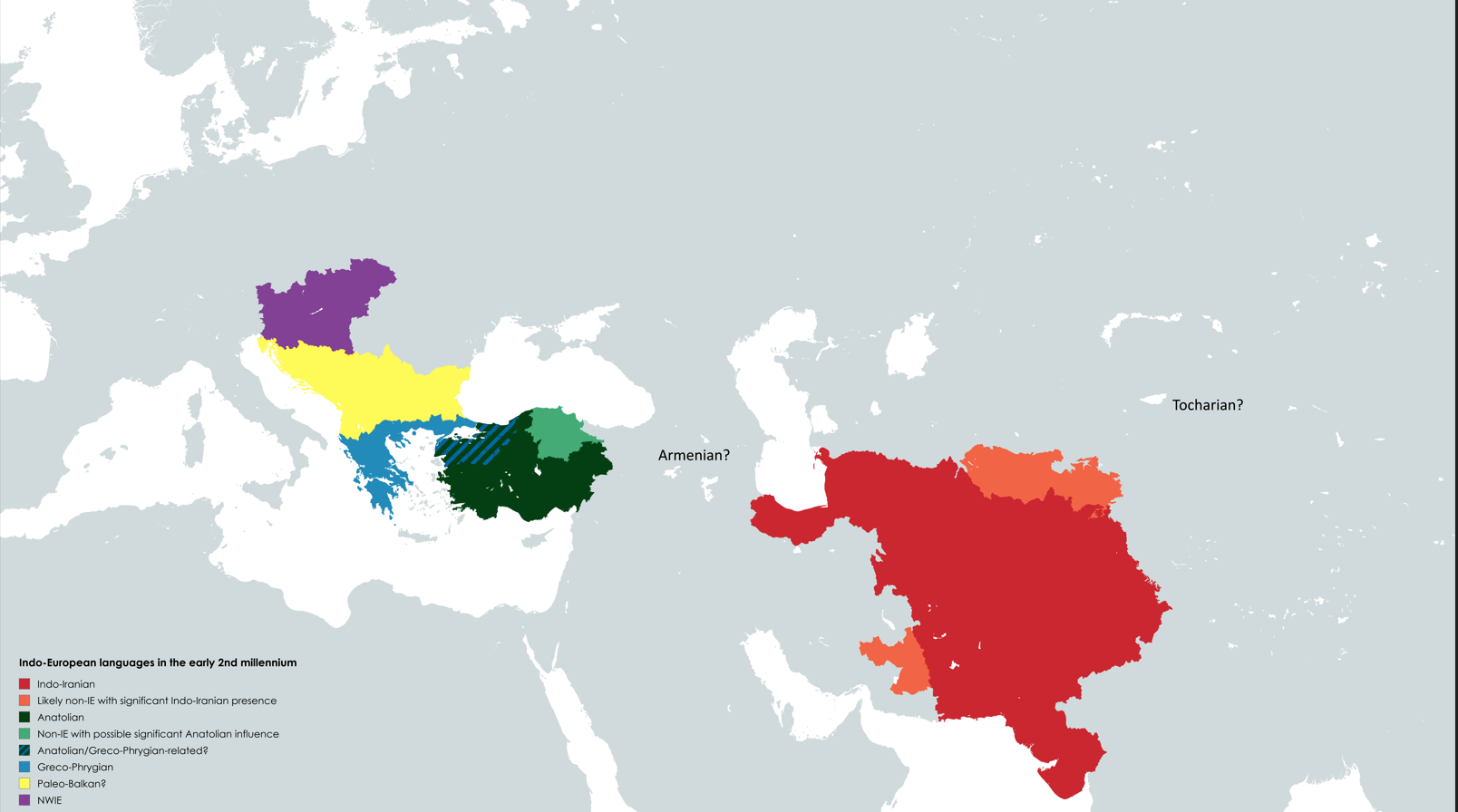
The deeper origin of this process may lie in the interaction between steppe groups and the high cultures south of the Caucasus, especially Maikop and related traditions. Maikop appears to have transmitted not only metallurgy, wagons, and elite symbolism into the steppe, but possibly also linguistic and ideological elements that shaped the emergence of Yamnaya. From there, Indo-European speech and aristocratic culture may have spread in stages through repeated processes of cultural dominance, alliance, emulation, and elite transmission.
The most likely conclusion is that the ancestors of several European Indo-European branches were formed not directly in Corded Ware, but in the Bronze Age interaction sphere stretching from Yamnaya through Maikop and into the Carpathian Basin, where the full package of Indo-European elite culture became visible and historically transformative.